There is a pattern in every published inventory of the world's largest private wine collections, and once you see it the trophy framing stops holding. The map does. The overwhelming share of bottles in the most famous cellars traces back to a handful of small European regions: the gravel and clay banks of the Garonne around Bordeaux, the east-facing Côte d'Or above the Saône in Burgundy, the chalk hills north of the Marne in Champagne, and — as a quiet correction — the warm plains east of Évora in the Alentejo. A cellar of fifty thousand bottles sounds like a monument to appetite. Read it as geography and it becomes a monument to four rivers.
The Bordeaux Skew: Why Every Great Cellar Overweights the Garonne
There is a pattern we keep seeing when the auction house catalogues publish a truly large private cellar: the Bordeaux section is always the longest one. Not by preference, and not because the buyer set out to concentrate there. By geography. Bordeaux sits between the Garonne and the Dordogne, and everything a serious cellar wants to hold — cellarability, brand continuity, subzone legibility — was built there before anyone thought to build a cellar around it.
Consider what a collector inherits when they turn toward the Garonne. Four sub-regions organise the whole thing: the Médoc downstream on the left bank, Saint-Émilion on the right, Graves upstream toward the city itself, and Sauternes tucked into the confluence country to the south. Each of those is a geographic argument, not a marketing category. The Médoc is gravel deposited by the river in flood, which drains fast and forces roots deep. Saint-Émilion is limestone plateau and clay slope, which holds water and rewards a different grape. Graves is exactly what its name says. Sauternes exists because two rivers meet and generate the autumn fog that a particular fungus needs to concentrate sugar in the fruit. A cellar that wants to represent Bordeaux has to represent that geography, and there is a lot of it.
The consequence is arithmetic. Once a collector commits to holding the anchor towns — bottles that carry the names Pauillac, Saint-Émilion, and Bordeaux itself — the depth of the catalogue does the rest. Verticals across decades exist in Bordeaux because the classification system has been continuous since 1855 and the châteaux have not moved. Cellars grow along that grain. The reason a great private collection reads three-quarters Bordeaux is not that the collector loved Bordeaux three-quarters more than everywhere else. It is that Bordeaux gave them something structurally holdable that other regions, for geographic reasons of their own, could not.
The Burgundy Scarcity Trap: Collecting a Twenty-Kilometre Slope
There is a pattern we keep seeing when a Bordeaux-heavy cellar tries to widen: the Burgundy section is small, expensive, and disproportionately hunted. The reason is not fashion. It is the Côte d'Or, and the Côte d'Or is roughly twenty kilometres long. You cannot collect what does not exist, and Burgundy makes remarkably little of what a large cellar wants.
The geography is the whole story. Burgundy runs south from Dijon down a single east-facing scarp above the Saône plain — the Côte de Nuits at the top, the Côte de Beaune below, with Beaune and Nuits-Saint-Georges as the anchor towns. The vineyard land is a narrow band on that slope, because east-facing at this latitude is what allows the fruit to ripen at all. Turn the slope, lose the exposure, lose the wine. The famous villages sit in a line you could drive in under an hour, and the parcels inside them are cut into holdings that were divided among heirs generation after generation under Napoleonic inheritance law. A single vineyard can have dozens of owners, each making a few barrels a year.
That geographic constraint is what turns a cellar's Burgundy shelf into a bottleneck. A collector who wants a vertical from one grower on one parcel is competing against every other collector in the world for a few hundred bottles per vintage. The Bordeaux château that makes twenty thousand cases annually has no equivalent on the Côte d'Or. This is why the largest private collections, the ones written up in the trade press, are almost always described as "Bordeaux-dominant with a serious Burgundy allocation" — the Burgundy allocation is small because it cannot be otherwise, and it is called serious precisely because assembling it took decades of standing patiently in the queue.
The Burgundy shelf in a great cellar is not a shelf at all. It is a receipt for waiting.
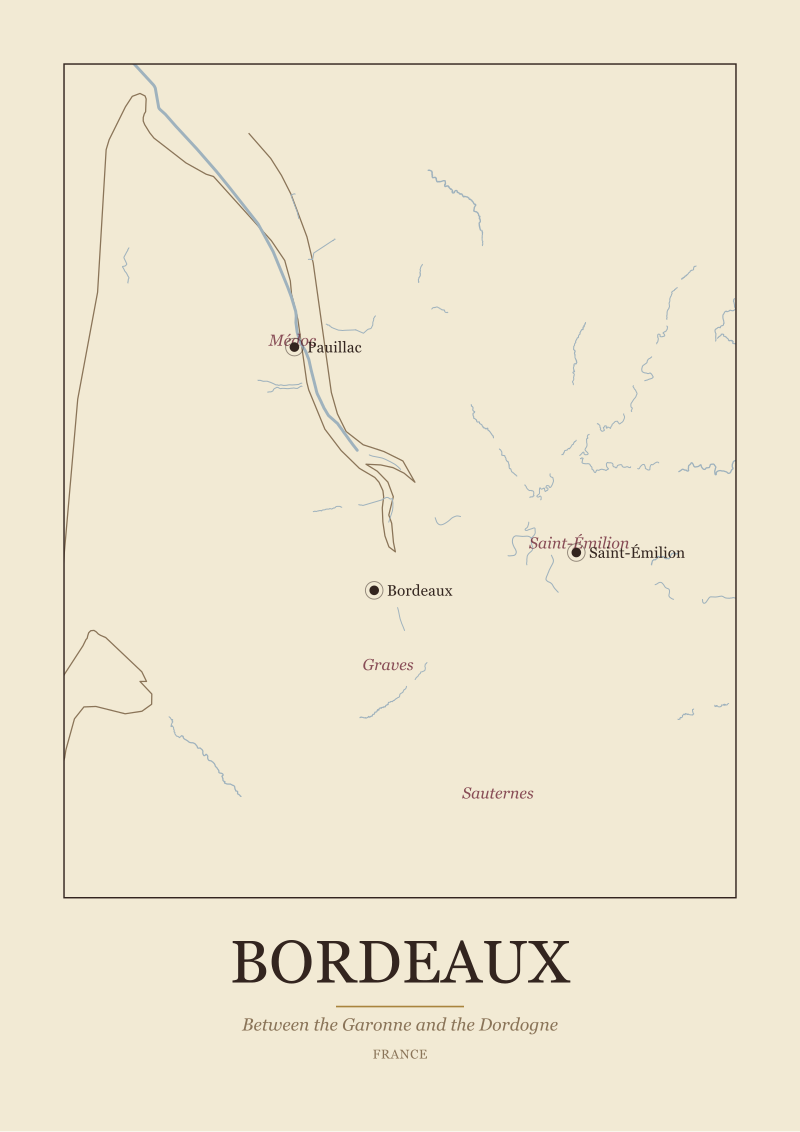 Bordeaux
The print from this article · from €29.95
View the print →
Bordeaux
The print from this article · from €29.95
View the print →
The Champagne Blind Spot: What Chalk Hills Actually Store
There is a pattern we keep seeing in cellar audits when the collector calls us in to draw the region maps: Champagne is treated as an occasion category rather than a cellar category, and the audit reveals it is being stored badly and drunk too young. The geography of Champagne is doing something the collector has not read.
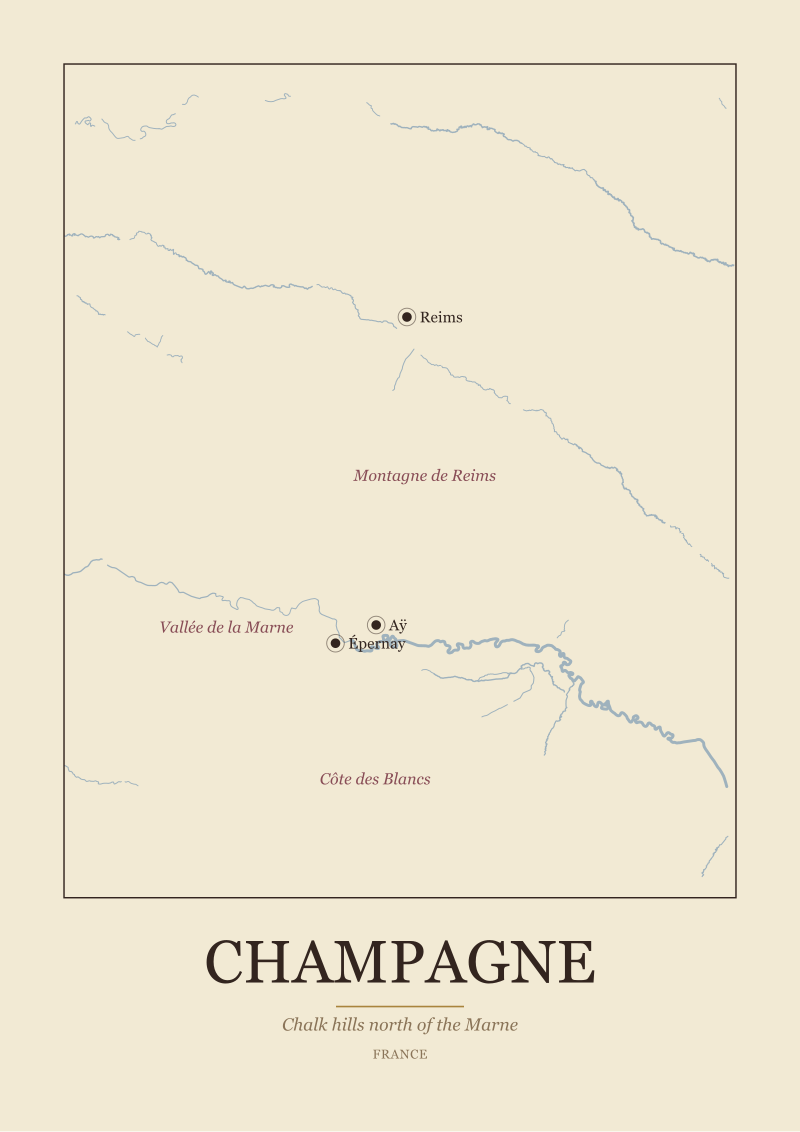
Champagne is chalk hills north of the Marne, with Reims, Épernay, and Aÿ as anchor towns and three named growing zones — the Montagne de Reims on the ridge above the city, the Vallée de la Marne along the river itself, and the Côte des Blancs running south from Épernay. The chalk is not decoration. It is a subsoil that drains persistently while holding a cool reservoir of moisture, and it sits at the northern latitudinal edge where grapes barely ripen at all. That marginal ripening is why the region invented a second fermentation in the bottle in the first place. Wine that would be lean and sharp as a still table wine becomes something else under pressure and time.
The cellar consequence is that the greatest Champagnes are ageing wines — bottles that have already spent years on the lees in the producer's cellar and are then designed to spend more years in yours. The blind spot in most collections is that these bottles are held at fluctuating temperature in the same rack the collector uses for Christmas Champagne, and released for parties before they have done what the chalk hills intended them to do. When we walk a cellar and see the Champagne section held between eighteen and twenty-two degrees Celsius on a swing depending on the season, we know without asking that the collector has never mapped where the wine came from. Marne-valley wines, in particular, are made to sit still and cool for a decade. A cellar reading of Champagne starts with the recognition that this is not a category to drink — it is a category to store, and the geography told you so.
The Alentejo Correction: Why Warm Plains Are Entering Serious Cellars
There is a pattern we keep seeing in cellars built in the last five years, and it is the first thing about the largest private collections that has genuinely changed. The Alentejo is showing up. Not as a token, and not as a cheap-shelf filler under the trophy Bordeaux. As a serious allocation held on its own terms.
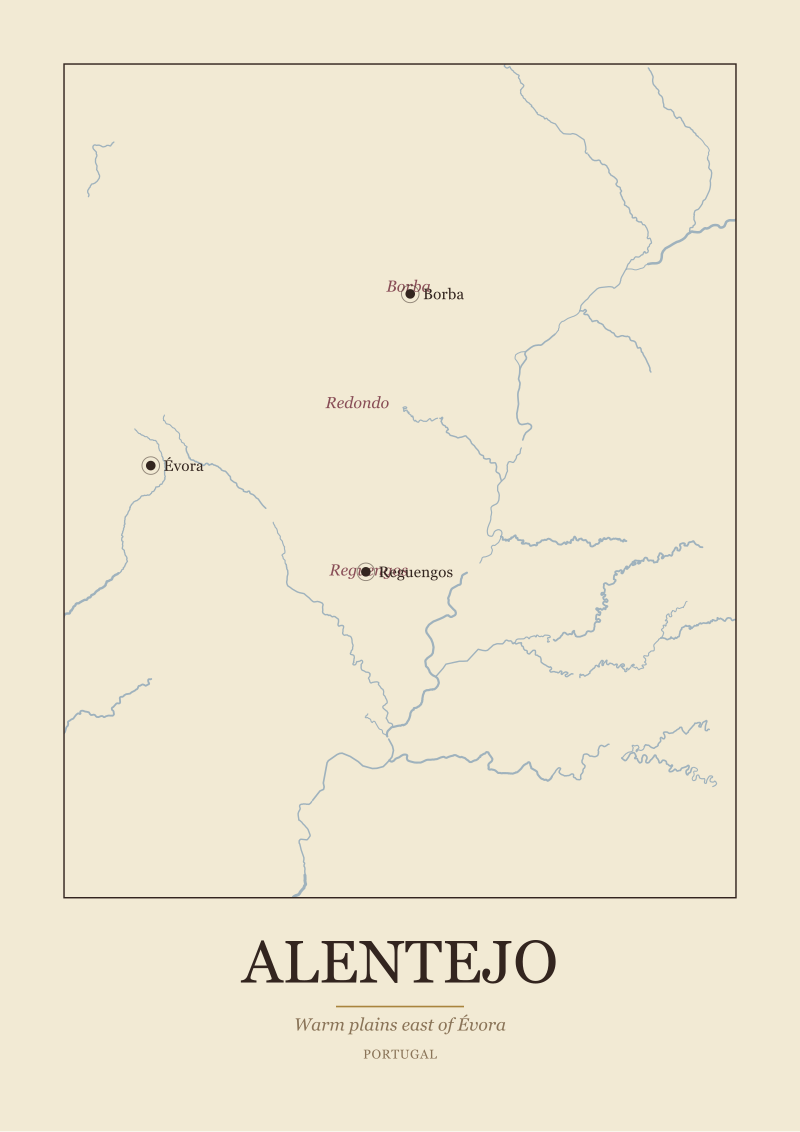
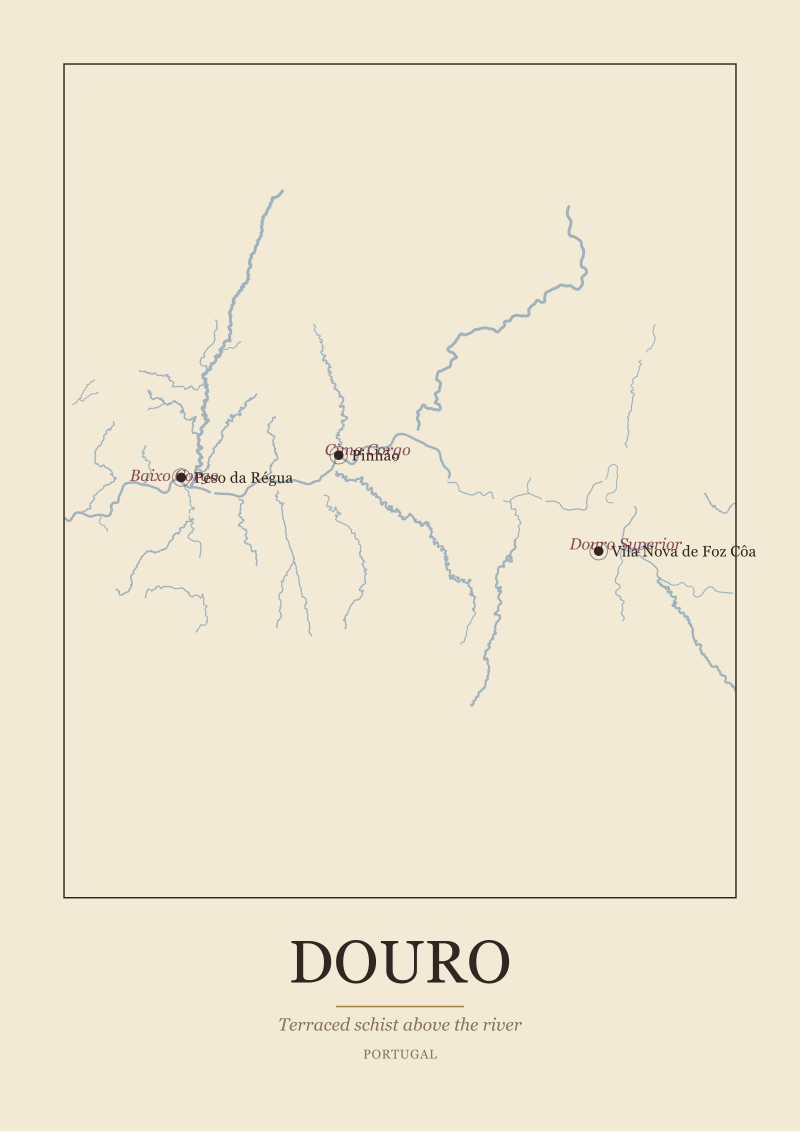
The geography is unlike anything else in this piece. The Alentejo occupies the warm plains east of Évora in southern Portugal, with the Guadiana as its main river and Borba, Redondo, and Reguengos as the sub-zones a cellar wants to represent. This is not slope country. It is not chalk. It is a broad, open landscape at low elevation, hot in summer, with a growing season that ripens fruit early and hard. For a long time that geography was read by serious collectors as a disqualification — the assumption being that great cellar wine comes from marginal climates where the fruit only barely gets there. The Alentejo, in that reading, was too easy.
The correction is that the climate itself is now marginal in a different way. Bordeaux vintages that used to sit at the ripeness upper edge are now regularly beyond it. The east-facing slope in Burgundy is warmer than it was a generation ago. The chalk hills of Champagne are producing riper base wines with each successive decade. Meanwhile the Alentejo, hot to begin with, has proven capable of holding structured wines that age. Cellars built by collectors who are thinking thirty years ahead are treating the Guadiana plains as a hedge — a region whose fundamental geography does not depend on cool marginality to make ageworthy wine. The Alentejo section in a serious 2026 cellar is small, but it is deliberate, and it did not exist in the same cellar's 2010 inventory. This is a geographic recalibration in real time.
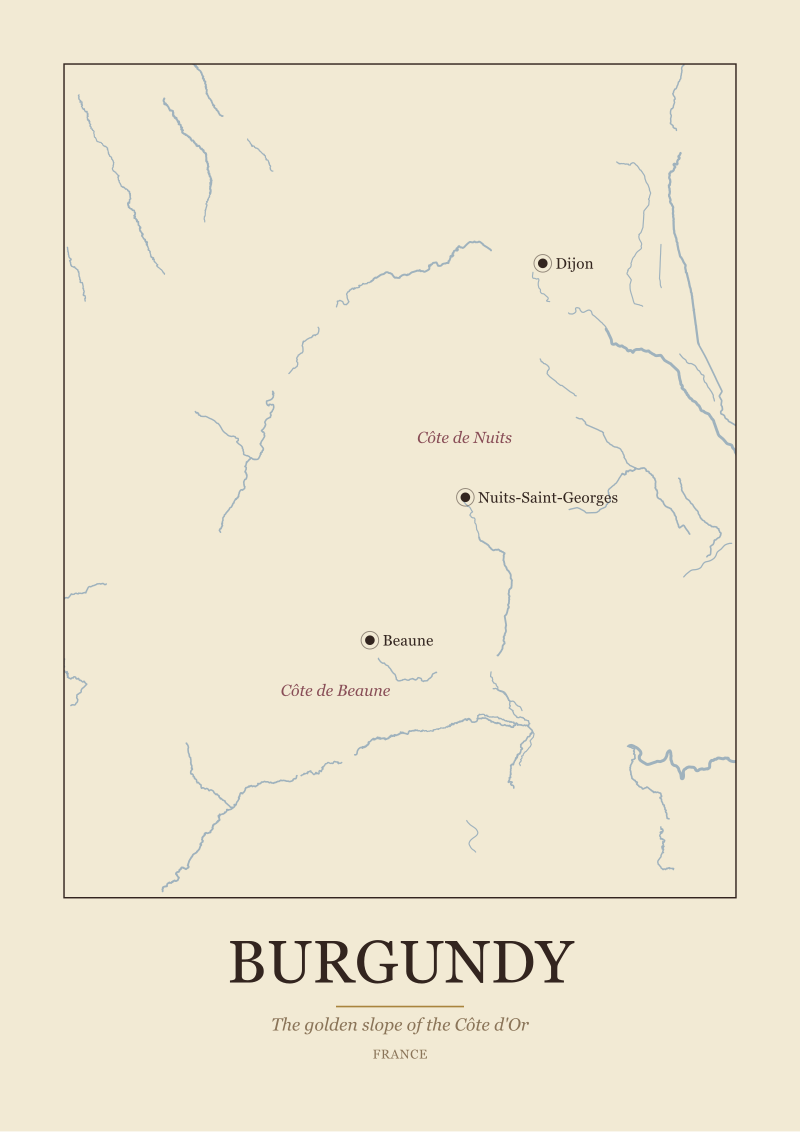 Burgundy
The print from this article · from €29.95
View the print →
Burgundy
The print from this article · from €29.95
View the print →
So What Do You Actually Do With a Cellar
The honest answer is that most large private cellars are not designed. They are accumulated. The buyer follows the auction catalogue, the auction catalogue follows the geography that gave it the deepest verticals, and the collection ends up shaped like the map above without anyone ever drawing it. Once you see this you have a choice — keep accumulating, or start reading the cellar as a map and edit it toward the geography you actually want to hold.
The practical version of that edit begins with knowing where your bottles come from at the sub-zone level, not the country level. A cellar that lists "France" and "Portugal" on its spreadsheet is not a cellar; it is a warehouse. A cellar that lists Médoc, Saint-Émilion, Graves, Sauternes, Côte de Nuits, Côte de Beaune, Montagne de Reims, Vallée de la Marne, Côte des Blancs, Borba, Redondo, and Reguengos is a cellar that can be reasoned about — because each of those names is a piece of ground with a river, a slope or a plain, a subsoil, and a reason. When you know why a bottle is in your cellar in that language, you know when to drink it and when to leave it alone.
The desk-level suggestion, from a studio that draws these regions before writing about them, is to hang the map of the region on the wall next to the rack it corresponds to. It sounds like a design flourish and it is not. Once you can look up from a bottle and see the slope it came off, the confluence it sat above, or the chalk hill it faced, the cellar stops being a scoreboard and starts being what it always geographically was — a small library of four European rivers, curated by you. Our own studio makes prints of exactly those regions at see the Bordeaux print for collectors who have started reading their cellars this way.
FAQ
Why do the largest private wine collections concentrate so heavily on Bordeaux?
Bordeaux is structurally the easiest great region to accumulate in depth. It has four legible sub-zones — Médoc, Saint-Émilion, Graves, and Sauternes — each rooted in a distinct geography between the Garonne and the Dordogne, and a continuous classification of estates that has held its lines since the nineteenth century. The châteaux produce enough wine annually to sustain long verticals, so a cellar that wants breadth across decades naturally overweights Bordeaux without the collector ever deciding to.
Why is Burgundy always a smaller shelf in even the biggest cellars?
The Côte d'Or is a single east-facing scarp roughly twenty kilometres long, running from Dijon down through Beaune and Nuits-Saint-Georges. The vineyard land is a narrow band on that slope, cut across generations into very small holdings. Each grower on each parcel makes only a few barrels a year, so total supply is a fraction of Bordeaux's. A large Burgundy allocation is small because the geography allows nothing larger, not because the collector was uninterested.
Is Champagne actually a cellar-worthy category rather than an occasion wine?
Yes, and reading it as occasion-only is the blind spot in most collections. Champagne comes from chalk hills north of the Marne, with three named zones — Montagne de Reims, Vallée de la Marne, and Côte des Blancs — that sit at the northern edge of ripening. The chalk subsoil and marginal climate are exactly what produce ageworthy base wines. Bottles from producers designed for long ageing on lees continue to develop in a cellar and should be held cool and still, not stored between parties.
Why is the Alentejo appearing in serious cellars only now?
The Alentejo has always been a warm-plain wine region east of Évora along the Guadiana, with Borba, Redondo, and Reguengos as its sub-zones. It was historically ignored by collectors who equated ageworthiness with cool, marginal climates. As classic northern regions have warmed over recent decades, the Alentejo's fundamentally hot geography has been reappraised as a hedge — a region whose ageworthy wines do not depend on the vintages staying cool to work.
How should a cellar be organised if you want to read it as geography rather than as a scoreboard?
Catalogue at the sub-zone level, not the country level. Write down Médoc rather than France; Côte de Nuits rather than Burgundy; Reguengos rather than Portugal. Group the racks by river system so that Bordeaux sits with the Garonne, Burgundy with the Saône, Champagne with the Marne, and the Alentejo with the Guadiana. Once the physical cellar mirrors the map, decisions about when to open which bottle become geographic rather than emotional.
Do you recommend specific producers or vintages for a large cellar?
No. Our desk is a wine-geography studio, not a wine shop or a critic. We write about regions — their rivers, slopes, subsoils, and sub-zones — because that is the layer where cellar decisions actually get made. Producer and vintage guidance is the domain of merchants and independent critics working directly with the trade. We stay out of the recommendation business precisely because our subject is the map, not the bottle.
Is there a "correct" ratio between Bordeaux, Burgundy, Champagne, and newer regions like the Alentejo?
There is no universal ratio, and any published one is fiction. The ratio you end up with should reflect the geographies you actually want to hold across time. What is worth noticing is that the historic default — a heavy Bordeaux base, a small Burgundy allocation, an under-cellared Champagne section, and nothing from southern Portugal — is a passive inheritance of the auction market's structure, not a considered position. A deliberate cellar makes that ratio a decision.
New regions and 10% off your first print.
One email now with your code. No noise after.