You do not need to be a sommelier to read a map of Piedmont. You need about ten words. Piedmont, Tanaro, Langhe, Alba, Asti, Barolo, Barbaresco, Nebbiolo, fog, appellation — with those in hand, the region stops being a wine list and becomes a geography: a river running east across northern Italy, a set of hills folded south of it, and the towns that sit on those hills for reasons older than any label. This is a glossary. Read it in order. The words build on each other the way the land does.
Piedmont
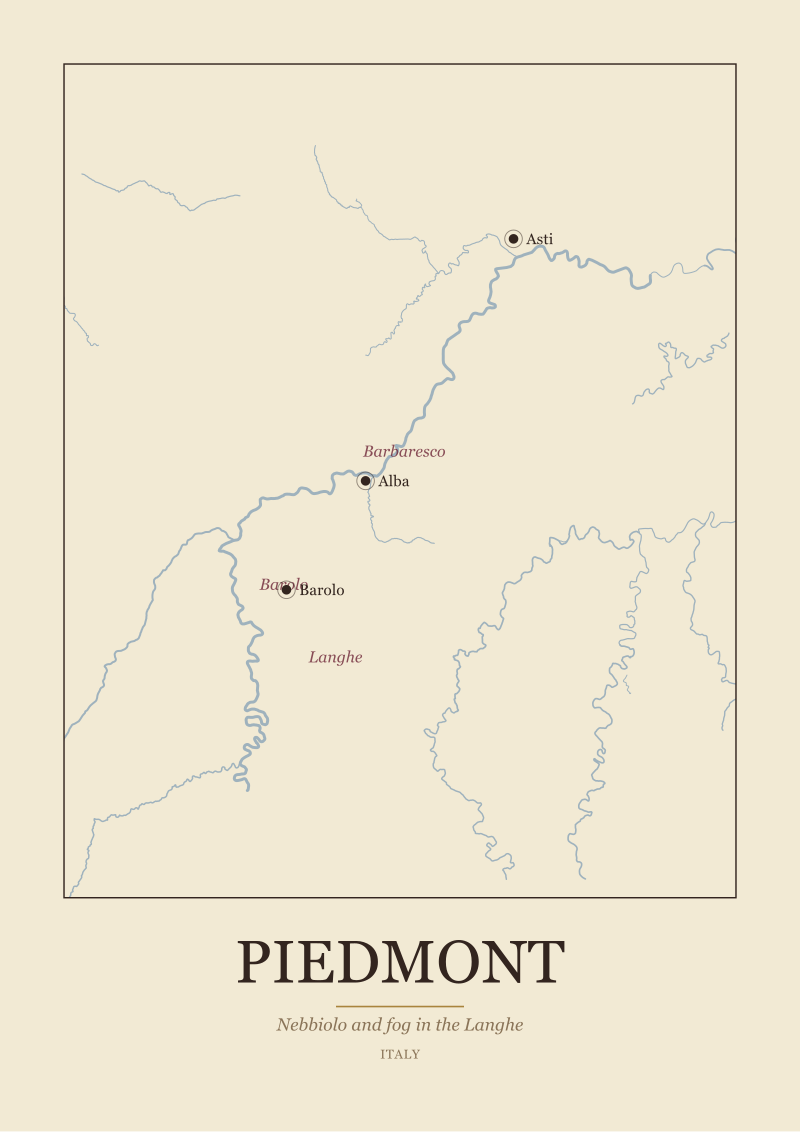
Piedmont is a region in the far northwest of Italy whose name means "at the foot of the mountains." That is a geographic fact before it is a wine label — the mountains are the Alps, curving around the region on three sides like a hood, and the foot is where the hills begin and the rivers start collecting themselves. On a map, Piedmont sits with Switzerland and France on the far side of the Alpine wall to the north and west, and Liguria between it and the sea to the south. It is not a coastal wine region. It is an inland, hill-and-river region drained toward the Po basin. Alba, Asti and Barolo — the three towns you will hear repeated in any conversation about Piedmontese wine — all sit in the hill country south of the region's main river, on ridges that fold and refold themselves in ways that only make sense once you have a map open. Keep the map open. Nothing about Piedmont explains itself from a list of grape names alone.
The Tanaro
The Tanaro is the river that organizes wine Piedmont. It rises in the Ligurian Alps in the region's southwest and runs roughly northeast across the province, past Asti, past Alba, and eventually joining the Po further along. Rivers matter to wine geography because they carve the valleys, expose the slopes, and decide which side of a hill faces which way — and the Tanaro is the reason the two most famous Nebbiolo hills sit where they do. Barolo's hills lie south of the Tanaro's course; Barbaresco sits on the near side of the river to Alba, on its own ridge overlooking the valley. That single sentence — one river, two hills, two appellations — is doing more work than any tasting note ever will. When you see a wine map of Piedmont that draws only borders and labels, ask where the river is. If it is missing, the map is not really a map of Piedmont; it is a table of names in the shape of a region.
 Piedmont
The print from this article · from €29.95
View the print →
Piedmont
The print from this article · from €29.95
View the print →
The Langhe
The Langhe is the range of hills that unfolds south of the Tanaro, around and below Alba. The name is usually traced to the local word for "tongues," which is what the ridgelines look like from above — long, low tongues of land pushing between narrow valleys. Langhe is a geographic term first and an administrative term second: geographically it is the hill country; administratively there is also a Langhe appellation acting as a wider umbrella around the more specific zones. If you are drawing the region, draw the Langhe as a folded blanket dropped south of the river, with the ridge-tops running roughly parallel and the villages perched on those ridges rather than in the valleys. The reason villages sit on ridges here is the reason vineyards do: you want the light, the drainage and, in autumn, you want to be above the fog. That last one matters more than it sounds, and it gets its own entry below.
Alba
Alba is the town that anchors wine Piedmont on the eastern side of the region — the market town, the road junction, the place the Tanaro passes on its way to the Po. On a map, Alba is where you should place your finger first, because almost everything else you will read about — the Barolo hills to the south, the Barbaresco ridge nearby, the wider Langhe itself — is being described in terms of its distance and direction from Alba. Alba is not itself a vineyard designation; it is the logistical and historical centre. The old roads, the medieval market, the modern rail line: Alba is the town that made the surrounding hills reachable and their wine tradeable. When people say "the hills around Alba," they almost always mean either the Langhe, spreading south and east, or the hill country across the river to the north. Both are Nebbiolo country in different ways; both owe their reputation to being close enough to Alba to matter.
Asti
Asti is the second anchor town, further west along the Tanaro, and it names a different wine story than Alba does. Where Alba's hills gave the world Barolo and Barbaresco — serious, ageable, red-and-fog wines — Asti's hills gave the world one of Europe's most exported sparkling traditions, made from a different grape and pointed at a different audience. Geographically, Asti sits upstream of Alba on the Tanaro, in slightly gentler country: the hills flatten a little as you move west, the fog behaves differently, and the wine tradition responded accordingly. On a wine map of Piedmont, Asti is the counterweight to Alba. If your map shows only the Alba side of the region, it is a map of Nebbiolo Piedmont. A full wine map of Piedmont has Asti on it too, because the region's identity is not one grape and one town — it is a river with two anchor towns, and hills that behave differently on either side of them.
Barolo
Barolo is the name of a village, of a set of neighbouring communes around that village, and of the appellation that governs the red wine produced there — three layers of the same word. The village of Barolo sits south of the Tanaro, in the Langhe hills, on ridge country looking out over a folded landscape of vineyard slopes. The appellation extends beyond the village itself to a small number of adjoining communes, all on similar hills, all sharing the same basic geography: exposed ridge-slopes, fog-prone valleys, well-drained soils on the higher ground. Barolo wine is made from Nebbiolo — that is not an editorial choice, it is what the appellation permits — and its character comes from where those Nebbiolo vines sit on those hills. A map that shows Barolo as a single coloured blob is missing the point. A useful map shows the villages, the ridges and, where it can, the direction the slopes face. That is where the wine actually lives.
Barbaresco
Barbaresco is the other Nebbiolo appellation of the Langhe, and it sits on the opposite side of the story from Barolo. Where the Barolo zone spreads across several hilltop communes to the south of the Tanaro, Barbaresco is smaller, closer to Alba, and set on its own ridge overlooking the river valley from the near side. The two appellations share a grape and a broader geography but not their exact conditions: the Barbaresco hills tend to be slightly closer to the river's moderating influence, and the appellation is more compact. Wine maps that show Barolo and Barbaresco as twin hill zones facing each other, with Alba between them and the Tanaro running through, are drawing the correct picture. It is the picture the region draws of itself: two Nebbiolo hill areas, two appellations, one town in between, one river doing the work that decided any of it.
Nebbiolo
Nebbiolo is the red grape that gives Barolo and Barbaresco their wine and gives Piedmont its most exported reputation. The name is usually traced to nebbia, Italian for fog — a grape named for the weather of the place it ripens in. Whether the etymology is strictly correct or partly folk tradition, the connection it draws is real: Nebbiolo ripens late, into autumn, when the Langhe valleys fill with fog in the mornings and the hilltops sit above it. The vines are planted on those hilltops for a reason. Nebbiolo is not planted everywhere in Piedmont — Asti's sparkling tradition uses a different grape entirely — and it is not planted on the valley floors of the Langhe either. It is a hillside grape in a fog-prone region, and every serious map of Piedmontese wine ends up, sooner or later, drawing where the fog sits and where the vines sit above it.
Fog
Fog is the geographic phenomenon that most non-Italian wine maps of Piedmont leave off, and it is the one that would explain the most if it were drawn in. In autumn, cold air pools in the Langhe valleys overnight and thick fog forms along the low ground, sitting under the ridges like a second river. The vineyards on the ridges rise clear of it; the vineyards on the valley floors do not. That is why the famous wines of the Langhe are ridgeline wines. The fog is also the reason harvest here is a late, careful, weather-watched affair — Nebbiolo ripens into the fog season, and the growers' calendar is built around it. If you are drawing a wine map of Piedmont and you want it to explain the region rather than merely label it, shade the valleys as fog basins and leave the ridges clear. That single visual choice does more explanatory work than any list of village names.
Appellation Border
An appellation border is a legal line drawn on top of a geographic one — usually. In Piedmont, the borders of Barolo, Barbaresco, Asti and the Langhe follow real features of the land: which commune a vineyard sits in, which side of the river, which slope, which valley. But an appellation border is not the same as a soil boundary or a fog line; it is a legal decision about what a wine can be called, based on where the grapes were grown and, sometimes, how the wine was made. When you look at a wine map of Piedmont and see a hard coloured edge between Barolo and the surrounding Langhe, remember that the coloured edge is a legal one. The underlying hills fade into each other. That is why our own Piedmont prints at /shop/ draw the river, the towns and the terrain first, using public-domain Natural Earth coastline and river data, and leave the appellation edges as a light overlay — because on the ground, the geography comes first and the border is drawn on top of it.
FAQ
Where exactly is Piedmont in Italy?
Piedmont is in the far northwest of Italy, hooded by the Alps to the north and west, with Switzerland and France on the far side of that Alpine wall and Liguria between it and the sea to the south. It does not touch the coast. Its wine country lies inland, drained toward the Po basin, and its most famous hills — the Langhe and the country around Asti — sit south of the Tanaro river.
Why is Piedmont a hard wine region to read at a glance?
Because it is not organized around a single hero grape or a single valley. Nebbiolo dominates the Barolo and Barbaresco conversation, but Asti's tradition uses a different grape entirely, and the surrounding Langhe hills add more layers. A useful map of Piedmont therefore has to show the river, both anchor towns, and the hills on either side — otherwise it is telling only part of the story the region tells about itself.
What is the difference between Barolo and Barbaresco on a map?
Both are Nebbiolo appellations in the Langhe, close to Alba, and both sit on hill country south of the Tanaro's general course. But Barbaresco lies on the near side of the river to Alba, in a compact zone on its own ridge, while Barolo spreads across several communes further south. On a map they read as two hill areas facing each other with the town of Alba and the river between them.
Is the Langhe a wine or a place?
Both, and it matters which sense is meant. Geographically, the Langhe is the range of hills south of the Tanaro around Alba, named for the tongue-like ridgelines that run through it. Administratively, there is also a Langhe appellation. When a map or label says "Langhe," you should ask whether it is describing the hills themselves, the wider appellation, or one of the more specific zones like Barolo or Barbaresco that sit within them.
Why is fog so important to Piedmont's wine geography?
Because it decides where the vines are. Nebbiolo ripens late into autumn, when cold air pools in the Langhe valleys overnight and dense fog fills the low ground. Vineyards on the ridges sit above the fog and get the light and airflow the grape needs; vineyards on the valley floors do not. This is why the famous wines of the region are ridgeline wines, and why a serious map of Piedmont shades the fog basins.
Does the Tanaro actually run through Alba?
Yes — Alba sits on the Tanaro, and that is one of the reasons the town became the region's market and logistical anchor. The river runs roughly northeast from the Ligurian Alps, past Asti and then past Alba, before joining the Po further along its course. On a wine map, the Tanaro at Alba is where you can see Barbaresco's ridge on the near side and, further south, the Barolo hills folded through the wider Langhe.
What is Nebbiolo named after?
The most common explanation traces the name to nebbia, the Italian word for fog — a name that fits the grape's late-autumn ripening in a fog-prone region. Whether the etymology is strictly documented or partly folk tradition is debated, but the description is honest either way: Nebbiolo ripens into the fog season of the Langhe, and its growing calendar is organized around the same weather the region's name for autumn mist describes.
New regions and 10% off your first print.
One email now with your code. No noise after.