How did two villages fifteen kilometres apart, on either side of the same river, end up as the two most closely watched names in Italian wine? We are a geography desk, so we started where geography starts: with the Tanaro, the river that cuts through Piedmont between Alba and Asti and separates the Langhe hills from everything to the north. Nebbiolo is planted on both banks. The fog — the *nebbia* that gives the grape its name — settles into the same valleys every autumn. And yet Barolo and Barbaresco are treated as distinct regions, with distinct rules, distinct reputations, and distinct histories. The timeline below is how the border between them was actually drawn.
1850s: Cavour, Alba, and the Making of Modern Barolo
The Barolo we recognise today — dry, tannic, capable of decades in bottle — did not exist before the middle of the nineteenth century. Nebbiolo did. The grape had been growing on the Langhe hills for at least six hundred years by that point, documented in notarial records around Alba. But the wine those vines produced was usually sweet, often oxidative, sometimes lightly sparkling. It did not travel and it did not age.
The transformation happened around Grinzane, a hilltop a few kilometres east of Alba. Camillo Benso, Count of Cavour — the man who would later engineer Italian unification from a desk in Turin — was mayor of Grinzane for seventeen years and owner of the castle vineyard there. In the same decade, Giulia Falletti, Marchesa di Barolo, was running her family's estate at the western edge of what is now the DOCG. Both households employed French-trained oenologists — the name most often cited is Louis Oudart — to rebuild Nebbiolo along Bordelais lines: complete fermentation, cleaner cellars, sulphur discipline, ageing in wood.
The story is often told as an aristocratic hobby that accidentally produced a great wine. The incentive structure was less romantic. Piedmont in the 1850s was the industrialising heart of the Kingdom of Sardinia. It had a functioning bourgeoisie, a rail network under construction, and export ambitions. A wine that could survive shipment to Turin, Genoa, Nice and Paris was worth more than a wine that could not. Barolo was engineered, and its first market was aristocratic Turin, not the local Alba trattoria.
1894: Domizio Cavazza and the Founding of the Barbaresco Cooperative
Forty years later, the same problem reappeared on the north bank of the Tanaro. The hills around Barbaresco — Neive, Treiso, and the frazione of San Rocco Seno d'Elvio — were also planted to Nebbiolo, but their wine had no name. It was sold as generic Nebbiolo, or shipped in bulk to be blended into Barolo bottlings across the river. The producers were smallholders with a few hectares each; they had no aristocratic patrons, no French oenologist on retainer, and no way to stand up against the merchants of Alba.
In 1894, Domizio Cavazza — director of the Regia Scuola Enologica di Alba, Italy's first state-funded wine school — founded the Cantina Sociale di Barbaresco. The cooperative bought grapes from nine founding members, vinified them separately in a single cellar, and put the village name on the label. It was the first time the word *Barbaresco* was legally used to identify a wine rather than a village.
Cavazza's motivation was documented and unambiguous. He believed the north-bank Nebbiolo ripened differently — earlier, on lower and warmer hills — and produced a wine with less tannic weight and a more perfumed profile. Selling it as Barolo, or as generic Nebbiolo, buried that difference. Selling it under its own name captured a premium the growers themselves could keep. The cooperative was not a philanthropic gesture; it was a distribution strategy against the Alba merchant class. The border between Barolo and Barbaresco, in other words, was drawn by a group of growers who wanted to be paid separately.
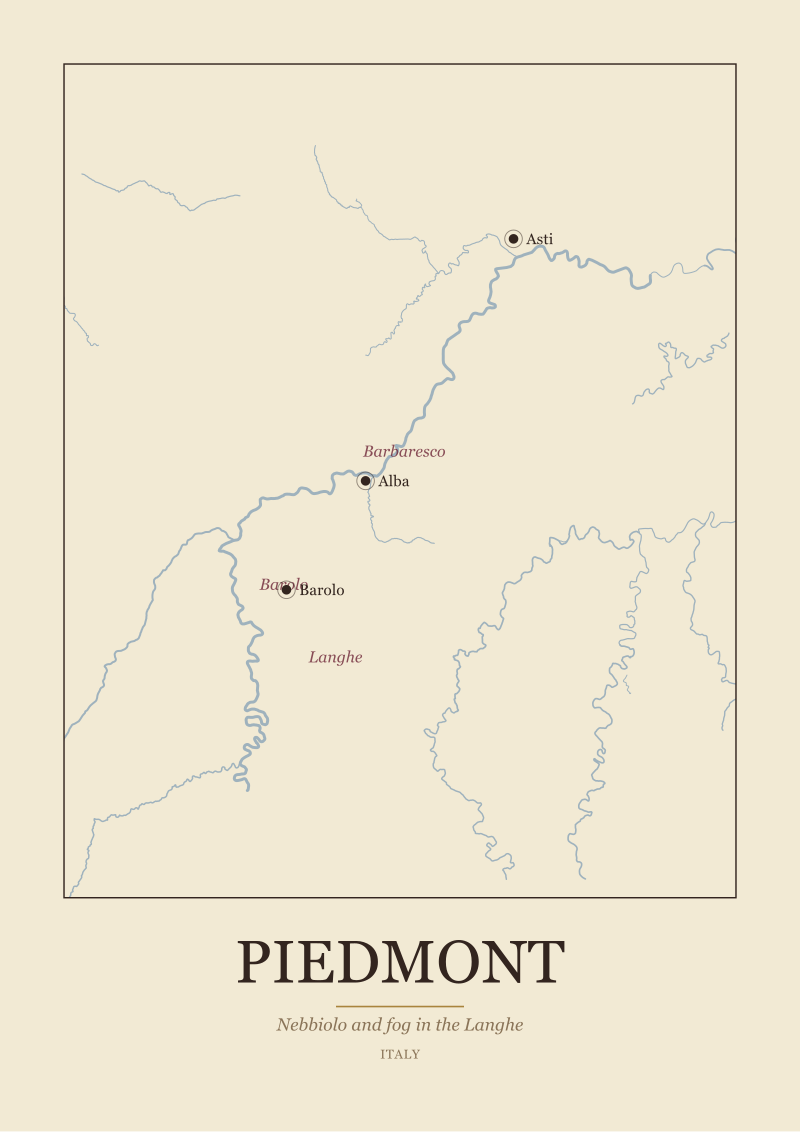 Piedmont
The print from this article · from €29.95
View the print →
Piedmont
The print from this article · from €29.95
View the print →
1966: Barolo Gets a Legal Border for the First Time
Between Cavazza's cooperative and the middle of the twentieth century, both wines existed as commercial names without legal definition. Nothing stopped a bottler in Turin from labelling wine "Barolo" if it contained Nebbiolo grown almost anywhere in Piedmont, and there was no cadastral map of what counted as Barbaresco land. The names were reputations. The borders were opinion.
The Italian DOC framework was enacted in 1963, and Barolo received its formal Denominazione di Origine Controllata on 23 April 1966. Barbaresco followed later in the same year. The decree did three things that had never been done before. It listed the specific communes — for Barolo, eleven villages including Barolo itself, La Morra, Serralunga d'Alba, Monforte d'Alba, and Castiglione Falletto; for Barbaresco, the three villages of Barbaresco, Neive and Treiso plus the frazione of San Rocco Seno d'Elvio. It mandated minimum ageing periods before release. And it fixed the grape variety at one hundred per cent Nebbiolo.
What the decree did not do was draw the borders on the ground. That work — vineyard by vineyard, parcel by parcel — took another three decades and is still being contested along the edges. But the 1966 decree was the moment the state took over the argument. Everything that came before it was private negotiation between growers, merchants and reputations. Everything after it has been public policy.
1980: Barolo and Barbaresco Are Promoted to DOCG
The DOC system had a design flaw that Italian producers exploited through the 1960s and 1970s. There was no ceiling on how much DOC could be granted and no meaningful audit of the wine going into DOC bottles. By the middle of the decade the number of DOCs had ballooned past two hundred, and the international market had noticed. A Chianti sold in New York in 1976 was not always the same category of thing as a Chianti sold in Florence.
The Italian legislature responded in 1980 with a new tier — Denominazione di Origine Controllata e Garantita, DOCG. The Garantita was the operative word: producers had to submit each bottling to a state-supervised tasting panel, and each bottle carried a numbered government seal on the neck. Compliance was expensive, and the number of DOCGs was deliberately kept small.
Four wines were promoted in the first wave. Two of them — Brunello di Montalcino and Vino Nobile di Montepulciano — were in Tuscany. The other two were Barolo and Barbaresco, promoted together. This mattered commercially and psychologically. Wine buyers in London, New York and Tokyo who had never heard of Nebbiolo could now see, on the neck of the bottle, a state warranty that the wine was what it claimed to be. The promotion locked the two names into the top tier of Italian wine alongside the most famous Tuscans, and it did so before the modernist revolution of the 1990s changed the way both wines were actually made.
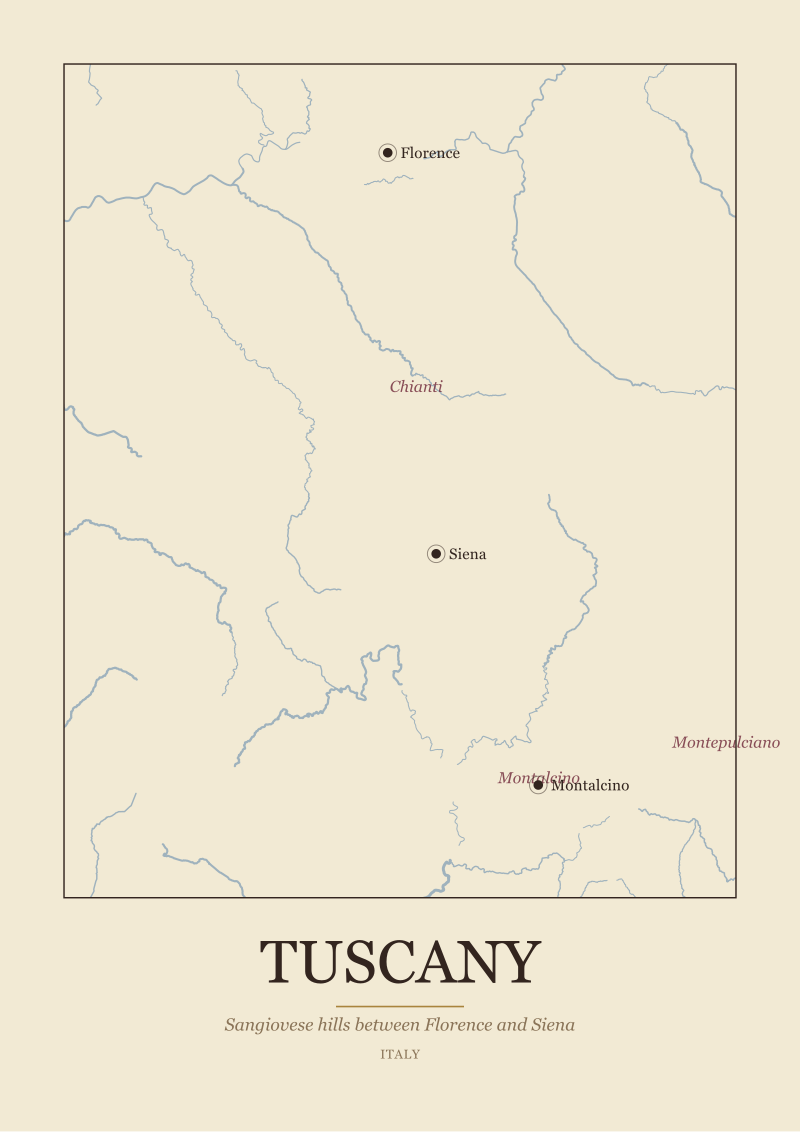 Tuscany
The print from this article · from €29.95
View the print →
Tuscany
The print from this article · from €29.95
View the print →
2014: UNESCO Inscribes the Langhe as a Cultural Landscape
On 22 June 2014, at its session in Doha, the UNESCO World Heritage Committee inscribed the Vineyard Landscape of Piedmont: Langhe-Roero and Monferrato on the World Heritage list. The inscribed area covers six distinct components across the wine country south of the Tanaro, including the Barolo growing zone, the village of Barbaresco with its surrounding hills, the castle of Grinzane Cavour, and a stretch of Monferrato to the east.
The UNESCO citation is worth reading closely because it does not talk about wine quality. It talks about landscape: the mosaic of hillsides under vine, the dispersed pattern of farmhouses and hamlets, the ridge-top villages, the specific relationship between the hills and the fog corridors of the Tanaro and its tributaries, and the human labour that shaped all of it over eight centuries. The listing was granted as a cultural landscape, not as a natural site.
The economic effect on the two villages was immediate and measurable. Land prices in the top-rated Barolo vineyards, already among the highest in Italy, climbed further. Barbaresco, historically the cheaper of the two, closed part of the gap. Tourism to Alba jumped, and the town of Barolo — with fewer than eight hundred permanent residents — began to structure its economy around wine tourism to a degree that would have been unrecognisable in 1966. UNESCO did not make the wine better. It made the geography legible to a global audience, and that legibility had a price.
What It All Means
The story of Barolo and Barbaresco is often written as if the wines wrote themselves — as if Nebbiolo, given the right hills and the right fog, was destined to produce two distinct Italian icons. It was not. The two names exist as separate things because a specific sequence of people, over a specific sequence of decades, drew a line between them and defended it.
Cavour and the Falletti household needed a wine that could travel to Turin, so they engineered one and gave it the name of a village on their side of the river. Cavazza needed his growers to be paid separately from the Alba merchant class, so he founded a cooperative under a different village name on the other side of the river. The 1966 DOC decree took the two commercial reputations and turned them into legal categories. The 1980 DOCG promotion put them in the top tier of Italian wine at exactly the moment international buyers were learning to trust Italian labels again. UNESCO in 2014 turned the whole geography into a heritage asset. Each step was a policy response to a distribution problem, and each step made the border between the two wines harder to erase.
The geography, meanwhile, has not moved. The Tanaro still runs between them. Nebbiolo still ripens on both banks. The fog still settles in the same valleys. If you stand on the hill at La Morra and look north across the river to the roof of the Barbaresco tower, you are looking at what is, geologically and climatically, one region. The reason you are looking at two is a hundred and seventy years of decisions taken by people whose incentives are now largely forgotten. We draw maps of this landscape at our studio in a way we hope makes those decisions visible — the river, the villages, the border between the two DOCGs as it actually runs on the ground. You can find the Langhe map in our /shop/. What you cannot see on any map, but is worth remembering, is that the border is a document, not a fact of the earth.
The next question is what the modernist producers of the 1990s did with the categories they inherited — and whether the split between Barolo and Barbaresco is beginning to blur again under estates that now own vineyards on both banks. That is a different piece.
FAQ
Where exactly is the border between Barolo and Barbaresco?
The border is a river. The Tanaro cuts west to east through central Piedmont, and Barolo lies on the south bank, Barbaresco on the north bank. Alba sits at the pivot point between them. Legally, the border is defined by the DOC decrees of 1966, which list the specific communes belonging to each denomination. The two zones do not overlap and are not contiguous — there is a strip of non-DOCG land, including the town of Alba itself, that separates them.
Are Barolo and Barbaresco made from the same grape?
Yes. Both denominations require one hundred per cent Nebbiolo, the same grape variety, under the DOCG regulations that came into force in 1980. The differences between the two wines come from ripening conditions — Barbaresco's hills tend to be slightly lower, warmer and closer to the river, so the grapes ripen a little earlier — and from the ageing rules, which are longer for Barolo. The grape itself is identical.
Why is Nebbiolo called Nebbiolo?
The most widely accepted etymology is from *nebbia*, the Italian word for fog, referring to the dense autumnal fogs that settle into the Langhe valleys during the Nebbiolo harvest. A competing theory links the name to the bloom — the natural waxy coating on the ripe grape skins — which can look almost foggy in appearance. The fog etymology is the one usually printed on the labels; the bloom theory is a linguist's argument.
What does DOCG actually guarantee?
DOCG — Denominazione di Origine Controllata e Garantita — was introduced by Italian law in 1980 as a stricter tier above DOC. It requires each bottling to pass a state-supervised tasting panel before release, and each bottle carries a numbered fiscal seal on the neck to prove compliance. The Garantita element is essentially a state warranty of authenticity, adopted to restore international trust in Italian wine categories after the DOC-inflation of the 1970s.
Who was Domizio Cavazza and why does he matter?
Cavazza was an agronomist and the first director of the Royal Enological School of Alba, founded in 1881. In 1894 he organised nine local growers into the Cantina Sociale di Barbaresco, the first cooperative to bottle wine under the Barbaresco name rather than selling it as generic Nebbiolo or as bulk feed for Barolo bottlings. He is the reason Barbaresco exists as a commercial — and now legal — category separate from Barolo.
What did UNESCO recognise in 2014?
On 22 June 2014, UNESCO inscribed the Vineyard Landscape of Piedmont: Langhe-Roero and Monferrato as a cultural landscape on the World Heritage list. The inscription covers six components across the wine hills south of the Tanaro, including the Barolo growing zone, the hills around Barbaresco, the castle of Grinzane Cavour, and parts of Monferrato. The recognition is for the historical vineyard landscape as a whole, not for the taste of the wine.
Is one wine older than the other?
As modern dry wines, both were created in roughly the same era — the second half of the nineteenth century — though Barolo was formalised first, in the 1850s around Cavour's estate at Grinzane, and Barbaresco followed as an independent commercial category in 1894 with Cavazza's cooperative. As place-names, both villages appear in Piedmontese records long before their wines were codified. Neither is meaningfully older than the other in geological or agricultural terms.
Does the fog actually matter to the wine?
Yes, but not in the mystical sense. Nebbiolo is a late-ripening variety harvested in October and often into November, when the Tanaro fog is at its densest. The fog moderates diurnal temperature swings during the final ripening weeks, slowing sugar accumulation and preserving acidity. That extended late-season hang time is what gives Nebbiolo its characteristic combination of high tannin, high acid and pale colour — a profile that depends materially on the microclimate the fog creates.
New regions and 10% off your first print.
One email now with your code. No noise after.