Most "best wine regions of France" lists rank the regions as if they were interchangeable weekends. They are not. Bordeaux is a river delta. Burgundy is a slope. Champagne is a chalk plateau that barely ripens grapes. Choosing between them is a geographic decision before it is a taste one, and the honest way to sort it is not a ranking — it is a flowchart. We will ask you three questions about how you want to move through a landscape. Your answers route you to one of France's great regions, drawn from the map rather than from a shop window.
Question 1: Do You Want a River or a Slope?
The first fork is the biggest one, and almost nobody asks it out loud. Some French wine regions are read horizontally, along water. Others are read vertically, up a hillside. The difference decides what your days look like — whether you spend them driving between estuary towns or walking a single ridge that changes name every kilometre.
We ask this question first because everything else follows from it. Distances, transport, the shape of a lunch, the view from the room you sleep in — all of it descends from whether the region is organised around a river or a slope. Get this fork wrong and you will spend a week in Bordeaux wishing it were smaller, or a week in Burgundy wishing it were bigger. Both are common regrets. Both are avoidable.
If Yes to a River
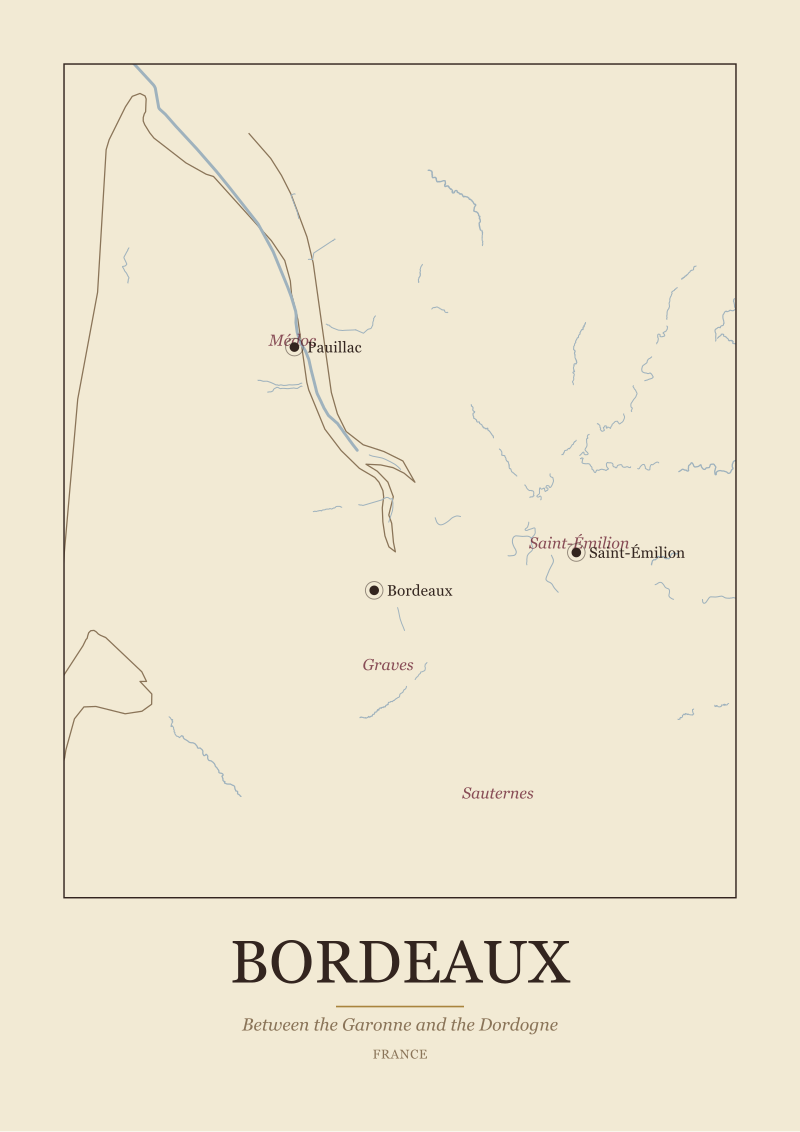
Then you belong in Bordeaux, and you should route your trip by water rather than by château. Bordeaux sits between the Garonne and the Dordogne, and its famous sub-regions are not really a list — they are two banks of two rivers. The Médoc runs north of the city along the Gironde estuary. Saint-Émilion sits inland along the Dordogne. Graves and Sauternes follow the Garonne south. The city of Bordeaux itself is the hinge.
A river trip here means treating the estuary as the spine. You base yourself in Bordeaux, and each day you follow one arm of the water: north to Pauillac one morning, east to Saint-Émilion the next, south toward Sauternes on the third. The distances are moderate but the landscape is flat, so the reward is the sequence of towns rather than any single vista. This is a region for readers who like a network of places connected by water, not one for readers who want a mountain view from breakfast.
If Yes to a Slope
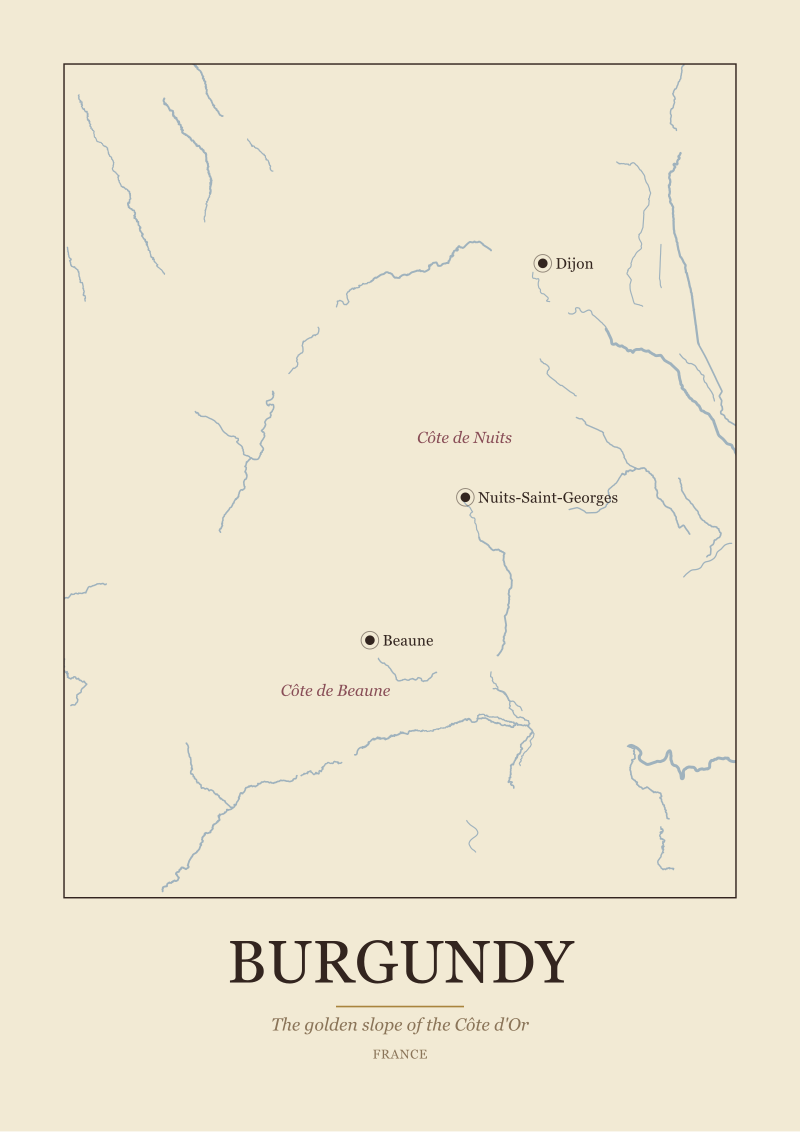
Then Burgundy is the answer, and specifically the Côte d'Or — the golden slope that runs south from Dijon through Beaune and Nuits-Saint-Georges. Burgundy's main river, the Saône, is not really the point here. The point is the escarpment: a long, low ridge facing roughly east, with village names lined up along its base like beads on a string. You walk it. You drive its length in a morning. You stand at the top of a wall of vines and see the next appellation half a kilometre downhill.
A slope trip is denser than a river trip. You do not need to travel far to change villages, and the change matters — the Côte de Nuits and the Côte de Beaune are neighbours with distinct characters. If your idea of a wine region is a landscape you can hold in one glance, Burgundy is the region. If your idea is a corridor of estuary towns, it is not.
Question 2: How Far North Can Your Trip Sit?
Latitude is the second fork, and it is more consequential than most travel writing admits. French wine regions are spread across a north-south range that includes places where grapes ripen easily and places where they barely ripen at all. That range is not a scale of quality — it is a scale of character. The regions at the edge of ripening produce wines with a nervous energy that warmer regions cannot fake.
The question matters practically, too. Northern French wine country has short seasons, cold shoulder months, and a rhythm of visits that is quite different from what a first-time visitor imagines. A trip to a chalk region in late October is a different experience from a trip to an estuary region in the same week. Neither is worse. But choosing the wrong latitude for the wrong month is how good trips become average ones.
If Yes, You Want Far North
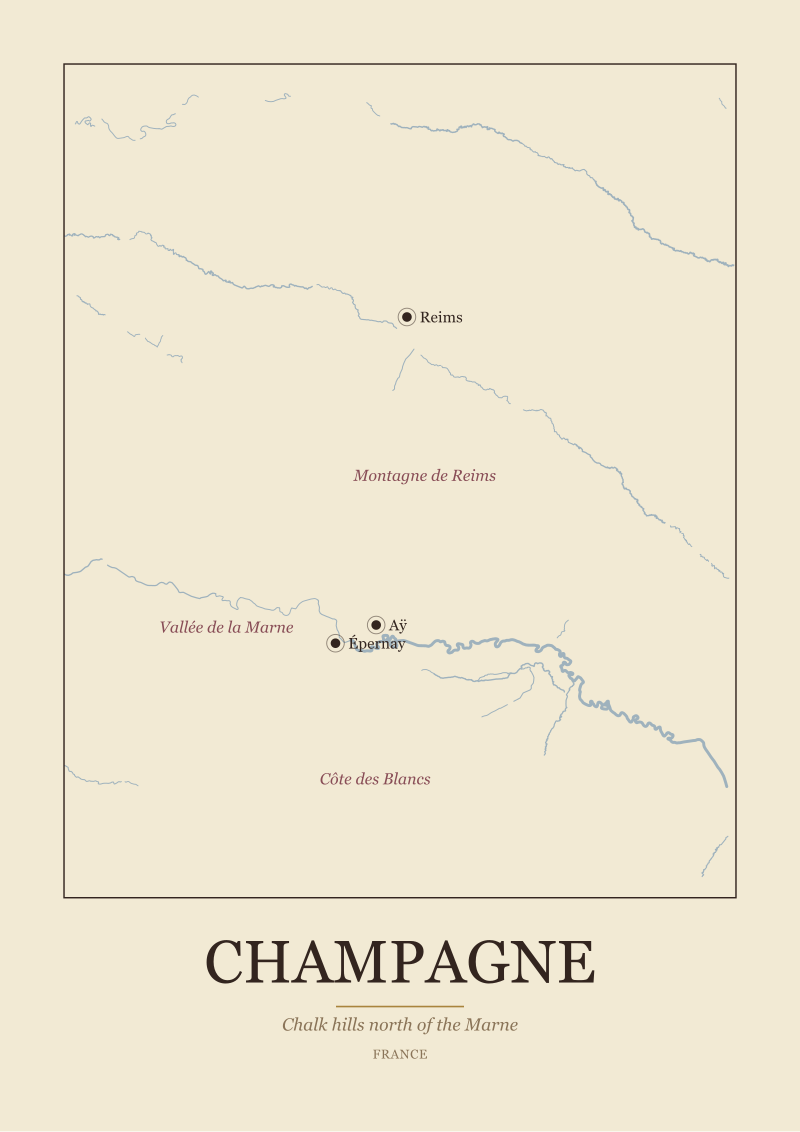
Then Champagne is your region, and the geography is the whole reason it exists. Champagne sits along the Marne, on chalk hills north of Paris, at the northern edge of where grapes ripen for wine at all. The anchor towns — Reims, Épernay, Aÿ — form a small triangle around the river. The three main sub-zones are named for terrain: the Montagne de Reims (a forested plateau of chalk), the Vallée de la Marne (the river corridor itself), and the Côte des Blancs (a south-east-facing slope of pure chalk south of Épernay).
The character of Champagne is exactly this marginal ripening. Grapes here work harder than they do elsewhere in France, and the result is a wine style that could not exist further south. Visiting means moving between three small towns and the chalk hills that connect them. Distances are short. The scale is intimate. You are, in effect, walking around the northernmost serious vineyards in France, which is a specific and rare thing to do.
If No, Anywhere Warmer Is Fine
Then Bordeaux or Burgundy will both suit you, and the decision reverts to the first question. Burgundy sits at a temperate middle latitude, roughly the same as the Loire — warmer than Champagne, cooler than the Mediterranean south. Bordeaux is warmer still, mitigated by the Atlantic and the estuary. Neither is a marginal-ripening story. Both give you a season that runs comfortably from late spring through October.
The practical implication is that you can be looser with timing. A Bordeaux or Burgundy trip in late September or early October is broadly a good trip. A Champagne trip in the same window is a specific decision — you are choosing to see the northern region in its short, precise season. If your calendar is inflexible, you probably want a region that is not.
 Bordeaux
The print from this article · from €29.95
View the print →
Bordeaux
The print from this article · from €29.95
View the print →
Question 3: Do You Want One Town or a Corridor of Them?
The third fork is quieter than the first two, but it decides how the trip feels day to day. Some wine regions in France are organised around a single anchor town that you return to each night. Others are organised as a chain of small villages, none of them large enough to hold you for a full trip. This is not a question about hotels. It is a question about the shape of your evening.
A one-town trip has a centre. You wake up in the same place, you drive out and back, and dinner has a familiar geography. A corridor trip is more dispersed. You may sleep in three different villages over five nights, and each of them will be small — a square, a church, three restaurants, a bakery, one bar that stays open late. Both are valid rhythms. They are not the same rhythm.
If Yes to One Town
Then Bordeaux is the region that supports this best. Bordeaux the city is large enough to sustain a full trip on its own — a working port with restaurants, museums, and the Cité du Vin as an editorial anchor. You base yourself there, radiate outward each day, and return each evening to a city that is not defined only by wine. The estuary is a day-trip landscape from an urban hub. This is unusual in French wine country and it is why Bordeaux, more than any other region, works for travellers who do not want to be in wine mode from breakfast to bedtime.
Reims, in Champagne, offers a milder version of the same shape. It is a cathedral city with its own history, and you can stay there while visiting the Montagne de Reims and the Vallée de la Marne. But Reims is smaller than Bordeaux, and the region around it is more compressed. If the "one town as base" model is why you are travelling, Bordeaux is the more comfortable answer.
If Yes to a Corridor
Then Burgundy is the region, and you will find yourself moving between Dijon, Beaune, and Nuits-Saint-Georges in a way that feels almost like reading down a list. None of these places is a metropolis. Beaune is the practical centre — small, walled, easy to walk — and the villages on either side of it (Meursault, Puligny, Volnay, Vosne-Romanée) are hamlets, not towns. A Burgundy trip is a corridor by design.
Champagne shares some of this quality on a smaller scale. Épernay and Aÿ are villages next to Reims rather than destinations that would hold you for a week alone. But Burgundy is the archetype of the corridor trip in France: a slope, a road along its base, and a sequence of place names that reward being visited in order. If that shape appeals to you, no other French region delivers it as cleanly.
If You Answered Everything: The Route Table
Below is the map of answer combinations to regional recommendations. Each row is a specific trip shape. Read the row that matches your three answers; the recommendation cell tells you where the geography sends you.
| Q1 (River / Slope) | Q2 (Far North?) | Q3 (One Town / Corridor) | Recommendation |
|---|---|---|---|
| River | Yes | One Town | Reims as base for a chalk-country Champagne trip along the Marne. |
| River | Yes | Corridor | Champagne's Épernay-Aÿ axis, treating the Marne itself as your corridor. |
| River | No | One Town | Bordeaux, city-based, radiating to Médoc, Saint-Émilion and Sauternes. |
| River | No | Corridor | Bordeaux by estuary, sleeping in Pauillac and Saint-Émilion in sequence. |
| Slope | Yes | One Town | Reims-based Champagne with day trips to the Montagne and Côte des Blancs. |
| Slope | Yes | Corridor | Champagne along the Côte des Blancs south of Épernay, chalk slope in miniature. |
| Slope | No | One Town | Beaune as your single base for the whole Côte d'Or, north and south. |
| Slope | No | Corridor | Burgundy the classic way: Dijon to Beaune to Nuits-Saint-Georges, in order. |
Two rows in the table deserve a note. The "river / far north" combinations point to Champagne rather than Bordeaux, because the Marne is the northern French wine river — the Garonne and the Dordogne are decisively southern in the ripening sense. And the "slope / far north" combinations still point to Champagne, because although Champagne is a chalk plateau, the Côte des Blancs is a real slope in miniature, oriented for sun in a landscape that needs it. Geography rewards specificity even when the table forces a single answer.
We drew this decision tree from the map rather than from a shop window because the map tells you what the trip will feel like before the wine ever reaches the glass. If a particular row of the table matches your instincts, our shop at see the Bordeaux print sells hand-drawn prints of these exact regions — the Garonne and the Dordogne meeting at Bordeaux, the Côte d'Or as an east-facing wall, the Marne bending through its chalk. Reading a region on paper before visiting it, and having that same paper on the wall when you return, is a small but honest way to keep the geography close.
 Champagne
The print from this article · from €29.95
View the print →
Champagne
The print from this article · from €29.95
View the print →
FAQ
Which French wine region is easiest to visit without a car?
Bordeaux is the most car-optional of the three. The city has a working transport network, and Saint-Émilion in particular is reachable by train from the central station in about forty minutes. Champagne is next: Reims and Épernay are on the mainline from Paris, and both towns are walkable. Burgundy is the hardest without a car — the corridor from Dijon to Beaune is drivable in under an hour, but the villages between them are not connected by useful public transport.
Is Champagne worth visiting outside of harvest and holiday season?
Yes, provided you accept the season on its own terms. Champagne's geography is the northern edge of French wine country, so late autumn and winter feel genuinely cold, and some smaller producers close for parts of that window. But Reims itself remains a working cathedral city, the chalk landscape has a particular austerity in low light, and the trip becomes quieter rather than lesser. Late September through mid-October is the sweet spot if you want both weather and openness.
How many days do you need for a Burgundy trip along the Côte d'Or?
Three full days is the honest minimum. The slope is short in kilometres — the Côte de Nuits and Côte de Beaune together are under sixty — but the density of named villages means that anything less than three days turns into a car tour rather than a visit. Five days is more comfortable, letting you walk parts of the slope on foot and eat lunches in villages rather than at motorway pauses. A single day is enough only to confirm you want to return.
Can you combine Bordeaux and Burgundy in one trip?
Technically yes, practically no. The train between the two cities runs several hours and requires a change, and the regions read so differently that combining them tends to blur both. If the calendar forces the combination, we recommend giving each region a minimum of four nights and treating the travel day between them as a full day off wine, ideally with a stop in a third place — Lyon, for example — to reset the palate and the pace.
Which region has the shortest walking distances between vineyards?
Champagne's Côte des Blancs south of Épernay is the tightest of the three. The villages sit close along a single chalk slope facing south-east, and it is possible to walk between two or three of them in an afternoon. Burgundy's Côte d'Or is walkable but longer overall. Bordeaux is not really a walking region between vineyards — the Médoc's estates are spaced by kilometres of road, and the estuary landscape rewards driving rather than walking.
Is Saint-Émilion a different trip from Bordeaux the city?
It is close enough to be a day trip and distinct enough to justify a separate night. Saint-Émilion sits east of the city on the Dordogne, and it is a medieval village built on limestone rather than an estuary town. Sleeping there for at least one night gives you evening and early morning in the village itself, which is when it stops being a coach-tour destination. If your trip is only Bordeaux the city, you will not fully understand why the region has two banks.
What is the difference between the Côte de Nuits and the Côte de Beaune?
They are the two halves of Burgundy's Côte d'Or slope. The Côte de Nuits is the northern half, running from just south of Dijon down to Nuits-Saint-Georges, and it is historically the region's stronghold of powerful reds. The Côte de Beaune is the southern half, centred on Beaune itself, and it is the region's more balanced middle ground with strong whites as well as reds. Geographically they are one continuous slope; editorially they are two chapters.
Which region is best if you only have a long weekend from Paris?
Champagne, without much competition. Reims is under an hour from Paris by fast train, which means you can arrive on Friday afternoon and be walking the Montagne de Reims by Saturday morning. Burgundy is possible in a long weekend but tight — the train to Dijon is quick, but the Côte d'Or itself needs more time than three days give it. Bordeaux is too far from Paris to be a weekend trip in any comfortable sense.
New regions and 10% off your first print.
One email now with your code. No noise after.