Open almost any English-language guide to Piedmont and the first noun you meet is Nebbiolo. The grape. Always the grape. Wine-Searcher does it, Decanter does it, the Wine Folly infographic that half the internet has pinned to a fridge does it. We understand the reflex — Nebbiolo is the region's most famous export — but starting there is like introducing the Loire by talking about Sauvignon Blanc. It puts the fruit in front of the geography, and Piedmont, more than almost any other European wine region, is geography first. The correct first noun is Tanaro.
We draw regions for a living. Before we write a word about a place, we trace its rivers from public-domain Natural Earth data, we mark its anchor towns, we shade its sub-zones, and then — only then — do we ask what grows there and why. The reason is unromantic. When you start with the grape, you end up writing tasting-note theatre. When you start with the water and the slope, the wine appears at the end of the sentence as a consequence, which is what it actually is.
So this piece is a small act of stubbornness. We are going to introduce Piedmont the way a cartographer would introduce it to a friend who has never been. River first. Towns second. Fog third. And by the time Nebbiolo shows up, you will already know why it grows exactly where it grows, and not one valley over.
The Nebbiolo-First Guides Are Reading the Region Backwards
The Nebbiolo-first template is so widespread it feels like the natural way to explain Piedmont, and that is precisely the problem. Natural feelings in wine writing are almost always inherited habits. Someone once decided to lead with the grape because grapes sell bottles, and every subsequent guide copied the shape without asking whether it still made sense for a reader who has never set foot in the Langhe.
Consider what the grape-first opening does to a newcomer. It hands them a word — Nebbiolo — with no anchor. The reader is told this grape makes Barolo and Barbaresco, that it is difficult, that it is late-ripening, that it needs fog. Fog from where? Late-ripening compared to what? Difficult in which soils? The vocabulary arrives before the ground it describes, and so it floats. Half the internet has memorised the word "terroir" without ever being shown a slope on a map.
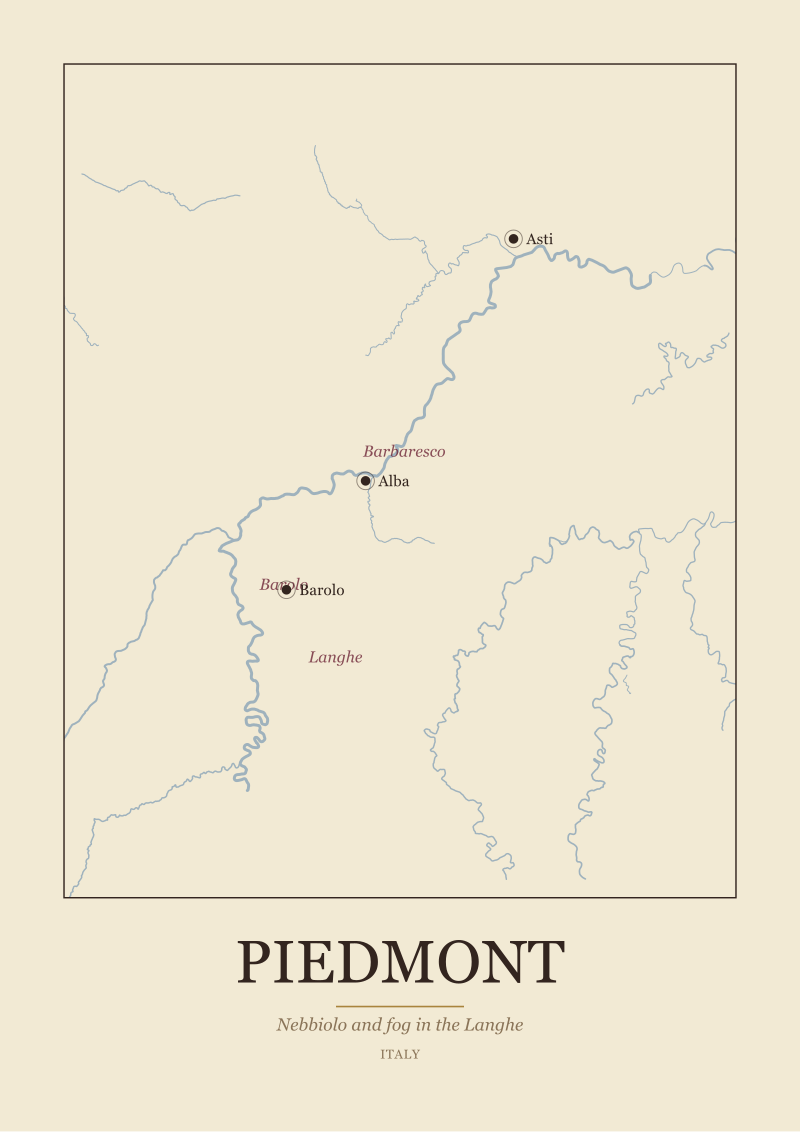
Now try the opposite. Start with a river that rises in the Ligurian Alps, runs roughly north-east through the province of Cuneo, cuts past a town called Alba, and empties into the Po. That river is the Tanaro. Everything a beginner needs to understand about Piedmont's most famous wines follows from where that river runs and what the land does on either side of it. The hills to the south of the Tanaro face one way; the hills to the north face another; the fog pools where the valley narrows. The grape is the answer. The river is the question.
This is not a small distinction. The people who write guides that lead with grapes are usually writing to sell you something — a bottle, a course, a subscription to a magazine that will teach you to identify tar and roses in a glass. We are not selling wine. We draw maps of the regions, and the maps have to be right, because a print hangs on a wall for years and a wrong river bend is a wrong river bend forever. That discipline forces a different order of operations, and we think it is the correct one for a reader too.
Piedmont, translated literally, means "at the foot of the mountains." The Alps arc around it to the north and west; the Apennines rise to the south. The region is a bowl of hills drained by rivers that all eventually feed the Po. Of those rivers, the Tanaro is the one that carved the specific corridor where the specific soils meet the specific fogs that make the specific wines the world has heard of. Start there and every subsequent sentence has somewhere to land.
Alba, Asti, Barolo: Three Towns the River Explains
If you were handed a blank map of Piedmont and asked to place three towns from memory, you could do worse than to draw the Tanaro first and pin the towns to it. Alba sits on the Tanaro directly. Asti sits further down the same river system, north-east of Alba, closer to where the Tanaro's tributaries braid into the wider plain. Barolo does not sit on the Tanaro at all — it sits on the hills just south of it. That geometry is the whole story.
Alba is the hinge. It is the town where the river meets the hills that produce both Barolo and Barbaresco, which is why almost every English-language piece about the Langhe eventually mentions Alba even when it is nominally about a grape. Alba is where the trucks come in during harvest, where the truffles are traded in autumn, where the merchants historically bought the wines from the surrounding villages and sent them onwards. The town exists because the river gave it a reason to exist, and the wine trade exists there because the river made the town first.
Barbaresco lies just to the north-east of Alba, on the opposite bank of the Tanaro from Barolo. This is one of those geographic facts that gets flattened in tasting-note pieces into a sentence about how Barbaresco is "softer" or "more approachable" than Barolo, as if softness were a property of grapes rather than of the specific hillsides where those grapes ripen. The hills on the Barbaresco side of the Tanaro have a slightly different exposure, a slightly different soil composition, a slightly different microclimate. The wine is different because the ground is different. Draw the river, and the difference becomes something you can point at instead of something you have to memorise.
Barolo, further to the south-west, sits in a cluster of villages — La Morra, Serralunga d'Alba, Castiglione Falletto, Monforte d'Alba, and the town of Barolo itself — that rise into the hills away from the Tanaro proper. This is why Barolo is spoken of as a "commune" cluster rather than a single vineyard: it is a family of villages sharing a section of hills, each with its own slope orientation and its own soil layers, all draining eventually back toward the Tanaro. When wine writers argue about which Barolo village makes the "greatest" wine, they are essentially arguing about which slope of which hill catches which combination of sun and morning fog, which is a geography question dressed up as a taste question.
Asti pulls the story in a different direction. It sits further from the Barolo–Barbaresco heartland and anchors a different wine tradition — the sparkling wines built on Moscato — which grows on hills of a different composition. It is a useful reminder that Piedmont is not a monoculture. The same region that produces some of Italy's most tannic reds also produces some of its most delicately sweet sparklers, and the reason is that the region is not one thing. It is a river system with several arms, and each arm gives a different valley a different vocation. A single grape cannot explain that. A river system can.
The three towns, taken together, form a rough triangle you can hold in your head. Alba at the hinge. Barolo and Barbaresco on opposite banks of the Tanaro just above and below Alba. Asti further along the drainage. If you have that triangle, you have Piedmont's wine geography in a shape simple enough to remember and specific enough to be useful. Everything else — the vintages, the producers, the tasting vocabulary — becomes ornament on a frame you can actually see.
 Piedmont
The print from this article · from €29.95
View the print →
Piedmont
The print from this article · from €29.95
View the print →
The Fog in the Langhe Is Not Atmosphere, It Is a Border
The Langhe is the name of the hills south of the Tanaro that hold Barolo and Barbaresco. It is also, according to a large body of Piedmontese folk etymology, the origin of the word Nebbiolo — from *nebbia*, the Italian for fog. Whether the etymology is strictly correct is a debate for linguists; what matters for our purposes is that the fog is not a mood. It is a functional weather system that draws a line around the region. The grape that made the region famous is named after a border condition.
Autumn fog in the Langhe forms because cool air drains down from the hills at night and settles into the river valleys, where the moisture from the Tanaro and its tributaries condenses in the still, chilled air. By dawn the valleys are white and the hilltops are clear. As the sun rises, the fog burns off from the top down. Vineyards planted at certain elevations get more sun; vineyards planted lower get more fog and cooler mornings. The grape needs the long autumn — it ripens late, harvest is often in October, sometimes into November — and the fog is part of what makes the long autumn survivable. Too warm and the acidity collapses. Too wet and the fruit rots. The fog holds the middle.
Read that as a mapmaker and you notice something important. The fog does not follow political borders. It follows valleys. This is why the appellation lines drawn around Barolo and Barbaresco are not straight — they wind along contour lines because the growers who drew them, decades ago, were essentially tracing the shape of the fog. A vineyard included in the Barolo appellation and a vineyard excluded from it can be a few hundred metres apart. The difference is often the direction the slope faces and how the fog moves through the specific fold of hill they sit in.
This is the sense in which we mean that Piedmont is geography first. The fog is a geographic fact. The appellation is a legal recognition of that fact. The grape is a botanical response to that fact. And the wine — the thing that sells in a glass in London or New York — is the last link in a chain that began with cold air draining down a hillside at three in the morning in a valley you have probably never visited. If you start the story at the wine, you have to invent a vocabulary to describe what you cannot see. If you start it at the fog, the wine is just what happens next.
We keep a map of the Langhe on our studio wall precisely because it makes this visible. You can see the river, the hills on either side of it, the clustered villages, the way the appellation borders curl. If you have ever wondered why one hillside carries a famous name and the hillside opposite carries a name you have never heard, the map answers before any book can. That is the whole reason we make maps of these regions in the first place — the geography, drawn honestly, teaches faster than any adjective. Ours are available in our shop, one region per print, but the point stands whether you buy anything or not: look at the map first.
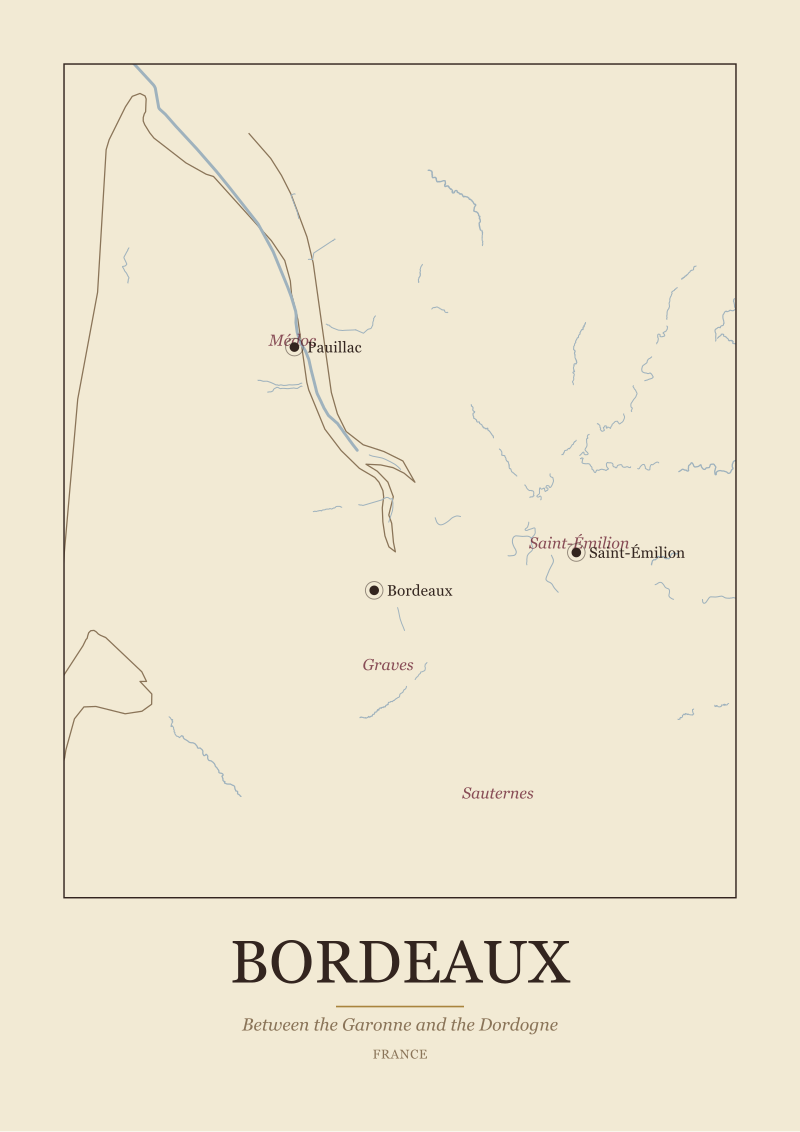
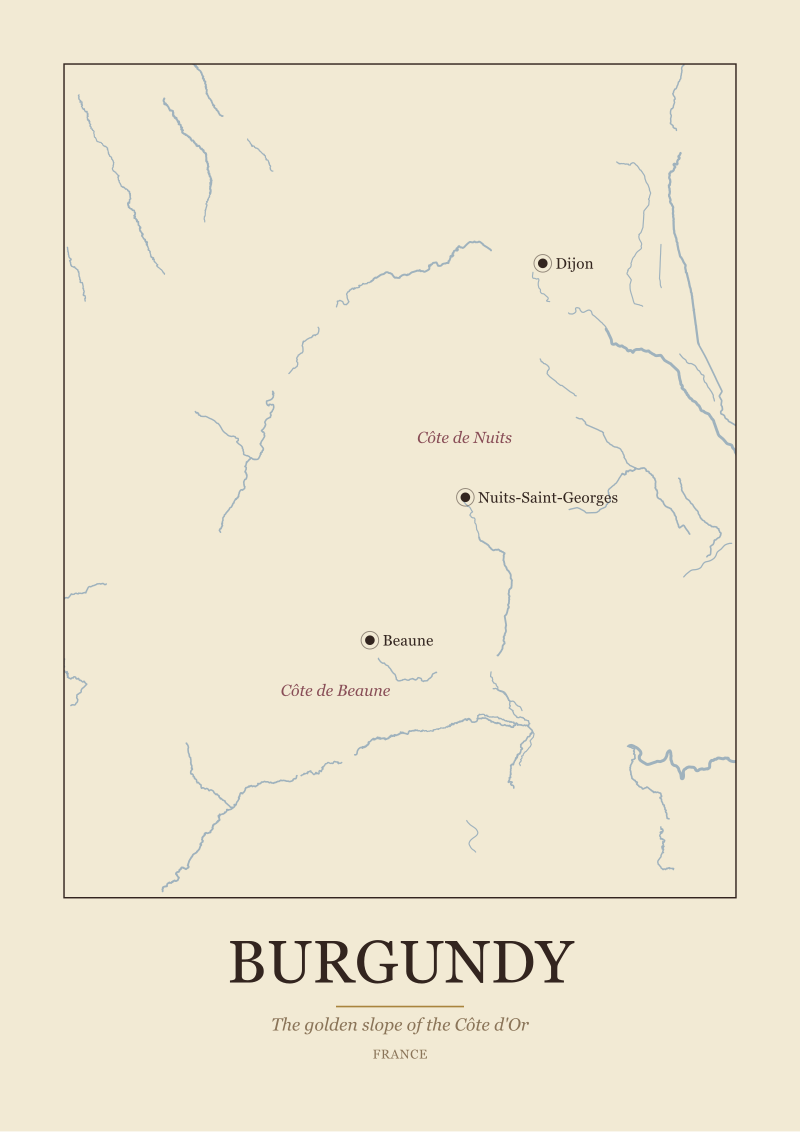
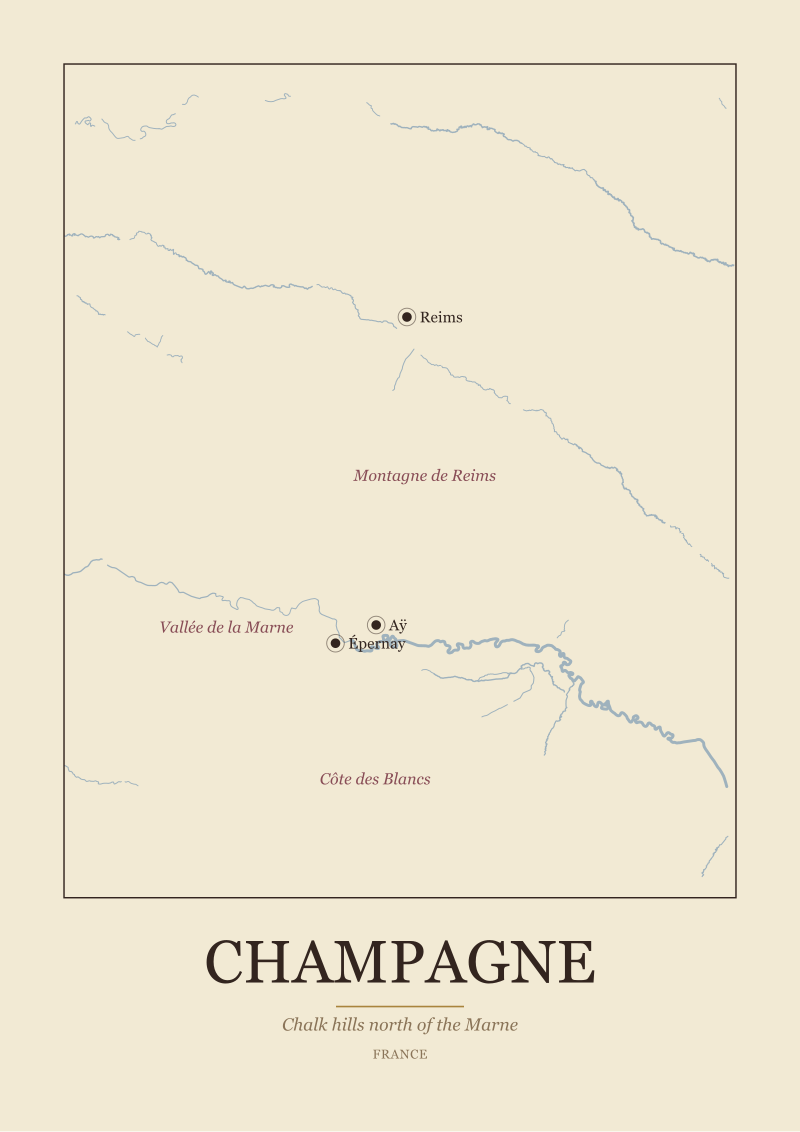
We started writing this piece intending to make a narrow point about how Piedmont guides mishandle Nebbiolo, and it turned into something larger — a small manifesto about the order in which regions should be introduced at all. The Nebbiolo-first habit is not unique to Piedmont; it happens to Bordeaux (grape-first before gravel-first), to Burgundy (grape-first before slope-first), to Champagne (grape-first before latitude-first). Every one of those regions is better understood with the geography as the opening chord. We keep noticing the pattern because we keep drawing the maps that would fix it.
Signals to Watch
Three things will tell you whether the wine writing establishment is starting to reorder its opening moves. First, watch whether new introductory Piedmont guides open with the Tanaro or with Nebbiolo — a slow shift toward river-first framing would be visible within a few years across the major English-language wine publications. Second, watch whether appellation maps start appearing above the fold in online articles rather than below the fold or omitted entirely; the placement is a proxy for whether editors trust readers to read a map. Third, watch whether writers begin naming the specific fog pattern of the Langhe as a functional weather system rather than as atmospheric decoration. When those three shifts happen, the geography-first reading of European wine regions will have arrived. Until then, the maps have to do the arguing.
 Bordeaux
The print from this article · from €29.95
View the print →
Bordeaux
The print from this article · from €29.95
View the print →
FAQ
Why is the Tanaro more central to Piedmont than Nebbiolo?
The Tanaro is the river that carved the specific valley system where the region's most famous wines are grown. Alba sits on it directly, Barbaresco lies just to its north-east, and Barolo rises in the hills south of it. The grape is what grows on those slopes; the river is what put the slopes in that shape and that microclimate in the first place. Grape-first framing skips the ground the grape depends on.
Where exactly does the Tanaro run?
The Tanaro rises in the Ligurian Alps of north-west Italy and flows roughly north-east through the Piedmontese province of Cuneo, passing Alba and continuing toward Asti before joining the wider Po drainage. Its exact bends are what draw the appellation borders of Barolo and Barbaresco: those borders follow the shape of the valleys the river shaped, not straight political lines on a map.
Are Barolo and Barbaresco really that different geographically?
Yes. They sit on opposite sides of the Tanaro, with Barolo in the hills to the south-west of Alba and Barbaresco to the north-east. That opposite-bank position changes slope exposure, soil layering, and how the autumn fog settles through the vineyards. Wine writers often reach for taste adjectives to describe the difference, but the underlying cause is a geographic one that you can see plainly on any decent regional map.
Why is the Langhe fog described as a border?
Because it functions as one. Autumn fog in the Langhe drains into the river valleys overnight and burns off from the hilltops downward in the morning, which means vineyards at certain elevations get very different exposures from vineyards a few hundred metres away. The appellation lines around Barolo and Barbaresco wind along the contours where that fog behaviour is favourable, effectively encoding a weather pattern into a legal boundary.
Does Asti belong to the same wine story as Barolo?
Only loosely. Asti sits further along the Tanaro drainage and anchors a different tradition — sparkling wines built on Moscato — grown on hills of different composition than the Nebbiolo heartland. Including Asti in the Piedmont story is important because it prevents the region being flattened into a single-grape narrative. Piedmont is a river system with several arms, and each arm supports a different vocation.
What does "Langhe" actually mean, and where is it?
Langhe is the name for the hills south of the Tanaro that contain the Barolo villages and, on the other bank, the Barbaresco vineyards. The name is old and its etymology is debated, but a common folk explanation links it to the region's characteristic fog. The Langhe is not a legal appellation on its own in the same tight sense as Barolo, but it names the geographic zone that the two famous appellations sit inside.
Why do you draw the region before writing about it?
Because drawing forces you to be correct about the geography before you say anything else. A print of a region hangs on a wall for years — a mis-drawn river bend or a misplaced town is not a correctable typo. That discipline pushed us into a habit of leading every article with the geography that the map has already forced us to get right, and it turns out that habit is also the clearest way to introduce a region to a newcomer.
Where can I see a map of Piedmont drawn this way?
We keep a Piedmont map on the studio wall and it is one of the prints we offer through our own shop — one region per print, drawn from public-domain Natural Earth river and coastline data with the anchor towns and sub-zones marked. But you do not need to buy anything to benefit from the point: any honest regional map that shows the Tanaro, Alba, Barolo, Barbaresco and the surrounding hills will teach the geography faster than a page of tasting notes.
New regions and 10% off your first print.
One email now with your code. No noise after.