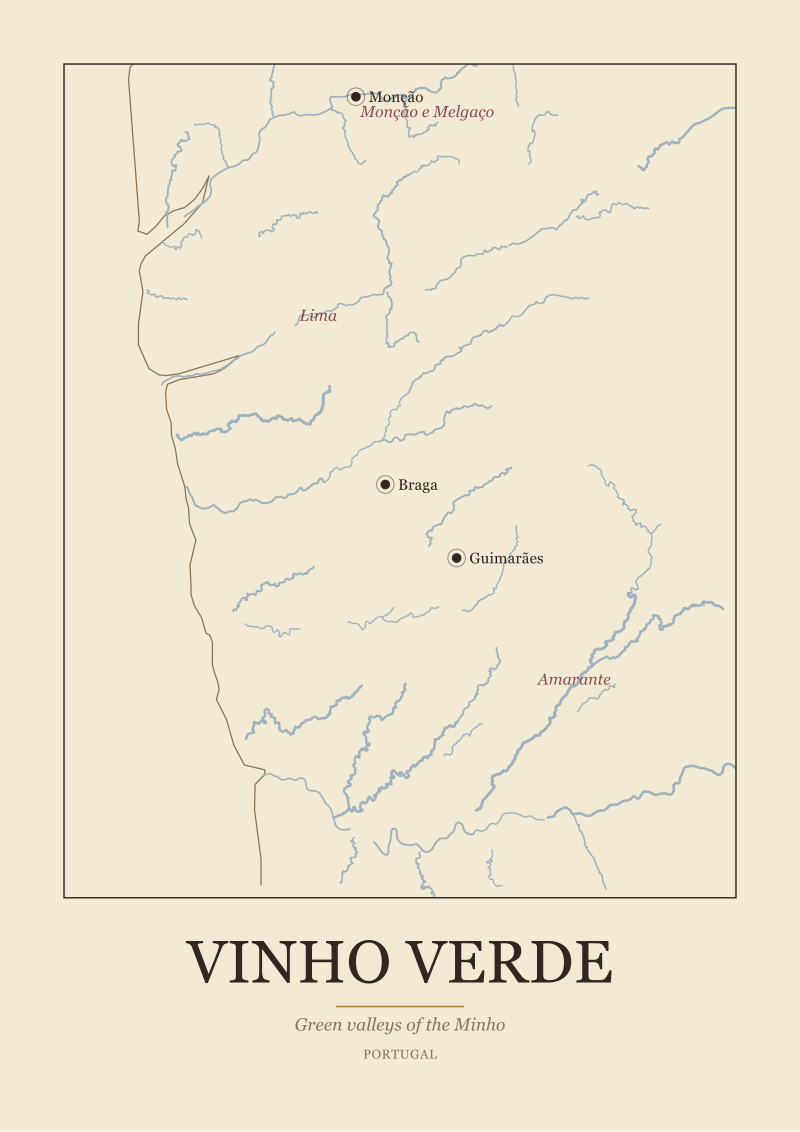
I spent a week reading appellation filings from Porto and cross-checking them against the coastline drawn by Natural Earth's public rivers dataset, because a question kept coming up in the studio: is Vinho Verde a wine, a place, or a marketing accident. The filings answer plainly. It is a place. The region sits in the far northwest corner of Portugal, pressed between the Atlantic and the Spanish border, drained by the Minho river, anchored by Braga and Guimarães inland and by Monção up on the frontier. Everything else follows from that geography.
The Region Was Renamed in 2026, and the Old Map Still Rules It
Somewhere in the last eighteen months the paperwork moved. Category refinements, subzone rewordings, a shuffle of what qualifies for what label — the sort of quiet administrative choreography that happens in every European appellation eventually, and that no one outside the trade press ever notices. I read a stack of these documents at the studio table with the Natural Earth coastline pulled up on the second screen, and the interesting thing was the mismatch. The paperwork changed. The ground did not.
That is worth saying slowly, because the wine press treats every rewording of an appellation as if the underlying region has been reinvented. It has not. The Minho river still enters the Atlantic at Caminha in the exact place it entered when the Cistercian monasteries at Braga first began pressing grapes in the twelfth century. The subzone boundaries still hug the same tributary valleys they hugged when Portugal codified the Denominação de Origem Controlada for Vinho Verde in the middle of the twentieth century. What shifts on paper is category language. What stays fixed is the drainage basin.
This is why we draw the region rather than write it. A map built from public geographic data — Natural Earth's 1:10m rivers and coastline files, the same base cartographers have used quietly for a decade — is indifferent to the year's regulatory mood. The Minho is where the Minho is. Braga sits where it has sat since the Romans called it Bracara Augusta. The geography does not consult the label.
I think this is the thing readers get wrong about wine regions in general and Vinho Verde in particular. They assume the region is what the bottle says the region is. They read a back label, they read a producer's marketing, they read a wine list description written by someone who last visited Portugal in 2009, and they treat that composite fiction as the place. It is not the place. The place is the valley system draining west toward the Atlantic between the Douro to the south and the Spanish province of Galicia to the north. Everything the bottle says is a summary of that.
What changed in 2026 is worth tracking if you sell wine. What did not change — the slope of the ground, the direction of the prevailing weather, the reach of the tide up the Minho estuary — is what you need to know if you want to understand why the wine tastes the way it does. The old map still rules it. It will still rule it in 2030.
The Minho Draws the Border, and the Border Draws the Wine
Look at the region from above and you notice one thing before anything else: the Minho is a border. It separates Portugal from Spain for the last hundred kilometres of its course, and Vinho Verde is the strip of Portuguese land that leans against it. This matters more than it sounds.
Borders shape wine in ways that terroir writing rarely admits. They dictate which side of a river got which grape varieties, because national viticultural authorities kept different registries. They fix which towns became trade hubs and which stayed farm villages, because customs offices sat where borders opened. Monção, on the Portuguese bank near the eastern end of the frontier stretch, is a border town in every sense the word carries — a crossing point, a customs memory, a place where the wine culture on one side of the river spent centuries reading and misreading the wine culture on the other. Alvarinho grows on the Portuguese side. Albariño grows on the Galician side. They are cognate names for the same grape, and the geography is one geography. The politics made them look like two.
Then there is what the Atlantic does. The far northwest of Iberia is one of the wettest corners of Europe. Weather rolls off the ocean and hits a low coastal ridge before it climbs toward the interior mountains. Vinho Verde sits inside that first band of rainfall, which is why the region is green in the landscape sense — pasture green, hedgerow green, the sort of wet Atlantic green that Ireland and Galicia and Brittany all share. The wine is called green not because it is coloured green, but because it was traditionally young, drunk soon after fermentation, sold quickly into local markets that had no interest in ageing anything. The name is a landscape word before it is a stylistic word. The bottle reflects the pasture.
The river also determines the sea influence. The Minho estuary lets Atlantic air travel inland along its valley, keeping the western subzones cooler and more humid than they would be if the coast were sealed by a cliff line. Move away from the river and the influence weakens. Move up a tributary valley into the hills behind Braga or Guimarães and you feel a different climate, one that ripens grapes later and rewards different varieties. This is the part terroir writing gets right but often gets vague about. The river is not decorative. The river is the region's thermostat.
Which is why the border and the wine are the same story. The Minho is what makes Vinho Verde a coherent place rather than a random cluster of northwestern Portuguese vineyards. Take the river away and you have three or four unrelated hill agriculture zones. Keep the river in and you have a region.
 Vinho Verde
The print from this article · from €29.95
View the print →
Vinho Verde
The print from this article · from €29.95
View the print →
Monção, Lima, Amarante: Three Subzones That Do Not Agree on What Green Means
The DOC Vinho Verde is subdivided, and the subdivisions are not administrative theatre. They correspond to real breaks in the geography, and once you read them as geography the region resolves into something you can actually hold in your head.
Monção — and its sister zone Melgaço a little further east — sits on the Minho itself, in the far north of the region, up against the Spanish frontier. This is Alvarinho country, and it is Alvarinho country for reasons that are not accidental. The Minho valley here runs east-west, which means the slopes catch different light than the slopes further south. The Serra da Peneda mountains to the east give some shelter from the sharpest Atlantic weather. The result is a subzone that ripens a little more reliably and produces wines with more weight than the classic light Vinho Verde stereotype. If you have ever drunk a Vinho Verde that tasted serious — that carried texture and length and did not simply refresh — you were probably drinking from Monção or Melgaço.
Then Lima. The Lima river drains a separate valley system further south, running west into the Atlantic near Viana do Castelo. This is the middle of the region in a geographic sense, and it produces what most drinkers think of as archetypal Vinho Verde — light, immediate, low-alcohol wines meant to be finished the week they are bought. Loureiro and Trajadura are the traditional grapes here, and the valley shape rewards them. Move north from the Lima toward Monção and the wines gain body. Move south from the Lima and you start climbing into different terrain.
Amarante is that different terrain. It sits inland, well south of the Minho and closer to the Douro, on the tributaries that feed the Douro basin from the north rather than the Atlantic drainage of the coast. The climate here is more continental. Summers get hotter, winters colder, the Atlantic influence thins. The vines behave differently. The wines carry more alcohol and less of the racy freshness the region is famous for. Some drinkers do not read Amarante as Vinho Verde at all when they meet it blind, and that is the point of the subzone — it is a border, in the same way the Minho is a border, but a climatic one instead of a national one.
Three subzones. Three answers to the question of what green means. Monção says green with weight. Lima says green as its own reward. Amarante says green with the Douro pushing back.
This is the part of the region that maps make obvious and that wine writing usually reduces to a footnote. A drawn map of Vinho Verde with its subzones outlined against the river system tells you the story in one look. A wine list description tries to tell you the same story in one sentence and always fails. We keep drawing the regions in the studio, and we keep printing the maps (the shop is here for anyone who wants one on a wall), because a wall map is the only format that lets the geography argue for itself.
This piece started as a note about whether Vinho Verde deserves to be talked about as a serious wine region and turned, somewhere around the third day of reading filings, into something else. It turned into a piece about what a wine region actually is, and what happens when you stop treating the label as the region and start treating the drainage basin as the region. The paperwork will keep moving. The Minho will not. If there is a next question worth asking, it is not whether Vinho Verde is good or bad wine. It is whether the way we teach wine regions — as lists of grapes, as flavour profiles, as producer rankings — has anything to do with the ground the vines are growing in. My working answer, after this week, is no.
FAQ
Is Vinho Verde a grape or a region?
Vinho Verde is a region, not a grape. The name refers to the Denominação de Origem Controlada that covers the northwest corner of Portugal, drained by the Minho river and anchored by towns like Braga, Guimarães and Monção. Within that region several grape varieties are grown — Alvarinho, Loureiro, Trajadura and others — depending on the subzone. When a bottle says Vinho Verde it is telling you where the wine came from, not which grape it was made from.
Why is it called "green wine"?
The word verde in Portuguese means green, and the name traditionally referred to the wine being young — drunk soon after fermentation rather than aged — as well as to the very green Atlantic landscape of the Minho valley. It is not a colour description. Most Vinho Verde is pale straw or light gold, not green in the glass. The name is a landscape and freshness word, carried over from centuries of local drinking habits.
Where exactly is the Vinho Verde region on a map of Portugal?
It occupies the far northwest of mainland Portugal, bounded roughly by the Atlantic coast to the west, the Minho river and the Spanish border to the north, the Serra da Peneda and inland mountains to the east, and the Douro river valley to the south. The main anchor cities are Braga and Guimarães in the interior, Viana do Castelo on the coast, and Monção up on the northern frontier with Galicia.
What are the subzones of Vinho Verde and why do they matter?
The DOC is divided into several subzones, of which Monção e Melgaço, Lima and Amarante are among the most distinct. Monção e Melgaço lies on the Minho itself and is the traditional home of Alvarinho, producing wines with more weight. Lima drains its own valley toward the Atlantic and yields the classic light, immediate style. Amarante sits inland toward the Douro, and its wines carry more alcohol and a warmer character.
Does Vinho Verde share territory with Spanish Galicia?
Geographically yes, culturally yes, politically no. The Minho river is the border between Portugal and Spanish Galicia along its lower course. The Portuguese side is Vinho Verde. The Galician side is Rías Baixas. They are separate appellations under separate national systems, but they occupy the same broad Atlantic climate zone, and the Alvarinho grape on the Portuguese side is the same grape as Albariño on the Galician side.
Is Vinho Verde always slightly sparkling?
Not always. A light natural spritz was traditional in older bottling practices and remains associated with the style, but many modern Vinho Verdes, especially those from Monção e Melgaço made from Alvarinho, are entirely still. The spritz, when present, tends to be gentle. Assuming every bottle labelled Vinho Verde will fizz is a stereotype the region has been working past for at least a generation.
How old is Vinho Verde as a wine tradition?
Wine has been made in the Minho region since at least Roman times, and organised viticulture on a monastic model dates back to the medieval period, with Cistercian houses in the Braga area among the historical drivers. The formal appellation as a modern legal framework is a twentieth-century construction, but the underlying tradition of drinking young wine from the green valleys of the Minho is much older than the paperwork that now defines it.
 Douro
The print from this article · from €29.95
View the print →
Douro
The print from this article · from €29.95
View the print →
New regions and 10% off your first print.
One email now with your code. No noise after.