Provence is the region where rosé stopped being a category and became a lifestyle. Côtes de Provence, Bandol, and Coteaux d'Aix ship out from Toulon and Saint-Tropez under labels tuned to pale-pink recognition, and the conventional read follows the marketing exactly. The wine is a colour, the colour is a coastline, the coastline is a season. Aix-en-Provence anchors one end of the story, Saint-Tropez the other, and between them a river most drinkers cannot name — the Argens — quietly does the geographic work that lets the whole marketing edifice stand up. This is the version that sells. It is also, in the parts it covers, entirely true.
Why This Is Actually True
The Mediterranean version of Provence is not a fiction invented to sell wine. It is a real geographic band, and within that band the marketing story holds up on its own terms. The coast from Toulon east to Saint-Tropez is a long, warm, sun-soaked line, and the vineyards that face it inherit that light directly. Summers are long. The mistral scours the sky clean. The sea moderates the nights. Grapes ripen quickly and evenly, and a wine style that is drunk young, cold, and outside is a rational cultural consequence of the climate that produced it.
The concentration of the Côtes de Provence appellation across this band is not accidental either. The appellation runs across the départements of Var and, in part, Bouches-du-Rhône, and its shape follows the geography of the coastal hinterland rather than any administrative straight line. From the drinker's point of view, this is a coherent region. A pale rosé from a producer near the coast and a pale rosé from a producer twenty kilometres inland taste like siblings because they are, in fact, siblings — same climate zone, same broad grape mix, same winemaking philosophy of short skin contact and cool fermentation.
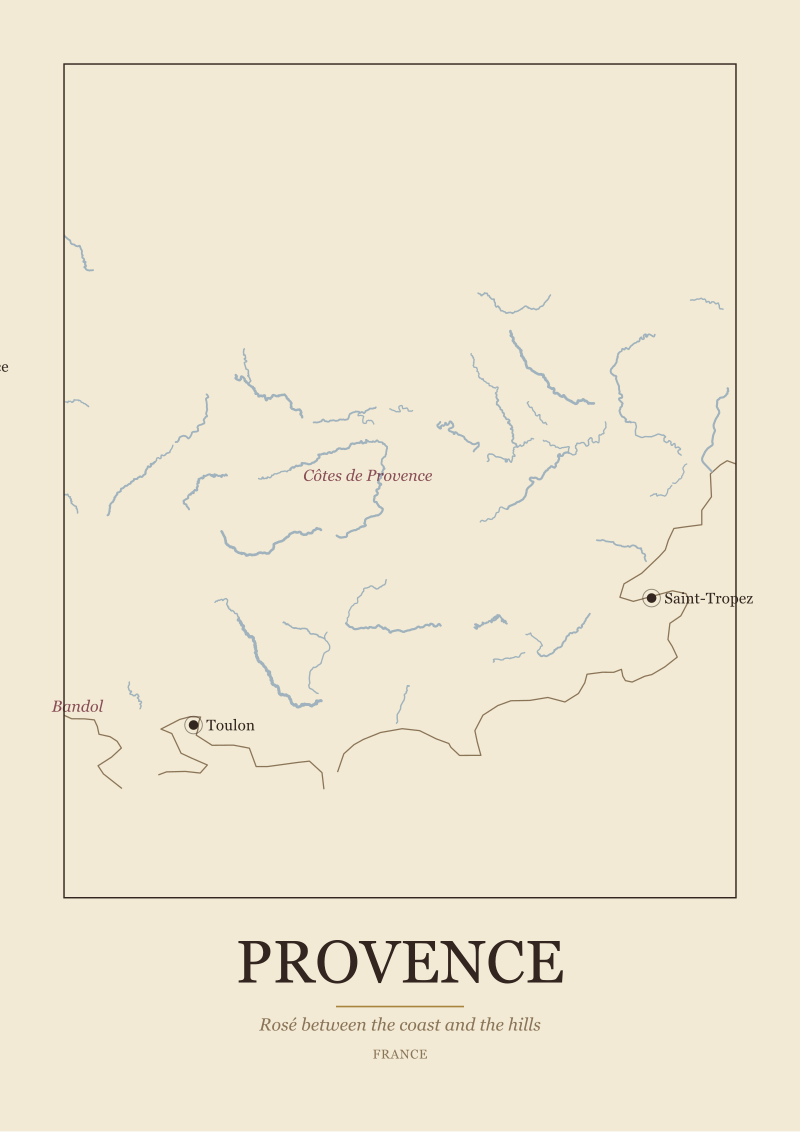
Aix-en-Provence at the western end and Saint-Tropez at the eastern end frame the story neatly on a map, and Toulon in the middle handles the port. The conventional read — a coastal region, a warm-climate wine, a pink drunk in the sun — is not wrong. It is the correct first sentence about the region. It is simply not the whole paragraph.
But here is what that framing misses entirely: the coast is where the wine is drunk, not where most of it is grown.
Where It Breaks Down
The coastal read starts to fail the moment you look at the river. The Argens rises inland, west of the Massif des Maures, and runs east across the Var toward the sea near Fréjus. Almost all of the eastern half of the Côtes de Provence appellation sits in its catchment. This is not a coastal river valley. It is an inland corridor that only meets the Mediterranean at the very last stretch. The vines that supply the appellation's volume are, in overwhelming majority, planted in this interior — on the slopes above the Argens and its tributaries, in a landscape of scrubland, limestone, and pine, not on the beach.
Look at the anchor towns the appellation itself claims and the fracture becomes obvious. Aix-en-Provence is not a coastal town. It sits well inland, north of the Étang de Berre, and it anchors the Coteaux d'Aix — a separate appellation entirely, geographically continental in character, closer to the foothills of the Alpilles than to any port. Toulon is coastal, but the vineyards behind it climb quickly into hills. Only Saint-Tropez fits the postcard, and Saint-Tropez is a peninsula, not a growing region — the Massif des Maures behind it is where the vines actually live.
Bandol is the sharpest fracture of all. It is a small appellation immediately west of Toulon, and it faces the sea in a geographic amphitheatre of terraced hillsides. But Bandol is not the pale-pink Provence of the marketing. It is a Mourvèdre-driven appellation whose serious reputation was built on red wine, with a structured rosé as a secondary but respected style. A Bandol red aged in oak has nothing structural in common with a fashion-brand Saint-Tropez rosé. They share a coastline and almost nothing else.
Coteaux d'Aix is the third piece that will not fit. Its vineyards sprawl across a wide zone west and north of Aix-en-Provence, in a landscape shaped by the Durance river and the low mountain chains that separate it from the coast. This is a continental Mediterranean climate, not a maritime one. Winters bite harder. The mistral hits without the sea softening it. The rosés from here can be pale in imitation of Côtes de Provence style, but the geography that produced them is a different geography entirely.
The pink coastline is a real thing. It is also a marketing composite of three appellations whose geographies do not overlap the way the label suggests.
 Provence
The print from this article · from €29.95
View the print →
Provence
The print from this article · from €29.95
View the print →
The Rule I Use Instead
Read Provence as three geographies, not one. The lens that works is to ask where the vines are, what river or hill their slope drains into, and how far the sea actually reaches them. The colour tells you almost nothing. The location tells you almost everything.
Côtes de Provence is the Argens appellation. That is the sentence to hold onto. Its centre of gravity is the interior corridor the river drains, from around Brignoles east toward Vidauban, Le Luc, Les Arcs, and on toward Fréjus. The coastal fringe from Toulon to Saint-Tropez matters commercially — it is where the wine is drunk and where the brand image is manufactured — but the vines themselves belong to a landscape of inland scrub. When a bottle says Côtes de Provence, the honest mental picture is a hillside above a Var backroad, not a beach club.
Bandol is the amphitheatre appellation. It is small, contained, and defined by the specific geography of hillsides opening onto the sea just west of Toulon. Its terraces catch heat and reflect it, and its vineyards are old enough and steep enough that the appellation was drawn to fit the geography rather than the other way around. Bandol is where Mourvèdre becomes a serious grape and where the wine has structural weight, red or rosé. It is coastal in the literal sense the wider region only pretends to be.
Coteaux d'Aix is the continental appellation. It sits behind the coast, in the wide bowl west and north of Aix, closer in temperament to the Rhône's southern reach than to Saint-Tropez. Its landscape is limestone plateau, garrigue, and low mountain, and its wines — red, white, and rosé — carry a slightly firmer, cooler character than the coastal cliché predicts.
Three appellations, three geographies, one shared colour palette. The colour is what the market sells. The geographies are what the region is. Once the appellation lines are read as geographic borders rather than as marketing zones, Provence stops being a monolith and becomes a legible piece of southern France — a river, an amphitheatre, and a continental basin, held together by climate rather than by sameness.
When the Old Rule Still Wins
For a drinker choosing a bottle for a summer table, the coastal frame is still the more useful one. The three appellations do share enough — climate band, grape mix, winemaking convention — that a pale Provence rosé from any of them will behave in a broadly similar way, and picking on that basis will not go wrong. If the question is what to open on a hot evening, "Provence pink from anywhere between Aix and Saint-Tropez" is a fine answer.
The geographic read matters when the question changes. It matters when someone asks why a Bandol costs three times a supermarket Côtes de Provence, or why a Coteaux d'Aix red tastes closer to a southern Rhône than to a Var rosé, or why a small producer inland from Le Luc has almost nothing in common with a coastal négociant brand from the same appellation. The marketing frame is a competent shorthand. It just stops answering questions the moment the questions get specific — and Provence, read as geography, always eventually does.
FAQ
Where does the Argens river actually run through Provence?
The Argens rises in the western Var, inland from the Massif des Maures, and runs broadly eastward across the département before reaching the Mediterranean near Fréjus. It is the geographic spine of most of the Côtes de Provence appellation's eastern volume. The corridor it drains — a band of hills, valleys, and scrubland behind the coast — is where the majority of the appellation's vineyards actually sit, well away from the beaches the marketing tends to show.
Is Côtes de Provence really a coastal wine region?
Not in the way the label suggests. The appellation touches the coast at points, and its brand imagery leans hard on Saint-Tropez and Toulon, but the bulk of the vineyard area is inland, in the Argens catchment and the hills of the Var interior. The coast is where the wine is sold, shipped, and drunk. The wine is grown on inland slopes with a Mediterranean climate softened, but not defined, by the sea.
How is Bandol different from the rest of Provence?
Bandol is a small, geographically distinct appellation immediately west of Toulon, built on terraced amphitheatre hillsides that face the sea. It is coastal in a way the wider region only pretends to be, and its reputation was built on Mourvèdre-driven red wine rather than pale rosé. Its rosé exists but is stylistically firmer and more structured than the Côtes de Provence norm. Treat Bandol as its own place, not as a subset of the Provence cliché.
What is Coteaux d'Aix and how does it relate to Aix-en-Provence?
Coteaux d'Aix is a separate appellation anchored on the town of Aix-en-Provence, spreading across the hills west and north of the city. Geographically it sits behind the coast, in a more continental Mediterranean climate closer in character to the southern Rhône's reach than to the coastal Var. It produces red, white and rosé, and its landscape — limestone, garrigue, low mountain — is distinct from the maritime scenery associated with Côtes de Provence.
Why do Provence rosés all look so pale?
Pale colour is a stylistic convention, not an accident of geography. It comes from short skin contact during pressing and cool fermentation, choices producers across the three appellations converged on for market reasons over recent decades. The climate — long ripening season, warm days, cooling coastal or hillside nights — supplies the fruit; the pale hue is what the industry chose to do with that fruit. Colour is a signature of the category, not a proof of terroir.
Which anchor towns actually matter for reading the region on a map?
Aix-en-Provence anchors the west, near the Coteaux d'Aix zone and the continental interior. Toulon sits on the coast in the middle, near Bandol and along the southern edge of the Côtes de Provence. Saint-Tropez marks the eastern coastal end, with the vineyards behind it climbing into the Massif des Maures. Between Aix and Saint-Tropez, the Argens corridor is the geographic thread — the piece of the map most drinkers never see.
Are the three appellations really that different or is this splitting hairs?
For casual drinking, the three overlap enough that treating them as one category is fine. For reading the region, they are three different geographies: a river corridor (Côtes de Provence), a coastal amphitheatre (Bandol), and a continental basin (Coteaux d'Aix). The shared pale-rosé style masks how differently the land behaves in each. Once the geography is read, price differences, style differences, and the persistence of red wine reputations in Bandol all stop being surprising.
New regions and 10% off your first print.
One email now with your code. No noise after.