The Côte d'Or is a slope. Not a region in the loose sense a wine list uses the word, but a physical incline running roughly north-south between Dijon and just past Nuits-Saint-Georges and Beaune, facing east over the Saône valley. That is the receipt. Everything expensive about Burgundy — the auction prices, the allocation lists, the waiting-room language of merchants — is downstream of a strip of hillside you could walk in an afternoon. Before we get to price, look at the geography. The rest of the argument writes itself from there.
Most explanations of Burgundy pricing start with demand: the collectors, the Asian markets, the auction records. We think that argument is the wrong end of the telescope. Demand is real, but demand attaches to a supply that is fixed by rock. Hear us out. The rock came first.
What the Map Actually Shows
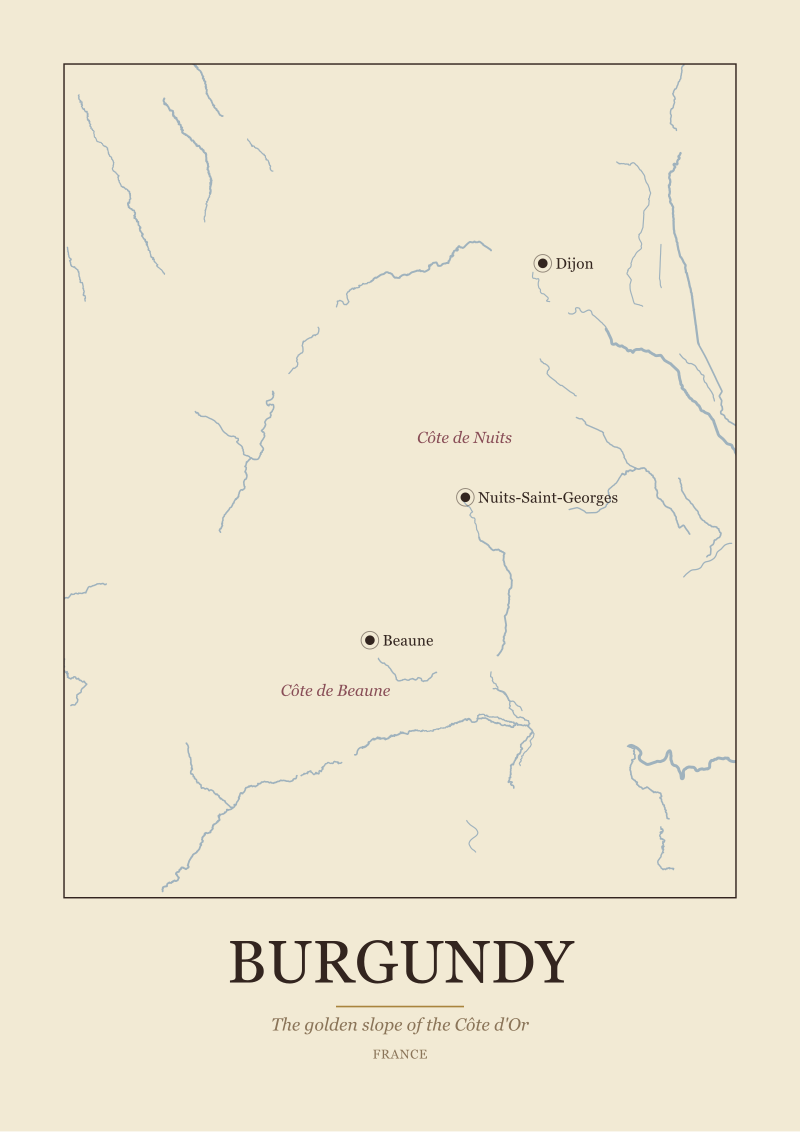
Open a map of eastern France and find Dijon. Drop your finger south. Within about forty kilometres you have passed through the entire Côte d'Or — the golden slope — and reached the town of Beaune, which sits roughly at its midpoint. Continue a little further and you reach Nuits-Saint-Georges, which the C ôte d'Or in fact places to the north of Beaune, not the south. Correct the mental picture: Dijon at the top, then the Côte de Nuits with Nuits-Saint-Georges as its anchor town, then Beaune, then the Côte de Beaune trailing off to the south.
That is the entire strip. Two sub-zones — Côte de Nuits in the north, Côte de Beaune in the south — meeting near Beaune itself. The Saône valley lies to the east. The vineyards look out across it. The land climbs behind them to the west into wooded plateau. What you are looking at, geographically, is the edge of a plateau where it drops away toward a river valley. Vineyards occupy the drop. The plateau above them is trees and pasture. The valley floor below them, historically, was farmed for grain and grazed.
The slope is not dramatic. It is not the Douro. It is not the Mosel. If you drove past it without knowing what you were looking at, you would see an unremarkable line of hills. That understatement is the first thing to internalise. Burgundy's geography is not spectacular. It is specific. The value is in the specificity, not the spectacle.
The anchor towns tell you where the commercial gravity sits. Dijon at the northern gate, historic capital of the Duchy. Beaune in the middle, the wine town, the négociant town, the town that runs the annual Hospices auction that sets the tempo of the market. Nuits-Saint-Georges gives its name to the entire northern sub-zone. Three towns, one slope, two zones. That is the whole map.
What Nobody Mentions About the Slope
Here is what the tasting-note literature tends to skip. The slope faces east. That direction matters more than any single fact about Burgundy pricing, and almost no consumer article about auction records mentions it.
East-facing means the vines catch the morning sun. At the latitude of Dijon, roughly forty-seven degrees north, that morning warming is not a garnish. It is the growing season. Burgundy is a marginal climate for the varieties it plants. The mornings do the ripening work; the afternoons and evenings cool quickly as the sun rotates behind the plateau. That diurnal swing — warm morning, cool afternoon — is what the region's grapes have been selected for over centuries. Move the slope thirty degrees to the north or the south and the wine that has made Burgundy famous does not exist in the same form.
Then there is the question of where on the slope the vine sits. Not all of the Côte d'Or is equal, and this is the fact that ranks the vineyards. The valley floor is too flat, too fertile, too prone to frost pooling and to the water sitting in the soil after rain. The plateau top is too exposed, too thin-soiled, too cold at night. The middle band of the slope — the section where drainage is good, where the soil is limestone-rich and mixed with clay, where the aspect is squarely east — is where the grands crus sit. Above that band, the premiers crus. Below it, the village-level wines. Below those, the regional Bourgogne appellation.
This is not a marketing hierarchy. It is a topographic one. If you walked the slope with a topographic map, you could predict the appellation rank at almost any point from the elevation, aspect, and soil composition alone. The Cistercian monks did exactly this in the medieval period, walking the slope and tasting the wines from each plot and drawing the boundaries that the modern appellation system inherited essentially intact. What the map shows today is the result of nine centuries of that walking and tasting. Nobody has redrawn it because nobody has needed to.
The wall matters too. Many of the great vineyards are enclosed by a low stone wall — a *clos* — and the wall is not decorative. It marks a specific plot with a specific geographic character. Clos de Vougeot is the famous example: a walled parcel whose interior actually contains land of varying quality, but the wall itself is a historical artefact of monastic land holding. The point of the wall, for the purposes of understanding price, is that it is proof of specificity. When you buy a wine from within a wall, you are buying a plot of ground that was drawn a very long time ago by people who worked it every day.
 Burgundy
The print from this article · from €29.95
View the print →
Burgundy
The print from this article · from €29.95
View the print →
The Real Cost of a Narrow Strip of Hill
Now the arithmetic. The Côte d'Or is, as noted, roughly forty kilometres long. The band of the slope where the grands and premiers crus sit is a strip perhaps a few hundred metres wide, taken as an average, sometimes narrower. If you multiplied that length by that width, the entire top-tier vineyard area of the Côte d'Or would fit inside a modestly sized suburb. The grand cru area alone — the top tier — is a tiny fraction of that already small strip.
Put the picture together. A limited number of hectares. A limited number of producers, many of them working plots measured in fractions of a hectare because centuries of French inheritance law split family holdings across generations. A limited yield per hectare, held down by both regulation and by the growers' own practice of pruning severely to concentrate the fruit. A single vintage per year, obviously, and a growing season that in bad years produces a fraction of the bottles a good year does.
Multiply those constraints. A grand cru with a total vineyard area of a few hectares, divided among a dozen or more owners each holding a small strip, each of them making perhaps a few hundred cases in a good year and half that in a poor one. The global supply of any single named grand cru is not commercial in scale. It is, in strict quantitative terms, artisanal. That is not a marketing word here. It is a description of the number of bottles that exist.
Now add demand. Wine is one of the few agricultural products where the name of the plot travels with the bottle, and where collectors, restaurants, and enthusiasts compete for a supply that cannot expand. The plot cannot be enlarged. The slope is what it is. You cannot plant grand cru on the plateau above or on the plain below because the ground there does not produce grand cru wine and, more prosaically, because the appellation law will not let you call it that. The boundary is legal and it is also physical. Both walls are load-bearing.
The result is an economy where price is set by the ratio of a fixed, small supply against a growing, global demand. That is the entire pricing story reduced to its geographic bones. Auction records, allocation lists, and merchant waiting rooms are mechanisms for rationing a supply that the slope itself has already limited. The mechanisms are not the cause. The slope is the cause.
If You Only Remember One Thing
Burgundy is expensive because the land that produces it is small, specific, and cannot be replicated. The slope faces east at a latitude where east-facing matters. The middle band of that slope is where the great wines grow. The band is narrow. The plots inside it were drawn centuries ago and have been divided by inheritance into fractions. The bottles that result are counted in the hundreds, not the millions.
Everything else — the collectors, the auctions, the language of the trade — is what happens when a large world discovers a small hill. If you want to understand a Burgundy price, look at a map of the Côte d'Or first. The tasting note comes later, and it comes second.
If the geography is where the argument starts, the next question the reader should be asking is not which bottle to chase but which map to keep on the wall — because reading a region, we would argue, begins with being able to see its shape at a glance. Our own studio shop draws the Côte d'Or and the other great European wine regions from the same public geographic sources we referenced above, if that is a rabbit hole you want to fall down.
 Douro
The print from this article · from €29.95
View the print →
Douro
The print from this article · from €29.95
View the print →
FAQ
Why is the Côte d'Or called the "golden slope"?
The name refers to the colour the vineyards turn in autumn, when the leaves of the vines go gold along the length of the slope. It is a visual description of the geography, not a claim about the value of the wine, although the coincidence is convenient. The slope runs roughly from Dijon in the north to just south of Beaune, with the Côte de Nuits and the Côte de Beaune as its two sub-zones, and in October it is unmistakable from a distance.
What is the difference between the Côte de Nuits and the Côte de Beaune?
They are the two halves of the same slope, meeting near the town of Beaune. The Côte de Nuits sits to the north, anchored by Nuits-Saint-Georges, and is historically associated with red wines from Pinot Noir. The Côte de Beaune sits to the south of the town of Beaune and produces both reds and some of the most sought-after white wines in the world. Geographically they are continuous; the distinction is a matter of appellation and tradition rather than a break in the hill.
Does grand cru status refer to the producer or the vineyard?
The vineyard. Grand cru in Burgundy is a classification of a specific plot of ground, not of the winemaker who owns a piece of it. Multiple producers typically own strips of the same grand cru vineyard and each makes their own wine from their own rows. Two bottles labelled from the same grand cru can therefore taste quite different depending on the grower, but the plot itself carries the classification.
Why is Burgundy divided into so many small plots?
French inheritance law, which requires estates to be divided among heirs rather than passed intact to a single successor, has been fragmenting Burgundian vineyard holdings for generations. The result is that a single named vineyard is often owned by dozens of families, each working a strip of a few rows. This is why Burgundy has so many small producers and why the same vineyard name can appear on many different labels.
Can you make grand cru wine outside the classified plots?
No — legally you cannot label it that way. The appellation boundaries are set in law and correspond to specific parcels drawn from centuries of observation about which ground produces which quality of wine. You can plant Pinot Noir on the plateau above the slope or on the plain below and make wine from it, but you cannot call it grand cru, and, as growers will tell you, the wine those places produce is a different wine in any case.
How much of the Côte d'Or is actually grand cru?
A very small fraction. Grand cru vineyards occupy only a narrow section of the middle band of the slope, and they are the smallest of the four tiers in the Burgundian hierarchy — Bourgogne regional, village, premier cru, and grand cru at the top. The grand crus are counted in tens of named vineyards across the whole Côte d'Or, and each one is itself only a few hectares.
Does the east-facing aspect really matter that much?
Yes, and it is one of the most underdiscussed facts in wine writing. At the latitude of Burgundy, east-facing slopes get the morning sun that drives ripening in a climate where ripening is not guaranteed. Slopes that face north do not ripen the grapes reliably. Slopes that face west heat too much in the late afternoon. The east-facing orientation of the Côte d'Or is not a poetic detail. It is a precondition for the region's wines existing in the form we know them.
Are the appellation boundaries in Burgundy ever redrawn?
Very rarely, and never lightly. The current boundaries reflect centuries of observation — much of it inherited from medieval monastic land use — about which plots produce which quality of wine. Small adjustments do happen through official processes, but the broad shape of the hierarchy has held stable for a very long time because it corresponds to real, observable differences in the ground. The map, in this sense, is a piece of history as much as it is a piece of regulation.
New regions and 10% off your first print.
One email now with your code. No noise after.