There is a pattern that shows up every time we draw a wine region from real geography. The vineyards do not sit on the flat, fertile ground next to the river, where a farmer would plant almost anything else. They climb. In Burgundy they climb the eastern face of the Côte d'Or above the Saône plain. In Champagne they climb the chalk hills north of the Marne. In Bordeaux they rise onto the gravel banks between the Garonne and the Dordogne. In Alentejo they lift off the Guadiana plain toward Borba and Redondo. Same instinct, four countries, one geography lesson.
The Sun Angle Pattern: Why the Same Latitude Ripens Differently
The pattern here is simple to state and slow to fully believe: two vineyards can sit within walking distance of each other, at the same latitude, in the same climate, and receive meaningfully different amounts of usable sunlight. The one on the flat plain and the one on the slope are not, in the eye of the vine, in the same country.
Flat ground receives sun that hits at whatever angle the day gives it. A slope tilts the ground toward the sun and effectively changes the angle of incidence — the light lands more directly, the surface warms faster, the growing season stretches. In Burgundy, the Côte d'Or runs roughly north-south along the western edge of the Saône plain, and the vineyards face east and southeast. That orientation catches the morning sun early, before the mist off the Saône burns away, and dries the vines before the day's real heat arrives. The best walls of that slope — Chambertin, Musigny, the great climats of Nuits-Saint-Georges — are not called great because the soil is different by the metre. They are called great because the ground is angled to catch light the plain below cannot catch.
Champagne makes the same argument from the opposite premise. This is Europe's coldest serious wine geography, chalk hills lifted just above the Marne, and the grapes there barely ripen in a warm year. On the flat, they would not ripen at all. The slopes of the Montagne de Reims and the Côte des Blancs do the work that latitude refuses to do: they angle the ground, they compound every extra degree of warmth, they buy the grapes the two or three critical weeks that separate acid-thin fruit from something a house can turn into a wine that keeps for decades. The region exists on a slope because on the plain it would not exist at all.
Move south to Alentejo and the logic inverts without breaking. On the warm plains east of Évora, along the Guadiana, the problem is not too little sun but too much of it landing on too little relief. Even here, the anchor towns of the wine sub-zones — Borba, Redondo, Reguengos — sit where the land begins to lift off the plain. A slope is not always about catching heat. Sometimes it is about turning heat into something a plant can survive, giving cooler night air somewhere to drain to, giving the vine an aspect that softens the worst afternoon hours. Same instrument, different tune.
The Drainage Pattern: Why Water Leaving the Root Matters More Than Water Reaching It
The second pattern is the one most farmers outside wine find hardest to believe: for a vine to make serious wine, water leaving the root matters more than water reaching it. Almost every crop we grow — wheat, potatoes, tomatoes, corn — rewards the grower who can supply steady water. The vine does the opposite. It rewards, sometimes spectacularly, the ground that lets water go.
A slope drains. The plain does not. Bordeaux is the textbook. The great communes of the left bank — Pauillac, Saint-Julien, Margaux, and up toward Saint-Estèphe in the Médoc — sit on gravel banks lifted from the Garonne over geological time. The gravel drains. Rain hits the vineyard and disappears downward through metres of pebble and sand before the vine has any chance to gorge on it. The root, refused an easy drink, is forced deeper — three, five, ten metres down — hunting for the water table. Every centimetre it descends changes what the vine sees, warms, and pulls upward into the grape.
On the other side of the confluence, Saint-Émilion sits above the Dordogne on a limestone plateau that behaves differently but ends at the same argument: water goes through the ground rather than sitting on it, and the root has to work. Where a flat, wet plain would produce a vine so happy it forgets to concentrate anything into the grape, a well-drained slope produces a vine that is mildly, permanently anxious. That anxiety is what fine wine is made of.
Burgundy tells this story through geology instead of geography, but the point is the same. The Côte d'Or's east-facing slopes are a stack of limestone and marl broken and re-broken by faulting, and they shed water sideways as much as downward. The great walled climats sit on middle-slope positions where the drainage is aggressive enough to stress the vine but not so aggressive that the roots find nothing at all. Move a hundred metres downslope onto the flat, and the ground turns heavy, cool, wet; the vine grows fatter, ripens later, and produces wine that has never in eight hundred years been mistaken for grand cru. The line between plain and slope is not a line between okay and good. It is a line between two different agricultural universes.
The plain grows food; the slope grows arguments about place.
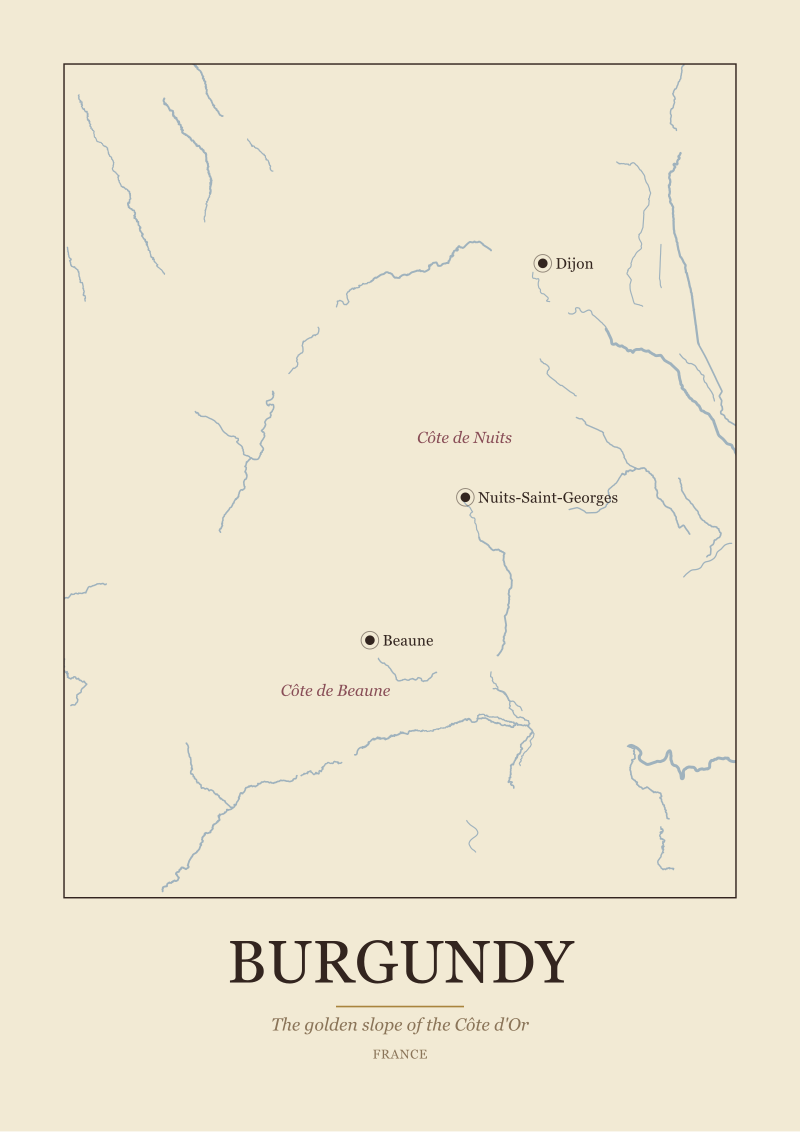 Burgundy
The print from this article · from €29.95
View the print →
Burgundy
The print from this article · from €29.95
View the print →
The River-Bend Pattern: Why the Best Slopes Sit Above a Curve
The third pattern is a favourite in this studio because you can see it on any decent river map before you know anything about wine at all. The best slopes tend to sit above the outside of a river bend. Look at the great regions of France and Portugal from above and it repeats like a signature.
Bordeaux is written along the meander system where the Garonne and the Dordogne pull apart and rejoin as the Gironde. The gravel terraces we have already mentioned — Médoc on one bank, Saint-Émilion and Pomerol on the other — are not scattered evenly along the water. They sit where the ancient river cut and re-cut its way through soft sediment, dropping gravel on the inside of some bends and lifting terraces above others. The two banks of Bordeaux are not two banks of a single line; they are two banks of a river that has been arguing with itself for a very long time, and the vineyards trace the record of that argument.
Burgundy is subtler because the great slope is not on the Saône itself but set back from it, on the western edge of the Saône plain. The river is the reason there is a plain at all; the plain is the reason there is a defined slope; the slope is the reason there is Burgundy. Beaune, Nuits-Saint-Georges and Dijon anchor the north-south spine of the Côte d'Or the way pins hold a hem. Every great village name — from the Côte de Nuits down through the Côte de Beaune — is a variation on the same geographic sentence: this village sits at the point where the slope meets the plain, and the vineyards climb from that hem into the hillside above.
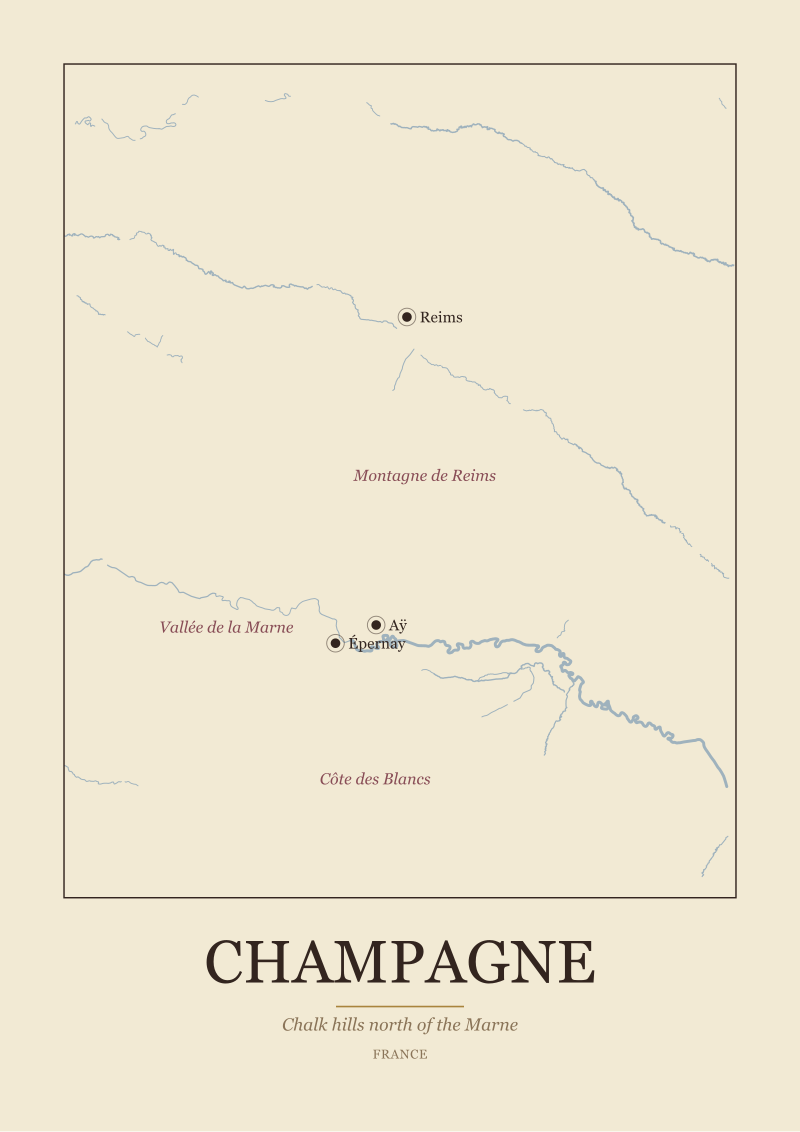
Champagne repeats the same reading with the Marne. The Vallée de la Marne runs along the river; the Montagne de Reims lifts above the northern side; the Côte des Blancs runs south from Épernay on ground that has been re-shaped by the same water system. Reims and Épernay are not accidentally the two anchor towns of Champagne. They sit where the geography is legible — where a river has laid out a plain, a hill has risen above it, and the chalk has come near enough to the surface to matter.
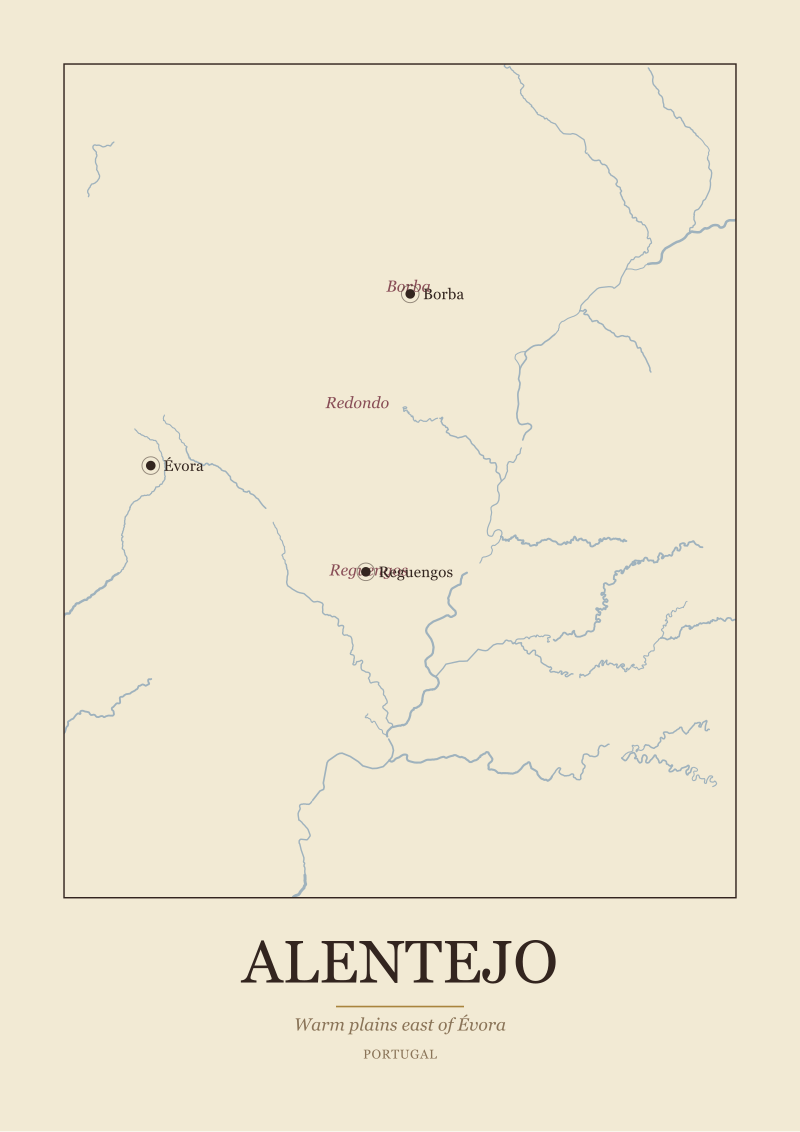
Alentejo shows the same pattern in a warmer key. The Guadiana runs south through the region on its way to the Atlantic, and the wine sub-zones — Borba, Redondo, Reguengos — are lifted off the river plain onto higher ground east and south of Évora. The relief is gentler than Burgundy or the Douro, but the instinct is identical: leave the flat by the water to the grain crops and the pasture, take the vine up onto the shoulder where the ground drains and the wind moves.
The Border Pattern: Why Appellation Lines Stop Where the Slope Stops
The fourth pattern is what the previous three add up to. If a wine region is really a piece of geography — a certain slope, a certain aspect, a certain drainage — then the human line that names it should stop where that geography stops. And when you draw the great European appellations on top of a topographic map, that is what you see.
The Côte d'Or is the clearest case. Its appellation boundary is not a diplomatic compromise; it is, near enough, the transition from slope to plain. Village-level Burgundy occupies the lower shoulder. Premier cru sits mid-slope. Grand cru sits on the narrow band of the best middle-slope, where the drainage, aspect and depth of soil align. Cross that upper line onto ground that is too high or too thin, and the appellation ends. Cross the lower line onto the plain, and it ends there too. The boundary is drawn by the hill, not by the town hall.
Bordeaux is harder to read at a glance because the terrain is gentler, but the same logic operates. The named communes of the Médoc — Pauillac, Saint-Julien, Margaux — sit on the gravel banks; the boundaries of the appellations follow the gravel more closely than they follow any road. Saint-Émilion's classified vineyards climb the limestone plateau above the town, not the alluvial ground below it. Graves takes its name and its identity from the ground itself. Sauternes concentrates in a specific pocket where autumn mist off the Ciron meets the warmth of the Garonne — a geographic event, not an administrative choice.
Champagne's boundary is the same story in chalk. The AOC map hugs the chalk hills — the Montagne de Reims, the Vallée de la Marne, the Côte des Blancs — and lets go where the chalk lets go. Alentejo is subtler again, its sub-zones softer at the edges, but the pattern still holds: Borba, Redondo and Reguengos are named for towns that anchor specific pieces of lifted ground, not for arbitrary polygons on the plain. When an appellation border feels arbitrary on the map, it usually means the geography under it is more interesting than a road map lets on. Read it against relief and rivers and it starts to click.
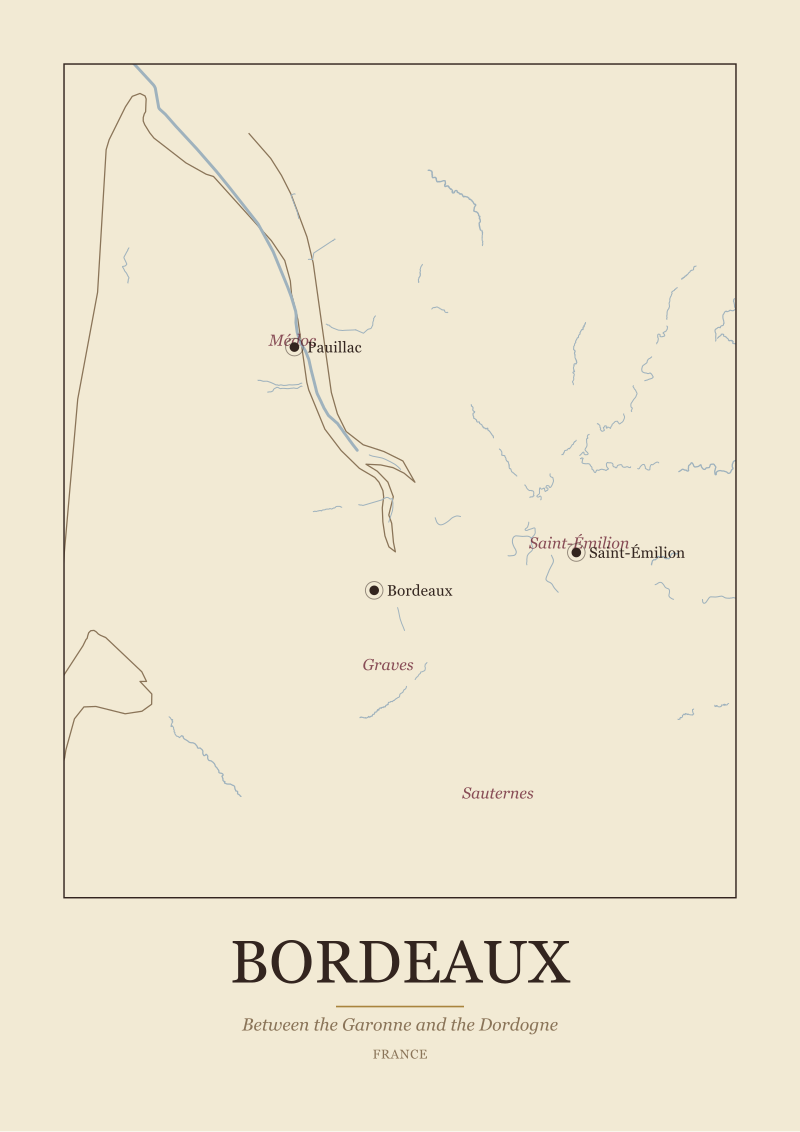 Bordeaux
The print from this article · from €29.95
View the print →
Bordeaux
The print from this article · from €29.95
View the print →
So What Do You Actually Do With This
If you take one thing from all this, take the habit of reading a wine region as a shape before reading it as a name. When you open a bottle from Burgundy or Champagne or Bordeaux or Alentejo, spend two minutes with a map of the region before you spend twenty minutes with the label. Find the river. Find the anchor towns — Beaune and Nuits-Saint-Georges, Reims and Épernay, Pauillac and Saint-Émilion, Évora and Borba. Find the slope between the river and the towns. The wine in the glass is a report from that specific ground, and the report reads more clearly when you know the ground.
If you visit, walk the hem where the plain meets the slope. In Burgundy, that hem is a road; you can drive it in an afternoon between Dijon and Beaune and read the entire Côte d'Or as a single, continuous geographic sentence. In Champagne, follow the Marne out of Épernay and watch the Montagne de Reims lift on your right. In Bordeaux, cross the Gironde and feel the gravel change underfoot between the estuary and the vines. In Alentejo, take the road east of Évora toward Borba and notice the moment the ground starts to lift. Every one of these regions is legible on foot in a way it will never be legible on a wine list.
And if what you want is to keep the region in the room after the bottle is gone, our whole studio is built around exactly that: maps of these regions drawn from real rivers, real coastlines, real relief, so the geography stays visible on the wall. You can see the shop at see the Burgundy print. But the deeper point survives without any object at all. Watch the slope. Watch where the vineyards stop and the plain begins. Watch which side of the river bend the great villages sit on. Watch where the appellation line follows the hill and where a road tries to override the hill and fails. Do that for a season and you will find you no longer need anyone to tell you why the wine tastes the way it does. The map has already told you.
New regions and 10% off your first print.
One email now with your code. No noise after.