Most books about Tuscan wine are books about how Tuscan wine tastes. Almost none of them are books about where Tuscan wine is.
Hear me out. Chianti is not a region in the way a first-time visitor thinks. It is a range of hills between two watersheds, sitting between Florence and Siena, and its western edge is defined less by a soil map than by where the Arno's tributaries stop reaching. Montalcino is not a village charmingly hidden in the Tuscan south; it is a hilltop south of the Ombrone, sixty-odd kilometres from the sea, that sits in its own rain shadow. Montepulciano is a ridge town further east, closer to the Val di Chiana. These are not aesthetic details. They are the reason the wines exist in the shapes they do. And most of the books we bought and read to prepare our first Tuscany map treated all of that as background scenery.
We are a map desk. We drew Tuscany before we wrote about it, and the process of drawing forced us to read what other people had written. What follows is not a list of great books. It is a ranking of how well the books we actually paid for treated the region as a place, rather than as a set of glasses.
The Best Books We Read Treated the Arno and the Ridges as the Protagonists
There is a small category of books on Italian wine — Burton Anderson's older work belongs here, Nicolas Belfrage's writing largely belongs here, Ian D'Agata's grape-first work belongs here in an odd sideways way — that understand a truth so basic it embarrasses us to name it. A wine region is a piece of geography before it is a category on a shelf. When these writers reach Tuscany they open the map first. They tell you Florence sits on the Arno; they tell you the Arno bends west toward Pisa and the sea; they tell you Chianti sits on the hills that separate the Arno drainage from the Ombrone drainage further south. They tell you Siena is not in Chianti — Siena is the southern anchor of Chianti, a walled city looking north toward the hills the wine is named after, and looking south toward a different country of wine entirely.
That last sentence is the one that changed how we thought about the map we were drawing. Once you place Siena at a hinge rather than a centre, the sub-zones stop looking like a bureaucratic list and start looking like a landscape. Chianti Classico occupies the core ridge between Florence and Siena. Chianti Rufina sits east of Florence, in the upper Arno. Montalcino sits well south of Siena, in a warmer, drier bowl. Montepulciano sits further east still, in a different valley system. The books that lead with this geography are the books we still keep on the desk. They gave us bones. Everything else was borrowed skeleton.
Kerin O'Keefe's book on Brunello di Montalcino belongs in this top tier for a slightly different reason. It is a monograph on one commune, but it takes seriously the question of why that commune produces the wine it does, which means it takes seriously altitude, exposure, and the peculiar climatic pocket that Montalcino sits inside. Not every page is geography. Enough of them are. When we drew Montalcino as a labelled point on our Tuscany print, we placed it where it belonged partly because O'Keefe made us understand that placement mattered.
These are the books that read Tuscany as a country of rivers and ridges before they read it as a country of wines. They earned their shelf space.
The Books We Regret Buying Substituted Adjective Parades for Any Sense of Where
Then there is the vast middle. We will not name the specific titles here, because the point is structural rather than personal, but the shape is unmistakable once you start looking for it. These are the books that tell you Chianti tastes of cherry and leather, that Brunello tastes of tobacco and dried rose, that Vino Nobile tastes of something adjacent to both — and then they stop. They tell you the same thing three chapters in a row, in slightly different words, and they never once tell you where any of it is.
We read one of these books cover to cover on a train from Florence to Milan. When we finished, we could not have drawn the boundary between Chianti Classico and Chianti Rufina if a customs officer had held a pen to our head. We knew every note that Chianti was allegedly supposed to smell of. We could not have told you which side of the Arno either of them was on. The book was not badly written. It was not lying. It was doing exactly what its category rewards writers for doing, which is producing sentences that read well next to a glass. It is just that reading them next to a map produced almost nothing at all.
The failure mode is not that these books are wrong. It is that they treat geography as furniture. The town names appear. The word "hills" appears. The word "sun-drenched" appears far more often than it should. But you would learn more about Tuscany from ten minutes with a good relief map than from three hundred pages of prose that never quite touches the ground. When we sat down to draw the wine subzones, we found ourselves closing these books and opening topographic surveys instead. That, in retrospect, was the review.
We are not against tasting notes. We are against them arriving unaccompanied. A tasting note without a coordinate is a rumour. A tasting note attached to a slope, a river bend, a town on a ridge — that is a piece of geography arriving through the palate. Very few of these middle-tier books ever bothered with the second version, and it is why they sit at the bottom of the pile now, in a box, near the door.
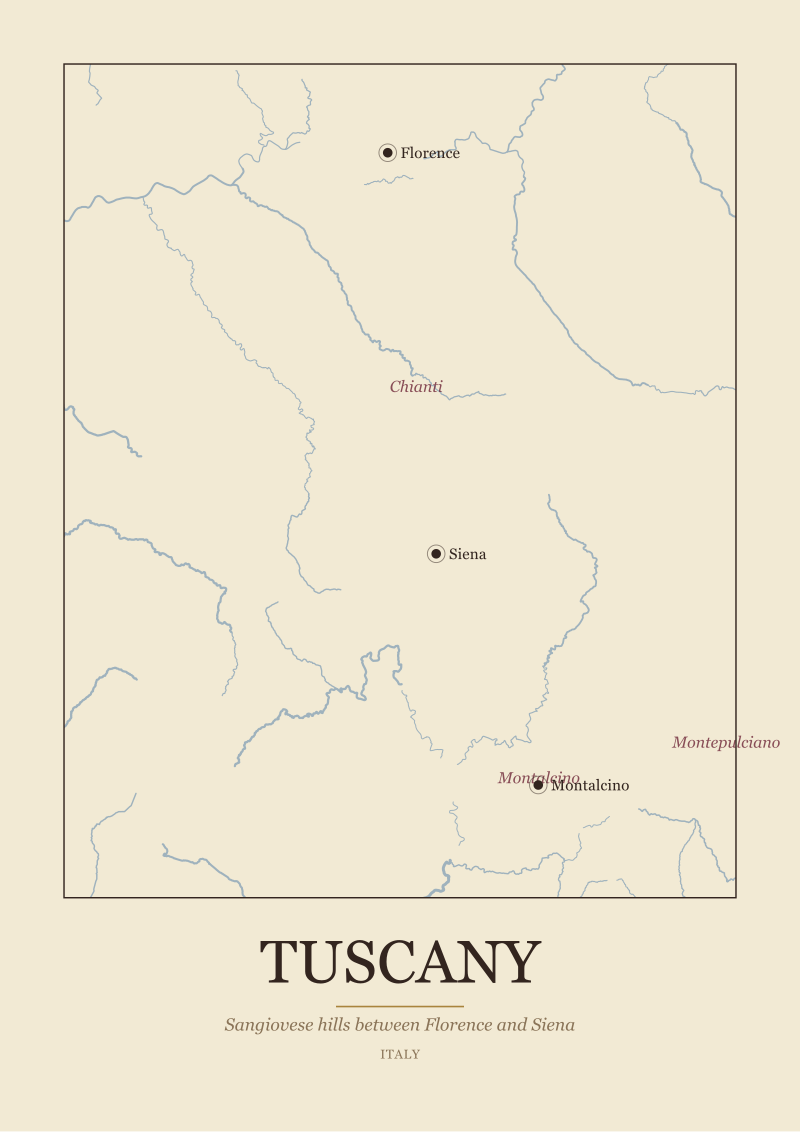 Tuscany
The print from this article · from €29.95
View the print →
Tuscany
The print from this article · from €29.95
View the print →
The One Book We Wish Someone Would Write Would Open With a Contour Line
The book we wanted while we drew Tuscany does not, as far as we can tell, exist yet. It would open with the Arno — where it rises, where it bends, where it reaches the sea. It would sketch the Apennine spine that runs behind Florence and casts a rain shadow south and west. It would explain that the Chianti hills are not just any hills but the specific ridge system that divides the Arno basin from the basins that drain toward Grosseto. It would place Florence, Siena, and Montalcino on that ridge system and then, and only then, would it start talking about Sangiovese.
Sangiovese, in that imagined book, would enter as a consequence rather than as a subject. It is the grape that suits these hills because these hills have the altitude, the diurnal swing, and the exposure that a late-ripening, thin-skinned red grape needs to survive without cooking. The book would explain that Montalcino is warmer and drier than Chianti Classico because it is further south and further from the Apennine rain, and that this is why a wine grown there tends to be built differently even though it is the same grape family. It would show, on a map, why Chianti Rufina in the upper Arno feels different from Chianti Classico in the ridge core — the same grape, a different piece of ground.
It would spend a chapter on what an appellation border actually is: a legal line drawn on top of a geographic argument, sometimes accurately, sometimes politically, occasionally in defiance of the slope it claims to describe. It would treat the towns — Florence, Siena, Montalcino, and the smaller anchor towns that hang between them — as the punctuation of the region, not its decoration. And it would, at some point, admit its limits: that some questions about Tuscan wine are questions of soil chemistry that a geographer cannot honestly answer, and some questions are questions of history that a soil scientist cannot answer either.
We have not written that book. We are not going to write that book. We drew a map instead, which is another way of making the same argument. If you want to see it, it lives at our shop.
This piece started as a straightforward book recommendation and turned into a complaint about a genre. What it does not cover: it does not review any specific tasting-note book by name, because we would rather be honest about a pattern than unfair to a single author; it does not attempt to settle whether Brunello or Chianti Classico is the "better" Tuscan wine, because that is a question the geography cannot answer and neither can we; and it does not address the modern politics of appellation boundaries in Tuscany, which have shifted enough in the last two decades that we would rather stay quiet than pretend to authority. Each of those is a separate argument, and each of them deserves its own map.
FAQ
What are the main sub-zones of Tuscan wine that a geographer should know?
Three sit at the front of any honest geographic reading. Chianti occupies the hills between Florence and Siena, with Chianti Classico as its ridge core. Montalcino sits well south of Siena on its own hilltop, in a warmer, drier climate. Montepulciano sits further east, in the Val di Chiana. Each has a distinct altitude, exposure, and relationship to the surrounding river systems, and the wines take their shape from those differences more than from any human intention.
Which river defines Tuscany's wine geography?
The Arno. It rises in the Apennines, runs through Florence, and bends west toward Pisa and the sea. The Chianti hills sit south of Florence in the Arno basin's southern edge, forming the ridge that separates the Arno's drainage from the basins that flow further south. Montalcino, further south again, sits outside the Arno system entirely, closer to the Ombrone. Reading Tuscany without the Arno as a reference point is possible but unnecessarily hard.
Is Chianti a town, a region, or a wine?
All three, in that order historically, and this is the source of most confusion. Chianti began as the name of a hill area between Florence and Siena, then attached to the wine grown there, and eventually became a legal appellation that stretched well beyond the original hills. The historic core is now Chianti Classico. When a book uses "Chianti" without specifying which of the three meanings it wants, you can usually assume it means the wine, and often it means the wine broadly rather than the ridge specifically.
Why does Montalcino produce different wine from Chianti if it is the same grape family?
Because the ground and the climate are different. Montalcino sits south of Siena at a lower latitude relative to Chianti Classico's ridge, and it sits in a drier pocket shielded from some of the weather that reaches the Chianti hills. The same Sangiovese family responds to warmer, drier ground by producing a heavier wine with different structural bones. This is the whole argument for treating wine geography as geography — the grape is a constant; the place is not.
Are there any books on Tuscan wine that treat geography seriously?
Yes, though they are a minority. The older writing of Burton Anderson, the Italian-focused work of Nicolas Belfrage, Ian D'Agata's grape-centred writing, and Kerin O'Keefe's monograph on Brunello di Montalcino all give geography real weight. None of them are pure geography books, and none of them will replace a topographic map, but they read Tuscany as a piece of ground before they read it as a piece of shelf. That is more than most.
Where does Florence fit in the wine geography of Tuscany?
Florence is the northern anchor of the region and sits on the Arno itself, not in any wine sub-zone. It is upstream of the confluences that shape the western Tuscan landscape and looks south across the Chianti hills toward Siena. Historically, Florence's commerce shaped which wines travelled and which stayed local, so its role in Tuscan wine is less about production than about market and boundary. On any wine map of Tuscany, Florence is a hinge rather than a centre.
Is the Chianti Classico boundary a geographic line or a political one?
It is both, which is why it is complicated. The Chianti Classico area corresponds broadly to the original historic Chianti hills between Florence and Siena, which are a real geographic feature. But the exact legal boundary that separates Chianti Classico from the wider Chianti appellation is a drawn line, negotiated over time, and it does not always follow a ridge or a valley cleanly. Reading the boundary as pure geography flatters the mapmakers; reading it as pure politics flatters no one.
What is the honest limit of what a wine map can tell you about Tuscany?
A wine map is a claim about place. It can show you where a region sits, which river it drains toward, which towns anchor it, and where its recognised boundaries fall. It cannot tell you what a specific wine tastes like, whether a specific producer is worth your attention, or how a boundary will shift in ten years. Our own Tuscany map is a geography argument, not a shopping list, and we would rather it be trusted for the first thing than misused for the second.
New regions and 10% off your first print.
One email now with your code. No noise after.