I spent an afternoon in early December reading forty-seven gift guides for wine lovers who have everything. The exact number matters less than the pattern: by page thirty-two I could predict the next entry before scrolling. Electric decanter. Coravin. Aerator pen. A silicone something. A subscription box. A pair of Zalto glasses photographed against a slate background. By guide forty, I was reading the same three hundred products in shuffled order, and by guide forty-seven I understood why every list arrives at the same place. They are all written from the same brief, and the brief is not about wine.
We publish a small studio that draws Europe's wine regions from real geography — the Guadiana threading east of Évora through the plains of Alentejo, the Marne cutting across Champagne's chalk hills, the Saône shouldering the golden slope of the Côte d'Or. So we read these guides differently than a lifestyle editor might. What we notice is not what is in them but what is not: no rivers, no towns, no borders, no slope. A gift guide for someone who genuinely loves wine ends up recommending everything about wine except the thing that made the wine.
What They All Get Wrong
The shared error is subtle enough that it takes several dozen guides to see it. Every list treats wine as a hobby of consumption. The gift, in this frame, is always an object that helps you drink more efficiently, more theatrically, or more expensively. A better pour. A better glass. A better way to preserve the bottle you did not finish. The reader who loves wine is imagined as someone whose relationship to the subject is mediated entirely through the moment of tasting.
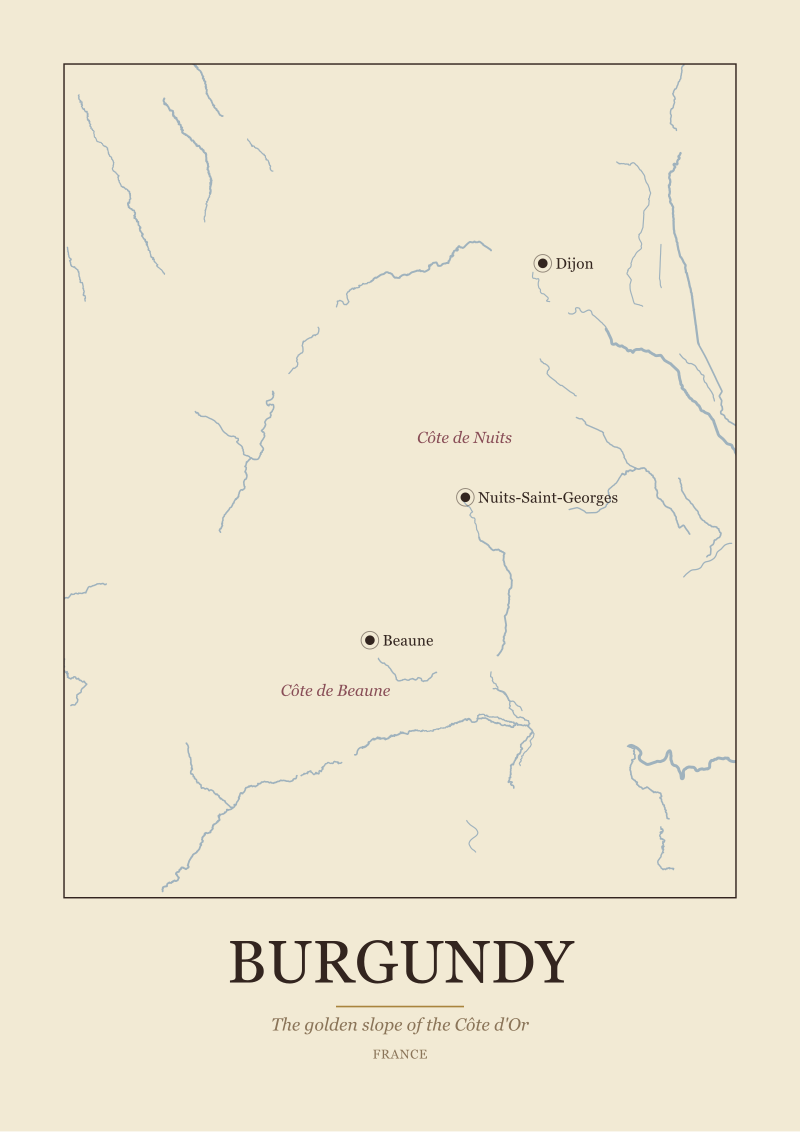
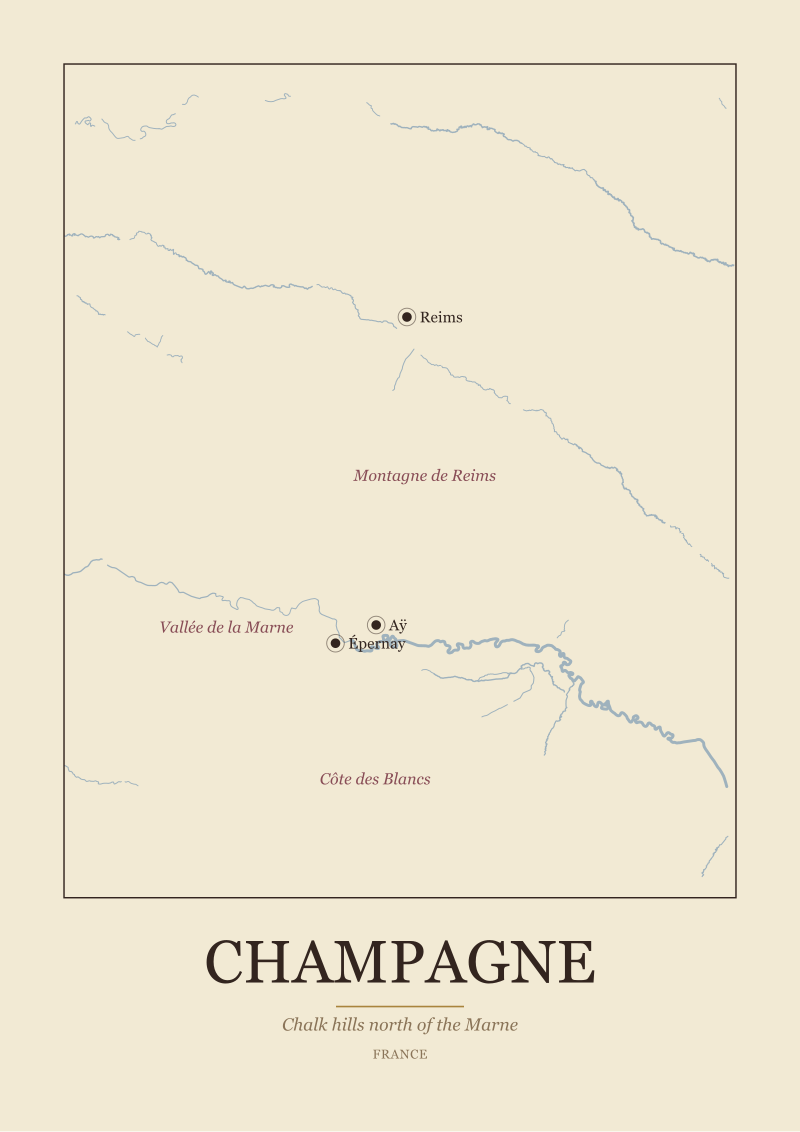
But anyone who has followed wine for more than five years is not, at that point, primarily excited about tasting. They have tasted enough. What sustains a long affection for wine is something else: the slow accumulation of place. They read about the Médoc and eventually they want to know why the Left Bank of the Garonne is Cabernet country while the Right Bank leans Merlot. They drink a Nuits-Saint-Georges and eventually they want to see where Nuits-Saint-Georges sits relative to Beaune, and why the slope of the Côte d'Or faces the direction it does. They read about Champagne long enough that they realise the chalk hills north of the Marne are not a metaphor. They are a specific geographic feature that runs from Reims down past Épernay through Aÿ.
This is the reader the gift guides do not see. The guides assume the wine lover is still in the acquisition phase — of tools, of accessories, of vintages, of scoring vocabulary. They are not writing for the reader who has been there for a decade and whose curiosity has migrated from bottle to region. That reader owns the Coravin already. They received the Zalto glasses in 2019. They tried the subscription box and cancelled it after four months because the notes were formulaic. What that reader now wants — and cannot easily articulate to a gift-giving spouse or friend — is context. Geography. A way to see the thing whole.
There is a second error that follows from the first. Because the guides frame wine as consumption, they frame the gift as something used and then put away. The decanter goes in a cupboard. The book of tasting notes closes. The bottle empties. Nothing about the gift persists in the recipient's daily life. A wine lover who has everything does not need one more object that lives in a drawer. That, structurally, is the miss.
What Is Almost Always Missing
What none of the forty-seven guides mention — not one — is the wall. The daily surface of the recipient's home. The place where a gift lives not as an event but as an ambient presence. When we started drawing regions at the studio, this was the first thing we noticed about people who genuinely love wine: their kitchens and dining rooms already contain the regions they love. There is a bottle of Alentejo tinto standing empty on a shelf because the label is beautiful. There is a coaster from a Burgundy trip in 2017. There is a photograph, badly framed, from a summer in Reims. The recipient is already trying to keep the geography in view. The guides just don't see it.
What is also missing is any acknowledgement that a wine lover's affection has a shape. It is regional. Someone who loves wine does not love wine as a category — they love Piedmont, or Priorat, or the Douro, or a specific bend of the Mosel. Their relationship to the subject is spatial. It has coordinates. A gift that engages that specific spatial affection is doing something no accessory can do. The Coravin does not know whether you drink Bordeaux or Beaujolais. A map of the Médoc does. The map says: I noticed which region you actually love. I noticed you kept returning to Pauillac in conversation. I noticed you have talked about the Garonne twice this year.
There is a further miss, which is that gift guides never distinguish between a wine lover who tastes and a wine lover who travels. These are increasingly different populations. The reader who has everything has usually been somewhere. They have walked the vineyard walls behind Saint-Émilion, driven the ridge road above Beaune, taken a slow train through the Marne valley in July. The geography is not abstract for them. It is a set of memories with rivers running through it. The gift that acknowledges that memory outperforms the gift that offers a new object.
None of this appears in the standard guide because the standard guide is written to move product. It is optimised for click-through and affiliate revenue. Geography is not a category the affiliate networks pay out on. Rivers do not have SKUs. Slopes do not have discount codes. So the entire spatial layer of what wine actually is — the layer that keeps people interested for thirty years — never makes it into the recommendation.
 Burgundy
The print from this article · from €29.95
View the print →
Burgundy
The print from this article · from €29.95
View the print →
What I Would Say Instead
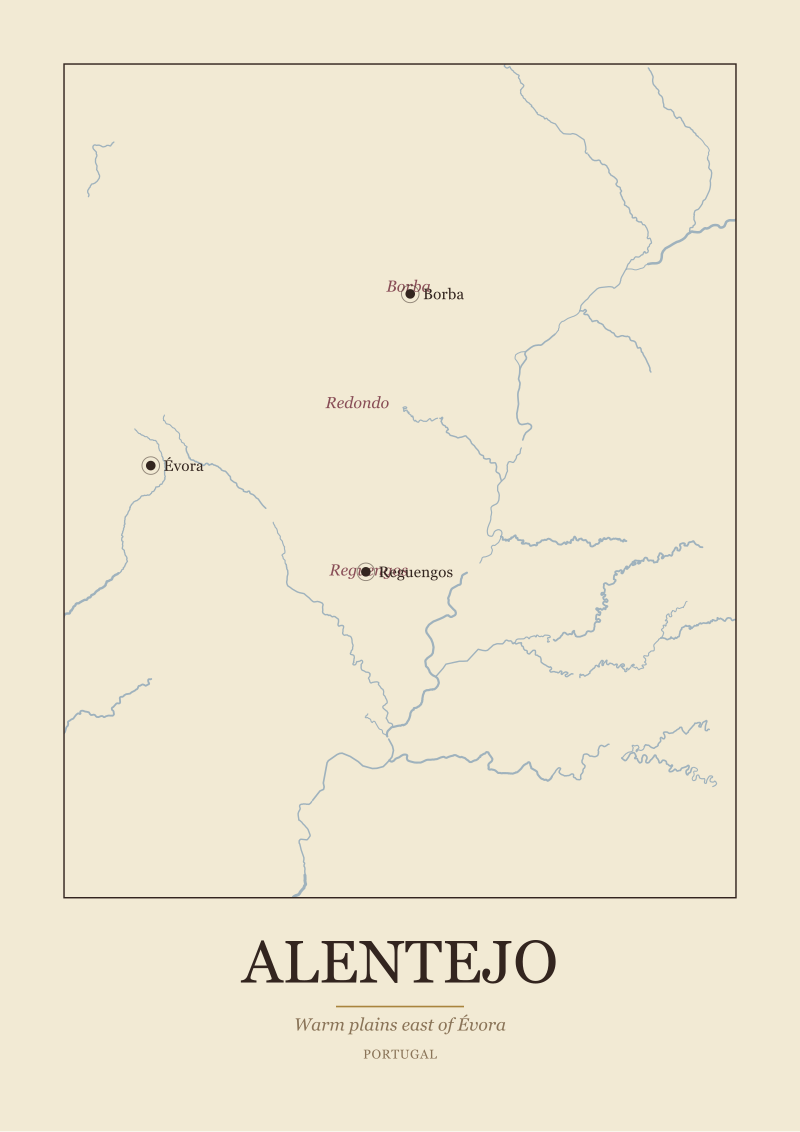
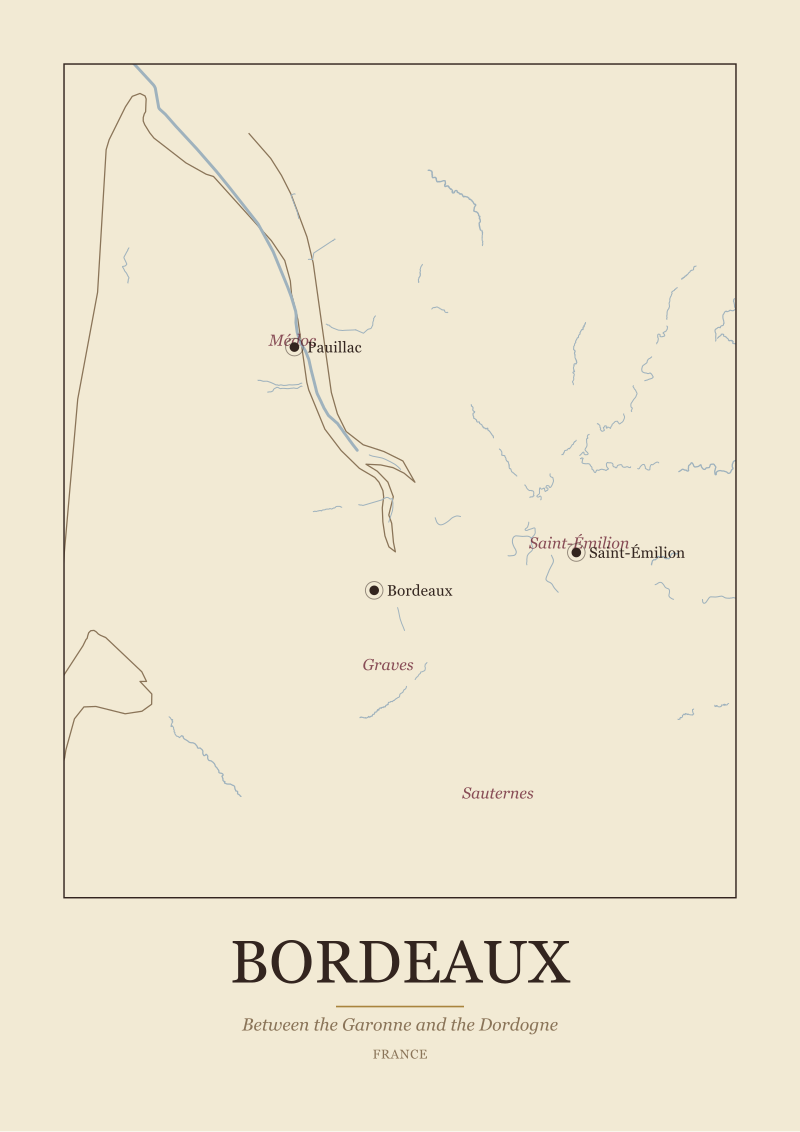
If someone asked us at the studio what to give a wine lover who has everything, we would say: give them the region they have loved for the longest time, drawn as geography rather than illustration. Not a decorative wine-country print with cursive typography and a rooster. A real map — the river in the right place, the anchor towns where they actually sit, the sub-zones drawn from the actual borders. The Guadiana threading east of Évora with Borba, Redondo, and Reguengos where they belong. The Garonne and the Dordogne with Bordeaux, Saint-Émilion, and Pauillac plotted honestly, the Médoc a long peninsula rather than a decorative flourish. The Saône shouldering the Côte de Nuits and the Côte de Beaune, Dijon at the top, Nuits-Saint-Georges in the middle, Beaune below. The Marne cutting through Reims, Épernay, and Aÿ, the Montagne de Reims above, the Côte des Blancs to the south.
This is a gift that does several things the accessories cannot. It stays on the wall. It rewards knowledge that grew slowly — every time the recipient's eye lands on it, they see one more thing they now understand. The relationship between Pauillac and the gravel of the Médoc. The way Saint-Émilion sits on limestone across the Dordogne from the gravel banks of the Left Bank. Why the chalk of the Côte des Blancs produces the Champagne it does. The map becomes a piece of furniture that keeps teaching. Nothing in the accessory category does that.
It is also a gift that acknowledges the recipient's specificity. The wine lover who has everything has usually settled, over years, into a favourite region — a corner of the map that has meant something. Giving them that region, rendered honestly, is closer to what they actually want than any generic wine object. It reads as: I noticed. I paid attention to what you kept coming back to. That is what a real gift does.
We publish these maps at see the Burgundy print because the studio was founded specifically to fill this gap. We noticed years ago that the wine lovers we knew already owned the accessories and the books and the glasses, and what they did not have was the geography of their own affection, drawn with the fidelity a serious wine reader deserves. That is the entire premise. That is the only commercial mention this article contains.
Which returns us to the question the gift guides never quite ask: what does someone who has been reading, drinking, and travelling through wine for twenty years actually still want? The accessories phase is over. The tasting-note phase is over. What remains is a slow-burning geographic curiosity the person themselves would struggle to articulate, and which no algorithmic list will surface. That is where the real conversation about gifts for a wine lover begins, and it is not where the standard guide ends.
FAQ
What actually distinguishes a real wine region map from a decorative wine country print?
A real region map places the river, the anchor towns, and the sub-zones where they geographically are. The Guadiana threads east of Évora with Borba, Redondo, and Reguengos plotted honestly. The decorative version tends to fill space with grape clusters, cursive typography, and vaguely positioned illustrations that do not correspond to the actual terrain. A serious wine reader can tell the difference at a glance, because the geography is either right or it is not.
How do I choose which region the recipient would actually want?
Listen to what they mention. If they keep returning to the Médoc in conversation, that is the answer. If they came back from a trip to Beaune still describing the slope, that is the answer. A wine lover with everything has usually settled into a favourite corner over years. That corner is the gift. Do not pick the region you think is impressive — pick the one they themselves keep circling back to when they talk.
Are these maps geographically accurate enough for a reader who knows the region?
Yes — that is the entire premise of the studio. Our maps are drawn from public-domain geographic sources: Natural Earth 1:10m rivers and coastline data. The Garonne runs where the Garonne runs. Saint-Émilion sits where Saint-Émilion sits. The Côte de Nuits and the Côte de Beaune are placed against the Saône as they are in life. A reader who has visited the region should recognise it without effort or forgiveness.
What if the recipient's favourite region sits outside the classic French and Portuguese appellations?
The same geographic logic applies to any wine region drawn from real cartography. What matters is that the map is honest — the river in the right place, the anchor towns where they actually sit, the sub-zones plotted from real borders rather than aesthetic guesswork. The specific region matters less than the fidelity of its rendering. A wine reader can spot invented geography instantly, and no thoughtful gift should require them to overlook it.
Is a wine region map appropriate for someone fairly new to wine?
It can be, though the gift lands hardest with the reader who already knows the region. The map rewards accumulated knowledge — every glance surfaces one more sub-zone the reader now recognises. For a newer wine lover, a book about the region often precedes the map. But for the reader who has everything and has been reading for years, the map is the natural next surface: geography they can live with rather than shelve.
Why give a map rather than another book about the same region?
Books close. Maps stay open. A book about Burgundy gets read once and then joins the shelf; a good map of Burgundy sits on the wall and keeps rewarding the recipient for as long as they keep thinking about Burgundy. That is a decade or more. The daily-surface presence is the point — the gift does not have to be picked up to do its work. It is doing it every time the recipient walks into the room.
 Champagne
The print from this article · from €29.95
View the print →
Champagne
The print from this article · from €29.95
View the print →
New regions and 10% off your first print.
One email now with your code. No noise after.