I spent three weeks in January re-reading four years of this desk's archived copy against Natural Earth's public-domain river data and the appellation shape files any cartographer can pull down for free. What began as a routine fact-check ended, by day nine, as a postmortem.
For a reader trying to understand why one hillside makes wine that another hillside a kilometre away cannot, terroir is geography — and nothing else. The likely objection is that geography sounds too clinical for something that arrives in a glass looking like poetry. We will defend the position across four sections drawn from four specific errors in our own archive: Champagne, Burgundy, Bordeaux, and Alentejo.
The strongest case for the mystical framing runs like this: experienced tasters routinely identify wines by origin blind, and no soil map has ever fully modelled that skill. Fair. But the skill is geography read backwards through the glass — the chalk-drained water, the east-facing morning sun, the ocean's distance — not the detection of spirits. Mystical vocabulary dresses a measurable fact in worse clothes. Every time we reached for that vocabulary, we were papering over a geographic fact we had not yet located on the map.
The First Mistake: We Called Champagne "Magical Chalk" Without Naming the Formation
In an archived essay from March 2023, this desk wrote that "Champagne's chalk gives the region its soul." Reading it back this January, we could not have written a less useful sentence.
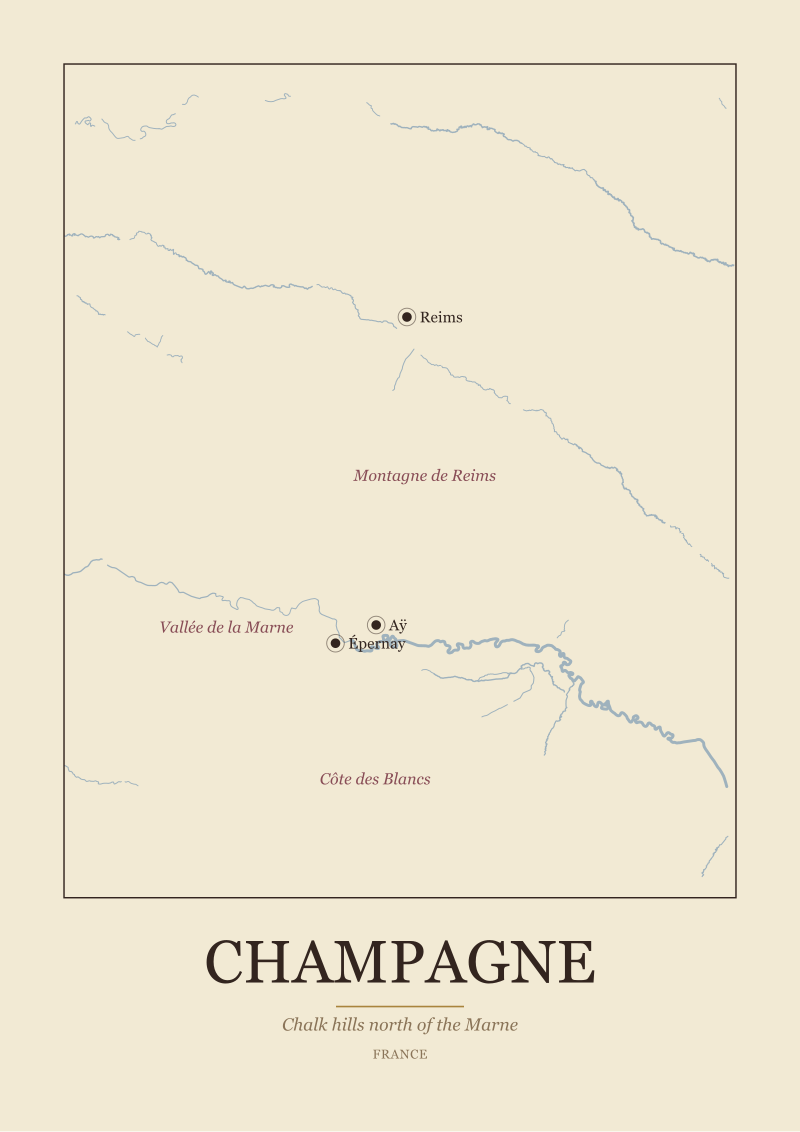
Champagne sits on chalk hills north of the Marne. That is what the maps show, and it is what the region is: a specific geological formation with three sub-zones — Montagne de Reims, Vallée de la Marne, Côte des Blancs — each anchored on the same Cretaceous bedrock, each behaving differently because the chalk sits at different depths beneath different aspects. The chalk drains water. It holds warmth at depth into autumn. It reflects light back at grapes that would otherwise struggle to ripen this far north.
When we wrote "gives the region its soul", we were writing, without knowing it, about drainage and thermal mass. The soul was hydrogeology. The actionable rule that came out of that postmortem: any time the copy reaches for a spiritual noun — soul, essence, spirit — stop. Find the geological or hydrological fact it is standing in for. Write that instead.
Reims and Épernay sit where they sit because they are the towns the growers built at the base of the slopes. Aÿ is a specific village on a specific bend of the Marne. There is no magic in that geography. There is only geography, and it is enough.
The Second Mistake: We Praised Burgundy's "Blessing" Without Naming the Slope
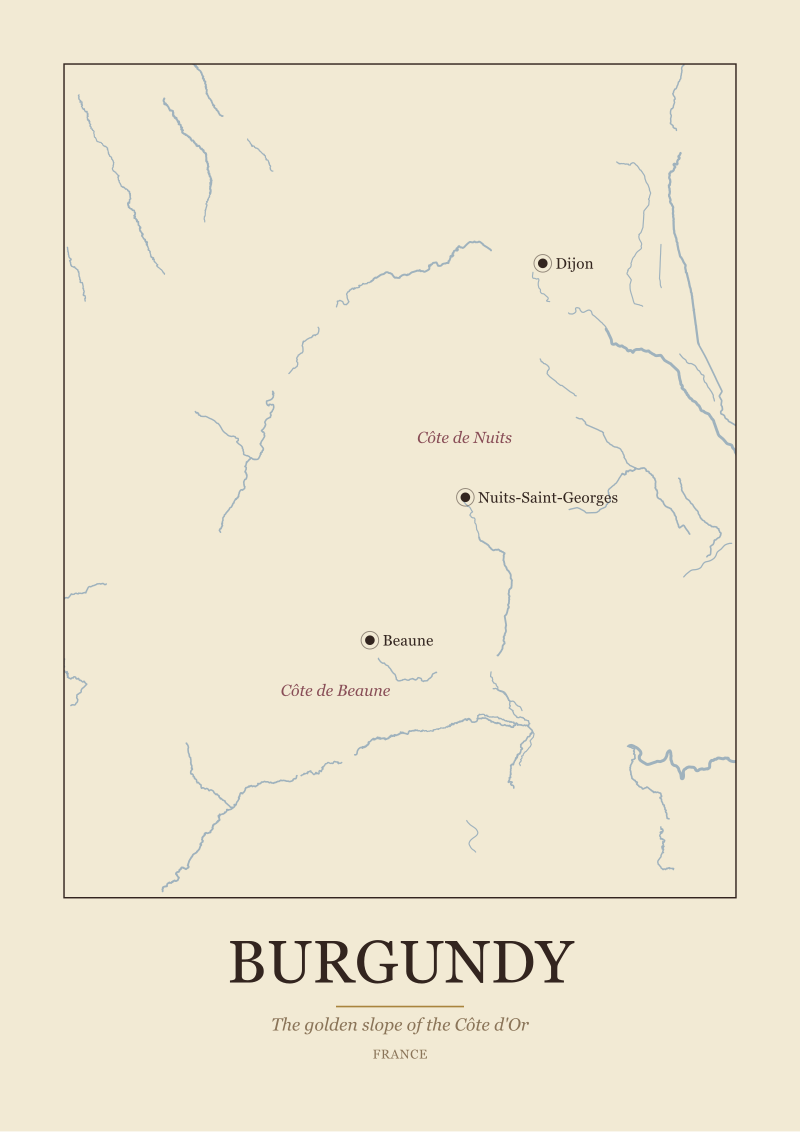
The Côte d'Or is a west-side escarpment above the Saône valley. It faces east. The best sites cluster at a mid-slope band high enough to drain cold air downhill on frost nights, low enough to catch the sun before humidity settles. Two sub-zones: Côte de Nuits, running south from Dijon; Côte de Beaune below it.
A piece we ran in 2022 described Nuits-Saint-Georges as "favoured by an old, quiet blessing". That was the sentence that first made an intern email in to ask what, specifically, the blessing was. We did not have an answer. Going back to the map, the answer was straightforward and unmystical: Nuits-Saint-Georges sits on the east-facing mid-slope of a limestone escarpment above the Saône, at an altitude that keeps the vines above the valley-floor frost pocket and below the exposed hilltop. Dijon marks the northern edge, Beaune the pivot, and the whole strip is oriented so that the sun hits the vine before the dew burns off — which is exactly what wine grapes need at this latitude.
The revised rule: when writing about Burgundy, name the slope. Say which direction it faces. Say what is above it and what is below it. If we cannot say those three things, we do not understand the site well enough to publish.
 Alentejo
The print from this article · from €29.95
View the print →
Alentejo
The print from this article · from €29.95
View the print →
A Field Guide to the Language We Should Have Used
The table below is what our archive would have looked like if we had done the geography before we reached for the vocabulary.
| Region | Main river | Geographic anchor | What "magic" was hiding |
|---|---|---|---|
| Champagne | Marne | Chalk hills north of the river | Cretaceous chalk depth and drainage |
| Burgundy | Saône | East-facing Côte d'Or escarpment | Slope aspect and mid-slope altitude |
| Bordeaux | Garonne | Between the Garonne and the Dordogne | Which bank — gravel or clay — you stand on |
| Alentejo | Guadiana | Warm plains east of Évora | Distance from the Atlantic in kilometres |
Every one of those third-column phrases is what the "magic" formulation used to be. Every one is the thing we should have written first.
The Third Mistake: We Wrote "Left Bank" as a Style When It Is a Substrate
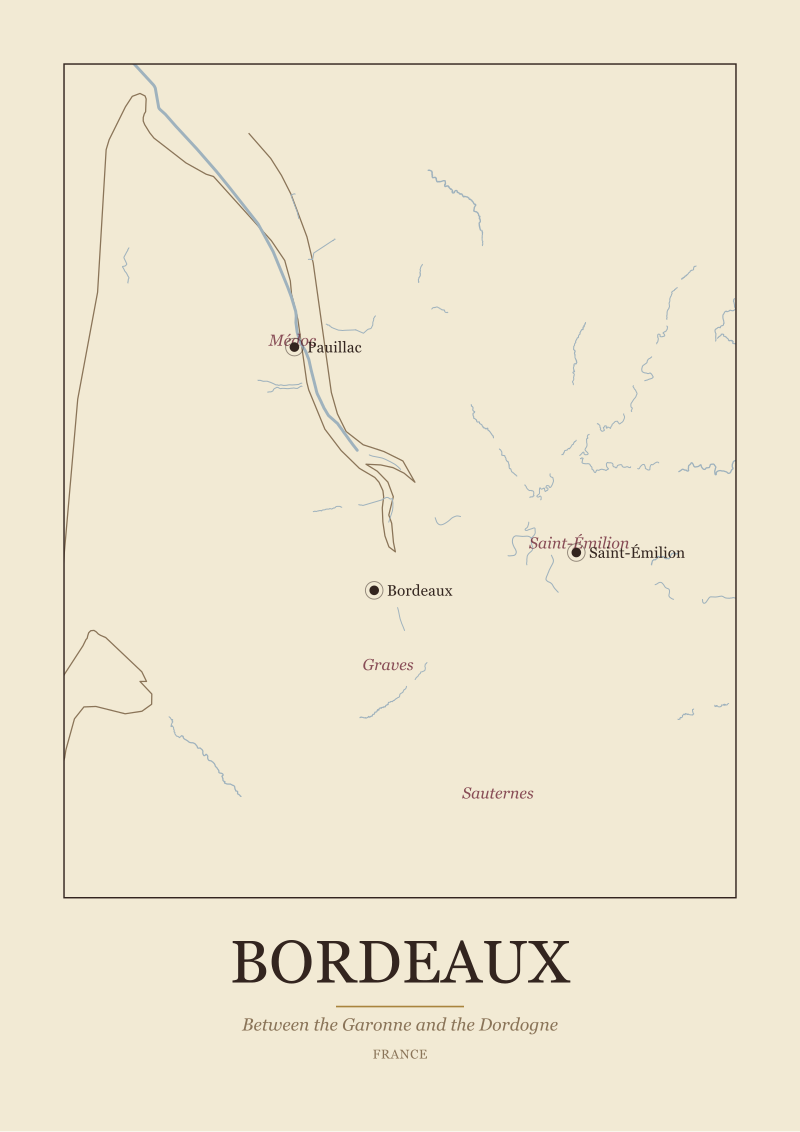
Bordeaux lies between the Garonne and the Dordogne. The Left Bank of the estuary — Médoc running north from the city, Graves running south, Sauternes further south still — is dominated by gravel carried down by Pyrenean and Massif Central rivers across the last two million years. The Right Bank, where Saint-Émilion sits, is clay-limestone.
For most of 2024 this desk used "Left Bank" as a shorthand for a certain kind of wine and a certain kind of prestige. That is affiliate-blog framing dressed as authority. Left Bank is not a style. It is a substrate. Gravel drains water and reflects heat, which is why Cabernet Sauvignon ripens there and why the medieval towns of Pauillac and its neighbours grew where they grew. The Right Bank's clay holds moisture, which is why Merlot became the anchor grape around Saint-Émilion.
The revised rule from the postmortem: never use a bank name as a stylistic label. Name the rock. If we do not know which rock, open the appellation shape file and find out. The estuary is not a metaphor; it is a river system with two different rocks on either side, and the wines follow from that.
 Champagne
The print from this article · from €29.95
View the print →
Champagne
The print from this article · from €29.95
View the print →
The Fourth Mistake: Alentejo's "Portuguese Sun" Was a Distance Measurement All Along
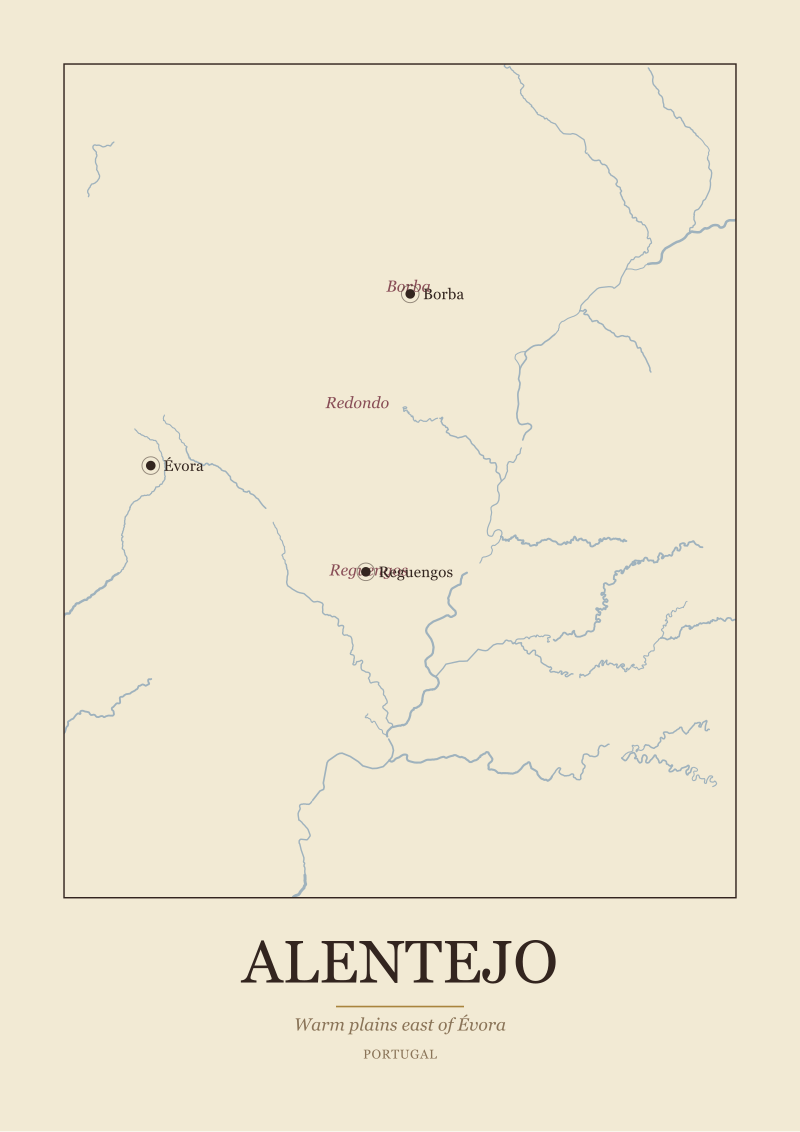
Alentejo lies east of Évora, on plains drained by the Guadiana river system. Reguengos and Borba mark sub-zones inside it. It is warm because it is inland — roughly two hundred kilometres from the Atlantic, far enough that oceanic moderation drops out and the continental climate takes over.
An essay from November 2023 described "the Portuguese sun blessing the plains of Alentejo". The sentence was pretty. It was also, functionally, a bad map. The Portuguese sun also blesses Vinho Verde, and Vinho Verde reads as nothing like Alentejo. What was actually being described was distance from the ocean. Alentejo is what you get when you take Portugal, walk two hundred kilometres east from the Atlantic coast, and stop where the ocean no longer cools the afternoons.
The correction: replace "sun" with the specific geographic fact. In Alentejo's case, that is the distance measurement and the Guadiana anchoring the eastern edge. Évora is not blessed. Évora is inland.
What You Should Actually Do When You Read Wine Writing
For readers who want to hold wine writing accountable, four signals separate the geographic writers from the mystical ones — the same four this desk now uses on every draft before it leaves the room.
Watch first for the river. If a region is discussed for four paragraphs without its main river being named, the writer has not looked at the map. Marne for Champagne, Saône for Burgundy, Garonne for Bordeaux, Guadiana for Alentejo. The river tells you where the towns are and where the vines can be. Watch second for the sub-zone treatment: if Montagne de Reims, Côte des Blancs, Médoc or Reguengos are named as marketing labels rather than as geographic boundaries with borders you could walk, the writer is trusting the reader's laziness. Sub-zones are lines on the ground. They exist because something changes across them.
Watch third for the substrate noun. Chalk, gravel, clay, schist, granite — when these appear as decorative words rather than as formations with measurable depth and drainage behaviour, the writer is decorating rather than mapping. Watch fourth for what happens at the appellation border. A writer who treats the border as a magic line has not asked the geographic question. A writer who tells you what shifts across it — the aspect, the substrate, the altitude, the river's distance — has done the work. That is the entire test. We draw these regions at our shop because the argument for geography-not-magic is easier to make when the geography is hanging on the wall.
FAQ
If terroir is only geography, why can experienced tasters identify origins blind?
Because they are reading geography through the glass. A taster who names a wine as coming from the Côte de Nuits is detecting the signature of an east-facing limestone mid-slope above the Saône valley — drainage, aspect, mineral chemistry — assembled in the fermenter and remembered against thousands of prior comparisons. The skill is real. Its object is measurable. Nothing mystical is required to explain it.
Does this mean climate does not matter, only rocks and rivers?
Climate matters enormously — but climate is itself a geographic fact. Champagne is cool because it sits far north. Alentejo is hot because it sits far from the Atlantic. Bordeaux is temperate because the Gironde estuary buffers it. Every climate statement about a wine region resolves, if you push on it, into a statement about latitude, altitude, or distance from a large body of water. Climate is what geography does over time.
Is this desk saying famous producers do not add anything?
No. Human decisions — where to plant, which grape, when to pick, how to ferment — are decisive at the winemaking layer. What this desk objects to is the language that credits those decisions to a mystical spirit-of-place. The producer is doing craft on top of geography. Both are real. Neither is magic, and it helps nobody to conflate the two.
Why does this article not recommend specific bottles or producers to try?
Because we are a wine geography studio, not a wine shop. Our commercial destination is a print of the map itself, not a bottle. Producer names appear in our writing only as historical or geographic fact — the town they are based in, the sub-zone they work in — never as buying recommendations. Anyone selling you bottles at the end of a terroir essay is selling something other than the geography.
How can a reader check whether a wine writer is doing the geography or faking it?
Look at the article's nouns. If the main river appears in the first three paragraphs, if sub-zone names are treated as boundaries rather than labels, and if the substrate is named with a formation rather than an adjective, the writer is doing the work. If the paragraphs are dominated by spirit-of-place vocabulary and the actual river never appears, the writer is decorating. It is a surprisingly reliable test.
What is the difference between a sub-zone and an appellation?
A sub-zone is a geographic sub-division inside a larger region. An appellation is the legal boundary drawn around a sub-zone, or a full region, that regulates what may be labelled from there. Sub-zones exist because geography changes; appellations exist because someone drew the change onto a map and got it into law. The best appellations follow the geography. The worst are political compromises stretched over unmatched ground.
Where does the "spirit of place" language come from historically?
It is largely a nineteenth and twentieth century marketing overlay on top of much older geographic knowledge. Growers in Burgundy in the fourteenth century already knew, in practical language, which slopes ripened first and which stayed frosty; they simply did not call it mysticism. The romantic vocabulary arrived later, when regions began exporting to markets that could not visit the maps themselves — and needed a story a stranger could carry.
New regions and 10% off your first print.
One email now with your code. No noise after.