Santorini is the wine world's favourite volcanic postcard. The caldera photographs itself. The vines coil on the ground like rope. Every wine list in Athens seems to carry an Assyrtiko now, and every sommelier reaches for the same word: minerality, from the ash. It is a tidy story, and most of it is even true. The island did erupt catastrophically around 1600 BCE. The soil is genuinely volcanic. The wines do taste like nothing else in Greece. But spend a week reading the island as geography rather than as geology, and a different explanation starts to surface — one the marketing rarely tells.
The Conventional Wisdom: Volcanic Soil Makes Great Wine
Ask ten sommeliers what makes Santorini special and nine of them will say the same word before you finish the question. Volcanic. The story goes like this. Somewhere around 1600 BCE, the island then called Thera detonated in one of the largest eruptions of the Holocene. The centre of the island collapsed into the sea, leaving the crescent we photograph from cruise ships. The eruption buried the surviving land under metres of pumice and ash — a pale, porous, mineral-rich blanket the locals call *aspa*. Those volcanic sediments, the story continues, are what the vines drink from. They give the wine its salinity, its flint-struck bite, its sense of the earth beneath still smouldering. This is the version told in every export brochure, every wine-tourism reel, every hotel restaurant on the caldera rim.
The story has a second act, and it is more compelling than the first. Because Santorini's soils never received the killing blow that reshaped almost every other European vineyard: phylloxera. The louse that ate through Bordeaux, Burgundy and every other classical region between roughly 1863 and 1900 could not survive the loose, sandy, pumice-heavy substrate here. Which means the vines on Santorini are, in some cases, ungrafted and traceable to root systems several centuries old. Old rootstock, unmediated by American graft wood, drinking directly from post-Minoan ash. Add a native grape — Assyrtiko — that ripens without losing acidity in a climate that should logically fry it, and the marketing writes itself. The wine is what it is because the volcano made it that way.
We have read this version of the island many times. We have also drawn its map. And when you draw Santorini honestly — the crescent, the wind rose, the height of the caldera cliffs, the direction the vineyards face — you start to notice that the volcano did more than deposit ash. It built a wind trap. That will matter shortly.
Why This Is Actually True
Let us concede the volcanic reading first, fully, without hedging. Because the parts of it that are true are load-bearing, and no honest geography of Santorini can wave them away.
The Minoan eruption did happen. It was one of the defining seismic events of the Aegean Bronze Age, and it deposited a layer of pumice and volcanic ash across the surviving crescent thick enough that farmers today still dig through it to reach older strata. That layer is not decorative. It is porous, chemically distinct from the limestone and schist substrates that dominate most European wine regions, and it drains water in a way that punishes ordinary root systems. Vines that survive on this soil do so by sending roots deep — sometimes many metres — chasing residual moisture that gathers below the pumice. Deep roots draw a different mineral profile than shallow ones. The volcanic input is real, and it is measurable in the finished wine.
The phylloxera immunity is also real, and it is one of the genuinely rare things about Santorini as a viticultural site. The louse cannot burrow through loose pumice with the same efficiency it burrows through clay-loam, and populations never established on the island in the way they did across mainland Europe. The consequence is that Santorini today grows on original European rootstock, ungrafted, in a way that Bordeaux and Burgundy have not since the nineteenth century. That is a genuine link to pre-industrial viticulture. Very few places can claim it. Chile is one. Parts of the Mosel's steepest slate are another. Santorini belongs on that list.
And Assyrtiko itself is a remarkable grape. It holds acidity in extreme heat — the vine equivalent of a long-distance runner who does not sweat. On Santorini it produces dry whites of a structural intensity that has no obvious peer in Greece and few in the wider Mediterranean. That achievement is not marketing. It is chemistry, and the chemistry is inseparable from the site.
So: volcanic soils, ungrafted roots, a heat-tolerant native grape. Every element of the conventional story is defensible on its own terms. Nothing in the argument that follows is meant to dismiss any of it.
But the volcano is the stage, not the play. What actually decides how these vines grow — and why they are trained into those improbable coiled baskets — is the wind.
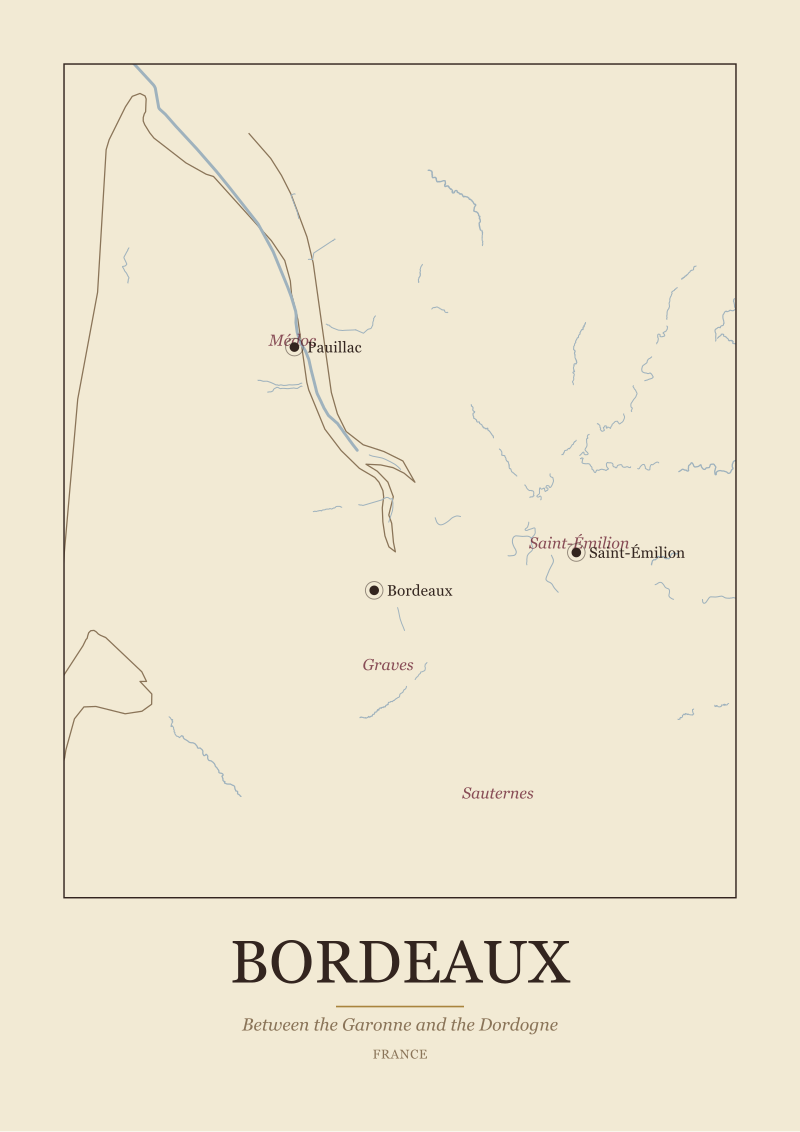 Bordeaux
The print from this article · from €29.95
View the print →
Bordeaux
The print from this article · from €29.95
View the print →
Where It Breaks Down: Santorini Is Not Really About the Volcano
Here is where the tidy version starts to leak. If volcanic soils were the primary driver of Santorini's greatness, we would expect other volcanic islands to produce comparable wines, and the parts of Santorini planted on the deepest ash to outperform the parts on shallower ash. Neither is cleanly true. Mount Etna's vineyards on Sicily grow on genuinely comparable volcanic substrate and produce excellent, entirely different wines. The Canary Islands sit on volcanic rock and make wines that share almost nothing with Santorini stylistically. Ischia, Vesuvius, the Azores — all volcanic, all distinct, none of them Santorini. The soil is a necessary condition. It is nowhere near a sufficient one.
The variable that separates Santorini from every other volcanic island in the wine world is the *meltemi*. This is the northerly summer wind that funnels down the Aegean from roughly May through September, at times sustained above thirty knots for days at a stretch. On most Mediterranean coastlines the wind is a background actor. On Santorini it is the lead. The crescent-shaped island, oriented with its high caldera wall to the west and a shallow slope descending east toward the sea, functions as a wind ramp. Air compresses over the cliffs, accelerates across the vineyard plateau, and desiccates everything it touches. Rainfall is negligible in summer — well under 400 millimetres a year total, and most of it in winter. There are no rivers. There is no meaningful surface water. And there is that wind, all summer, every summer, without pause.
An ordinary trellised vineyard would be dismantled here inside a season. Which is why, over centuries, the growers of Santorini developed a training system that exists almost nowhere else on earth. The *kouloura* — literally "wreath" or "basket" — is a vine trained into a low, coiled crown that sits on the ground like a nest, with the grape clusters hanging inside the basket, sheltered from the wind and shaded from the sun by the vine's own leaves. It is a small architectural solution to a very specific meteorological problem. It is not decorative. It is not tradition preserved for tourism. It is the only training system that keeps grapes alive on this piece of rock.
Read the island that way — wind first, soil second — and a different geography surfaces. The famous minerality that everyone attributes to volcanic ash also correlates almost perfectly with sea-spray deposition carried inland on the *meltemi*. The extreme concentration of the wines correlates with radical water stress from wind desiccation, not just from soil drainage. The old ungrafted rootstock survives partly because phylloxera cannot cross the pumice, yes, but also because those roots have to dive deep to escape a surface layer that the wind sterilises every summer. The volcano wrote the topography. The wind is what makes the topography productive.
The Rule I Use Instead: Read the Wind Before the Rock
The rule we have started applying, when reading any wine region that gets marketed on a single geological feature, is straightforward: identify the atmospheric constraint before you identify the soil signature. Soil is a static input. It sits there for millennia. But what makes a soil productive — or forces it into producing a specific style — is almost always a dynamic factor. Wind, sun angle, fog cycle, frost risk, humidity swing. These are the invisible variables that decide whether a given plot of ground grows commodity wine or something singular.
On Santorini the rule reads cleanly. The *meltemi* dictates the training system, which dictates the vine density, which dictates the yield, which dictates the concentration. The volcanic soil filters and drains and contributes its chemistry — but it does so under conditions the wind sets. Change the wind and everything downstream changes. Keep the volcanic soil, remove the wind, and you get a completely different wine — probably a much less interesting one. Grafted vines in a wind-free Aegean microclimate would produce plusher, riper, less structured Assyrtiko. It might still be pleasant. It would not be recognisable as Santorini.
This is not a Santorini-specific insight. It travels. Champagne's chalk is famous, but what actually defines the region is a marginal ripening window and a specific angle of northern light — the chalk is a moisture buffer that becomes decisive only because temperatures are dangerously low. Burgundy's limestone is legendary, but the actual differentiator between a great *climat* and an ordinary one is often a two-metre difference in elevation that changes how morning fog burns off. Bordeaux's Left Bank gravel matters because it drains well in a maritime climate that would otherwise waterlog the vines. In every case the soil gets the credit and the atmosphere does the work.
The reason marketing gravitates toward soil is that soil is legible. It can be photographed. It can be crumbled between fingers on a video. A pumice cross-section in a wine bar looks like a story. Wind does not photograph. Fog cycles do not fit on a back label. But if you want to understand why a region tastes the way it does, the invisible variables are almost always more decisive than the visible ones. On Santorini the invisible variable is a summer wind that has been running down the Aegean for as long as anyone has been growing grapes there. It shaped the vines into baskets. The baskets shaped the wine.
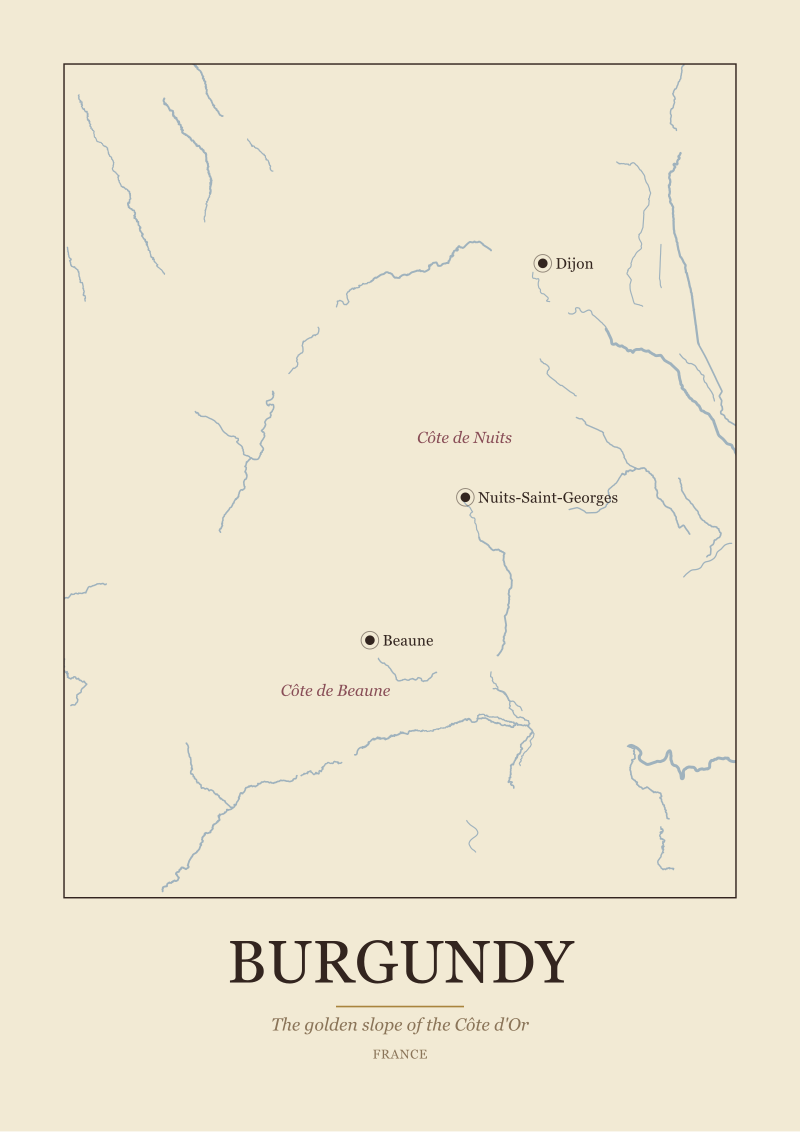 Burgundy
The print from this article · from €29.95
View the print →
Burgundy
The print from this article · from €29.95
View the print →
When the Old Rule Still Wins
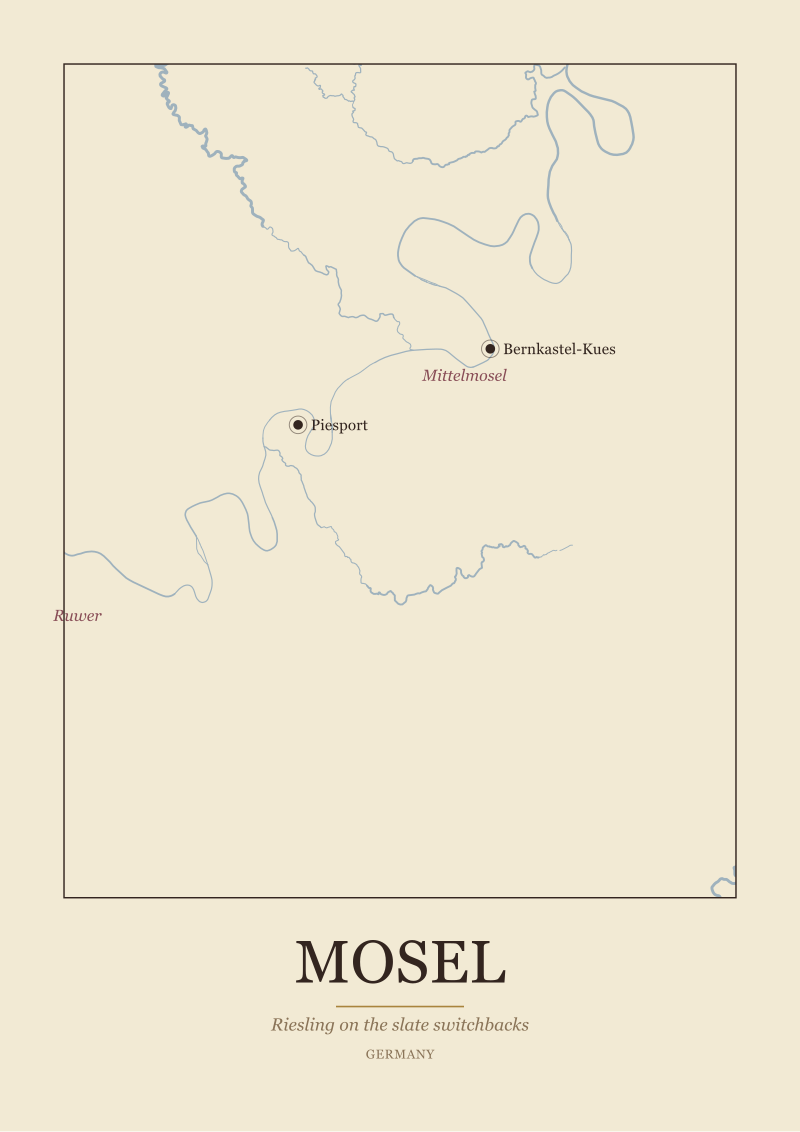
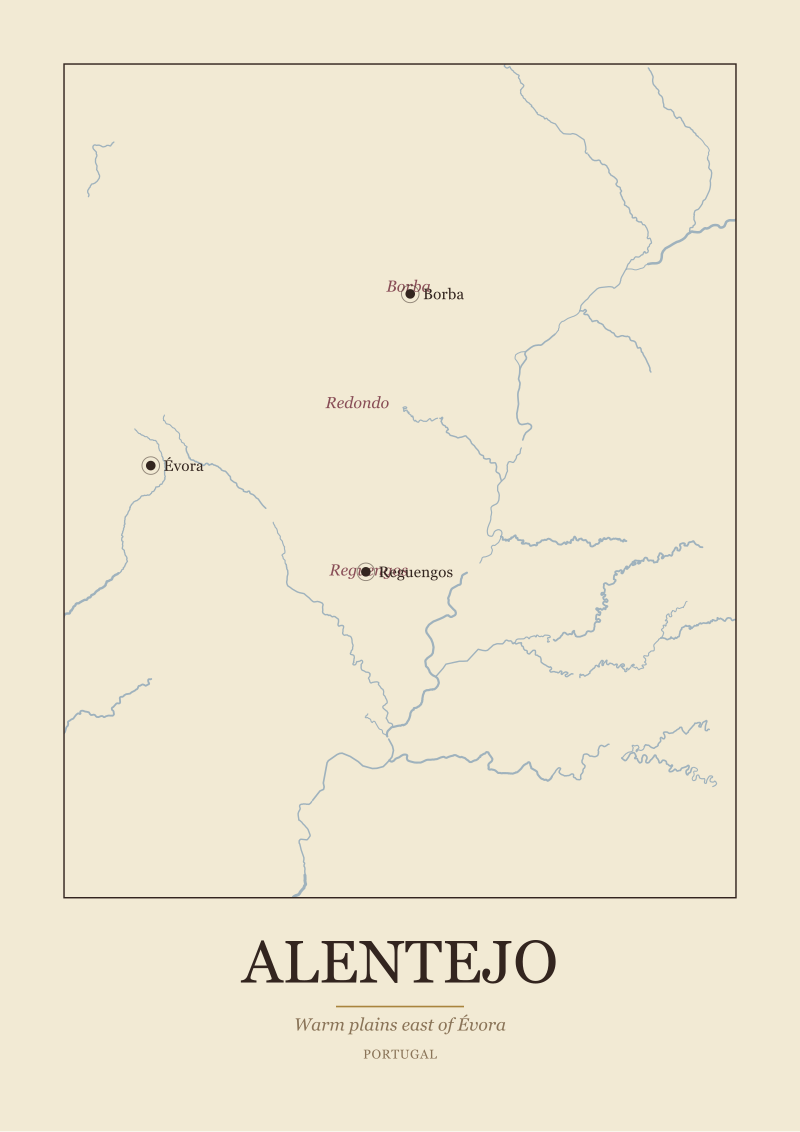
We would be overselling our own case if we did not concede that the wind-first framing has real limits. There are regions where the soil truly is the dominant variable, and reading them through atmospheric constraints would just miss what is actually happening. Priorat is one. The black *llicorella* schist there is not a wind story; it is a rock story, and the wines carry that rock in a way no meteorological reading fully explains. The Mosel's blue slate does something to Riesling that no other slate does, in a valley where the wind is a minor character. Even parts of Alentejo, where the granite and schist soils shift over short distances, are best read soil-first.
And even on Santorini, there is a version of the volcanic story that we take entirely seriously — the phylloxera-free rootstock lineage. That is a genuinely rare geological gift, and it is entirely a soil phenomenon. The *meltemi* did not save those roots. The pumice did.
So the rule we use — read the wind before the rock — is a corrective, not a replacement. It is what we reach for when a region has been so successfully marketed on a single geological headline that the actual mechanism has fallen out of the story. Santorini is the clearest case we know. But the reading depends on the region, and on being willing to admit which variable is doing the work in each specific place.
New regions and 10% off your first print.
One email now with your code. No noise after.