There is a pattern we notice every autumn at the map desk: someone types "highest rated Bordeaux wine" into a search bar, and what they get back is a scoreboard. The honest answer is a geography lesson. Bordeaux sits between the Garonne and the Dordogne, and every serious argument about which wines rate highest is really an argument about which side of which river, and which gravel or clay bed underneath. Ratings compress that geography into a single number and hand it back polished. We draw the region for a living, so we will do the uncompressing instead — and say plainly where the number is coming from.
The Pattern: Readers Ask for a Score, the Region Answers with a River
Every year the same question arrives in the same shape. It comes with the language of leaderboards attached — "highest rated", "top ranked", "which is the best" — as if Bordeaux were a single stadium with a single scoreboard mounted above the entrance. And every year the region gives the same answer, which is that it is not a stadium. It is a wedge of southwestern France bracketed by two rivers, and the rivers were doing the sorting long before any critic put a number on a bottle.
The Garonne runs up from the Pyrenees and swings north-west through the city of Bordeaux itself. The Dordogne comes in from the east. They meet just north of the city to form the Gironde estuary, which then empties into the Atlantic. That confluence is not decorative. It is the structural fact of the region — the reason there is a left bank, a right bank, and an "entre-deux-mers" caught in the middle. When a rating claims to have found the highest-scoring Bordeaux of the year, what it has actually done is picked a point on one of those banks and awarded it a headline.
We keep noticing that the readers who ask about scores are almost never asking about scores. They are asking, underneath the question, where in Bordeaux the wines they should care about come from. That is a geographic question with a geographic answer, and the scoreboard obscures it by translating the terrain into a two-digit number. Say a wine is rated 98. It is a fact about a taster, on a day, tasting a bottle from a plot on one of the banks. It is not a fact about Bordeaux. The scoreboard trades a landscape for a shorthand and hopes the reader will not notice the exchange rate.
The Left Bank and Right Bank Split the Ratings Quietly Flatten
There is a second pattern, downstream of the first. The scoreboards rank Bordeaux wines against one another on a single scale, but the wines they are comparing were grown on soils that are not really in the same conversation. The Left Bank of the Gironde is gravel country. The Right Bank, upriver on the Dordogne side around Saint-Émilion, is clay and limestone. The grapes respond accordingly. Cabernet Sauvignon does its serious ripening on Left Bank gravel because the stones drain and radiate heat. Merlot does its serious ripening on Right Bank clay because the cold, water-retentive soil is exactly the bed it thrives on. When a rating gives the highest score of the vintage to a Pauillac and the second-highest to a Saint-Émilion, it is not comparing two versions of the same idea. It is comparing two ideas.
This is why the phrase "highest rated Bordeaux" always collapses under its own weight if you press it. Highest rated on gravel, or highest rated on clay? Highest rated of the wines that need a hot summer to be great, or highest rated of the wines that need a merciful one? The Left Bank vintages that thrill the ratings are usually not the same vintages that thrill the Right Bank. In cooler years the Right Bank quietly wins and the scoreboards, which love a definitive answer, quietly re-shuffle. In hotter years the Left Bank swaggers back onto the leaderboard, and nobody at the scoreboard notes that this is a soil story pretending to be a quality story.
The Médoc, which runs north from the city along the Left Bank of the Gironde, is the strip of gravel that has done more to shape English-language wine writing than any equivalent piece of ground in Europe. Saint-Émilion, perched above the Dordogne on the Right Bank, is where the same writing tradition has repeatedly had to admit that its favourite grape was not the whole story. A ratings culture that ranks them together is asking Cabernet and Merlot to compete on a single ladder. They have never lived on a single ladder. They live on two banks.
A wine rating is a fact about a taster on a day; the bank the vineyard sits on is a fact about the region for a thousand years.
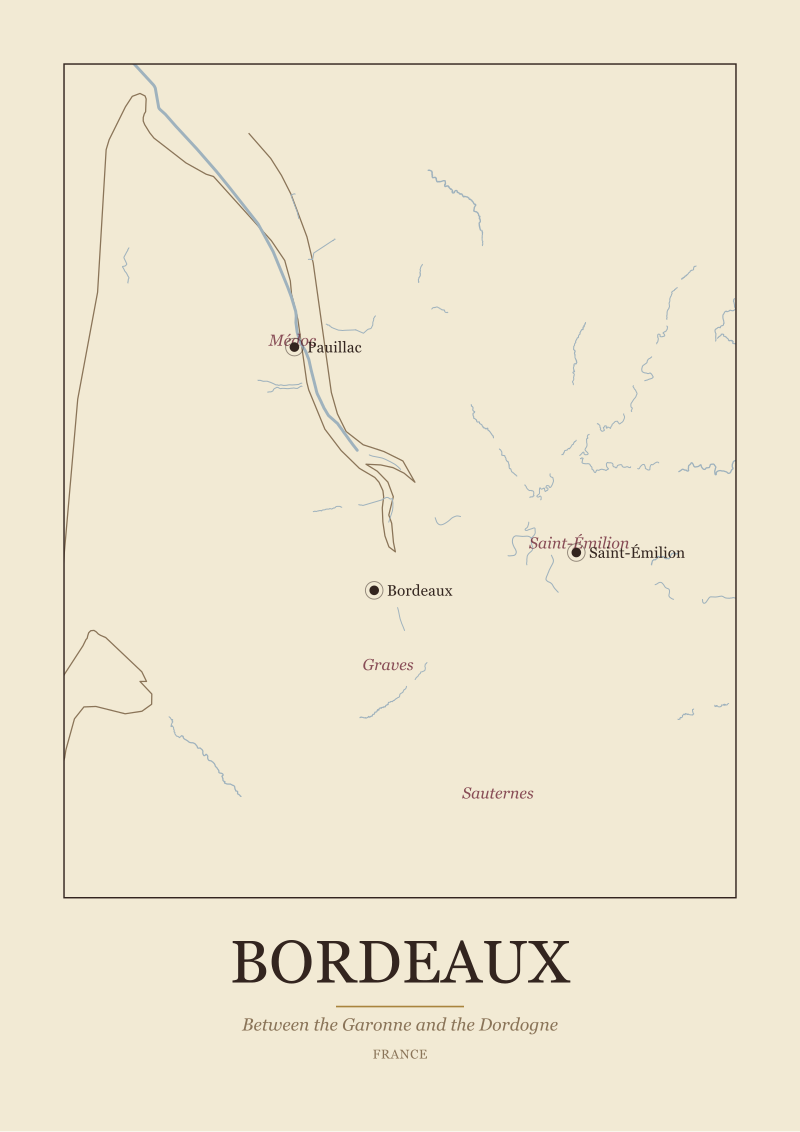 Bordeaux
The print from this article · from €29.95
View the print →
Bordeaux
The print from this article · from €29.95
View the print →
The Anchor Towns Do the Sorting the Scoreboards Take Credit For
The third pattern is the one the leaderboards never quite acknowledge, which is that the sorting was already done by the towns. Bordeaux the region is anchored by Bordeaux the city, by Saint-Émilion on the Right Bank, and by Pauillac up on the Médoc. These are not romantic ornaments. They are the reason the appellations are shaped the way they are. Historically, an anchor town gave a piece of ground a market, a name, a legal identity, and eventually a wall to draw around it. The scoreboard shows up centuries later and points at a wine and says: this one won. The town had already declared the terrain by then. The scoreboard is agreeing with a decision made long before it arrived.
Pauillac is the clearest case. It sits on the Left Bank of the Gironde in the northern Médoc, and it is the anchor of the appellation of the same name. Three of the five estates elevated to the top tier in the 1855 classification of the Médoc are Pauillac addresses. That classification is often described as a ranking, and it is treated as one by every "highest rated" list that quietly leans on it. But the 1855 was, in structural terms, a geographic reading of which plots the market had already been paying most for over the preceding decades. It sorted the region by parish. Modern ratings sit on top of that sort and inherit its shape while claiming to have generated their own.
Saint-Émilion did the same trick on the other bank in its own idiom. It is a medieval hill town looking down on the Dordogne, and the appellation named after it wraps the surrounding plateau of limestone and clay. When a critic hands a very high score to a Saint-Émilion wine, the wine's address is almost always inside the same handful of communes that were producing the same wines for the same reasons a century earlier. The town did the sorting. The ratings certify what the town already zoned.
The scoreboards enjoy the credit for this because the alternative — telling readers to think about parishes and river-bends instead of numbers — is harder to fit in a headline. But the pattern is stable. Read the "highest rated" list carefully, plot the wines on a map of the region, and the addresses cluster tightly around three or four anchor towns and the plots inside their appellations. The map is doing the work. The scoreboard is publishing the result.
Graves and Sauternes: The Subzones the Ratings Forget
The fourth pattern is quieter, and it costs readers the most. There are two Bordeaux subzones that the "highest rated" ecosystem consistently under-serves, and both of them sit on the Left Bank south of the city of Bordeaux itself. One is Graves. The other is Sauternes. Neither has the marketing gravity of Pauillac. Both are geographically foundational to the region.
Graves is the older story. Its name is the French word for gravel, and it is the strip of gravelly ground running south along the Left Bank from Bordeaux the city, from which the Médoc is essentially a northern extension. If you want to understand why the Left Bank is Cabernet country at all, you have to look at Graves first. It is where the pattern was established. The very-high-scoring Pauillac at the top of this year's list is, in structural terms, a wine grown on a soil that Graves was already growing wine on when the Médoc marshes upriver were still being drained. Ratings that treat Graves as an also-ran are ignoring the geography that produced their favourite banks.
Sauternes is stranger and even more overlooked. It is a small enclave inside the Graves area, along the Ciron, a cool tributary that meets the warmer Garonne and generates the autumn fogs on which the region's sweet wines depend. The wines made there are not on the same axis as the reds the scoreboards obsess over. They are made from grapes that have been shrivelled by a fungus the fog encourages. When a ratings culture built around the dry reds of the Left and Right Banks turns its attention to Sauternes, it always sounds slightly embarrassed, because the wine does not fit the metric. It rates it anyway and moves on. The reader is left with the impression that Sauternes is a footnote. It is not a footnote. It is the reason a specific micro-climate — a cold stream meeting a warm river, generating specific weather at a specific latitude — has been famous for four centuries.
The pattern in both cases is the same. The scoreboard prefers zones with a lot of comparable wines, because comparability is what a score is built for. Graves and Sauternes make comparability harder. So the ratings drift back toward Pauillac and Saint-Émilion, and the reader looking for "highest rated Bordeaux" is quietly steered away from two of the four subzones that give the grounding for the region as a whole. It is not a conspiracy. It is a metric doing what metrics do.
So What Do You Actually Do
Stop reading the scoreboard as if it were a map. Read it as what it is: a compressed report from a taster on a day, about a bottle from a plot, on a bank, near a town, in a subzone. Every one of those coordinates matters more than the number. If a critic hands out a very high score to a Pauillac and you find that useful, ask why: what year, which bank, which town, which soil. If the answer is "gravel on the Left Bank in a hot summer with a Cabernet-dominant blend", you have learned something durable about the region. If the answer is just "98 points", you have learned something about the critic.
The honest way to use the "highest rated" search is to treat it as a shortcut into the geography, not a substitute for it. The names that turn up are addresses. Look them up on a map of Bordeaux — the Garonne to the south-west, the Dordogne to the north-east, the estuary running out to the Atlantic, the Médoc as a long strip up the Left Bank, Saint-Émilion perched above the Dordogne, Graves and Sauternes sitting below the city — and the leaderboard turns into a small handful of neighbourhoods you can actually reason about. That is why we draw the region as maps of Bordeaux and its neighbouring appellations at the studio: because the map keeps the geography in the room after the score has stopped being useful.
None of this tells you which vintage of which estate is worth the price it is asking this year, and it will not. That is a question for a merchant with skin in the game and a cellar with the wines actually on the shelf. What the geography tells you is which questions to ask before you get there — which bank, which town, which subzone, which soil. Those questions travel from vintage to vintage. The score does not. Where the real work starts is the moment you close the scoreboard tab and open a map of the Garonne.
FAQ
Why do wine ratings disagree so much about which Bordeaux is highest rated?
Because they are rating wines from two different geographies on the same scale. Left Bank Bordeaux, on Gironde gravel, is dominated by Cabernet Sauvignon and needs warmth to ripen fully. Right Bank Bordeaux, on the clay and limestone above the Dordogne, is Merlot country and often shines in the cooler years the Left Bank finds difficult. A critic weighting one bank over the other in a given vintage will produce a very different leaderboard than a critic doing the reverse.
Is the 1855 classification a reliable "highest rated" list for Bordeaux?
It is the oldest surviving attempt, and it is still doing quiet work under every modern ranking of the region, but it only covers the Médoc and Sauternes on the Left Bank. Saint-Émilion and the rest of the Right Bank are not in it. Reading it as a complete ranking of Bordeaux is a category error. It is a structured reading of a specific stretch of the Left Bank at a specific moment, and its enduring accuracy about that stretch is the striking thing.
What is the difference between Left Bank and Right Bank Bordeaux in one sentence?
The Left Bank of the Gironde is gravel country anchored on the Médoc and dominated by Cabernet Sauvignon; the Right Bank, upriver along the Dordogne around Saint-Émilion, is clay and limestone country dominated by Merlot. Every serious comparison of Bordeaux wines is really a comparison of those two soils, and the wines that best express each are not on the same axis.
Where does Sauternes fit into the Bordeaux geography?
Sauternes is a small enclave on the Left Bank south of Bordeaux, inside the Graves area, along a cool tributary called the Ciron that meets the warmer Garonne. The meeting produces autumn fogs that encourage a fungus which concentrates the grapes into sweet wines. It is geographically part of the Left Bank but its wines are not on the same scale as the dry reds the scoreboards usually rank.
Why are Graves and Sauternes under-represented on "highest rated" lists?
Because ratings systems are built around comparability, and Graves and Sauternes complicate the comparison. Graves is the older stratum of Left Bank gravel from which the Médoc's model was extended, and Sauternes is a sweet-wine micro-climate that does not sit on the same evaluative axis as the dry reds. Leaderboards drift back toward the appellations that produce a lot of similar bottles, so those two subzones fall out of view.
Which anchor towns should a reader recognise to make sense of Bordeaux ratings?
Bordeaux itself, sitting on the Garonne as the region's commercial hub; Pauillac, the northern Médoc town that anchors the most-cited Left Bank appellation; and Saint-Émilion, the medieval hill town above the Dordogne that anchors the Right Bank's most famous plateau. Almost every wine that turns up on a "highest rated Bordeaux" list has an address inside the appellations these three towns organise.
Does a very high rating mean a Bordeaux wine will age well?
Not directly. A high score is a snapshot of a wine at the moment a taster met it, on a day, in a room. Ageing potential is a structural property of the wine and the vintage, closely tied to the bank and the soil the grapes were grown on. Left Bank Cabernet-dominant wines from cooler, more structured vintages have historically aged longest, but the scoreboard is not tracking that; it is tracking the wine in front of the taster.
If I only had time to learn one thing about Bordeaux geography, what should it be?
That the region is bracketed by two rivers, the Garonne and the Dordogne, which meet north of the city to form the Gironde estuary, and that the Left Bank is gravel country while the Right Bank is clay and limestone. Everything else — appellations, anchor towns, subzones like Médoc, Saint-Émilion, Graves and Sauternes, and the ratings that sort them — is downstream of that single fact.
New regions and 10% off your first print.
One email now with your code. No noise after.