Champagne is defined by chalk hills along the Marne, north of a river that barely leaves its own valley. Alentejo sprawls across warm plains east of Évora, its subzones — Borba, Redondo, Reguengos — each larger than several famous appellations put together. Both are called wine regions, both are famous, and one is unmistakably smaller than the other. The word "smallest" does the work of pretending this comparison is simple. It is not. Smallness in European wine is an editorial position, not a size class — a decision, taken by growers and legislators over centuries, that the geography beneath certain vineyards was specific enough to deserve its own name. We draw these regions for a living, so we will hold the question three ways — through a traveler, a collector, and a mapmaker — and let the geography answer.
There is a second reason the question is harder than it looks. Every famous European wine region is a nested object. Champagne contains Vallée de la Marne, which contains Aÿ, which contains a single south-facing slope above the river. Bordeaux contains the Médoc, which contains Pauillac, which contains a gravel mound of a few hundred hectares. Ask "what is the smallest famous wine region" and the honest answer is: at which layer are you looking? A traveler, a collector, and a mapmaker read the same map and see three different scales. Let us walk through each.
Scenario 1: The Weekend Traveler Choosing Between Champagne and Burgundy
Imagine a reader with three days, a rental car, and a flight into Paris. They want to visit one small, famous wine region. They narrow it to two: Champagne, an hour and a half northeast; Burgundy, two hours southeast. Both are, by any working definition, small. Both are among the most name-recognised wine regions on Earth. The traveller reads a guidebook, sees the words "Champagne region" and "Burgundy region", and assumes the choice is aesthetic. It is not. It is geographic, and the geography changes the trip.
Champagne, on the map, is a triangle of chalk hills sitting north of the Marne. The famous subzones — Montagne de Reims, Vallée de la Marne, Côte des Blancs — arrange themselves around Reims and Épernay like three fingers pointing away from the river. A weekend traveller staying in Épernay can see all three within a day. Aÿ, one of the anchor villages, is close enough to Épernay that the vineyards are effectively continuous. Distances between famous houses are measured in kilometres of Route de Champagne, not hours of highway. The region reads small because it *is* small in a way the traveller experiences directly: the same chalk under every glass, the same river visible from most of the good slopes.
Burgundy, by contrast, is a ribbon. The Côte d'Or — the golden slope — runs south from Dijon through Beaune and Nuits-Saint-Georges, a thin band of vineyard clinging to a single east-facing escarpment above the Saône plain. Côte de Nuits sits at the northern end, Côte de Beaune at the southern. To a mapmaker, this is a strikingly small object: a strip a few kilometres wide, perhaps forty kilometres long. To a traveller with a car, though, Burgundy behaves larger than it measures, because every village along the slope is its own commune with its own crus, and the road through them stops at every wall.
For the weekend traveller, the practical answer is: Champagne reads smaller and is easier to see in two days. Burgundy is geographically smaller in surface area but denser in named subdivisions, and rewards a slower pace. The choice is not between two comparable objects. It is between a triangle around a single river town and a ribbon along a single slope. If the traveller wants "small and famous" as an experience — the sense of standing inside a compact, self-contained region — Champagne delivers it more literally. If they want "small and famous" as an encounter with fractal detail — new place-names every hundred metres of road — Burgundy is the answer. Same descriptive words, different geographic reality.
Scenario 2: The Collector Building a Côte d'Or Cellar
Now picture a collector, ten years into a cellar, deciding to specialise. They have decided the small famous region worth serious attention is Burgundy — specifically the Côte d'Or. On paper, this is a modest commitment: one slope, two named halves, a manageable object. The collector opens the map and discovers the second nesting. The Côte de Nuits is not a place they can buy from. The Côte de Beaune is not a place they can buy from. What they can buy from is a village. And every village, on the Côte d'Or map, is itself a small famous region.
Nuits-Saint-Georges — one of the anchor towns of the Côte de Nuits — is not a single vineyard, not a single style, but a communal appellation containing dozens of named climats, some of which are famous in a way that dwarfs entire appellations elsewhere. The collector realises that the "small famous region" they set out to collect resolves, at closer range, into a lattice of even smaller famous objects, each with its own price signal, its own producers, its own hillside orientation. Beaune, the capital, is both a town and a communal appellation. Dijon marks the northern edge of the whole strip. A cellar plan built on "the Côte d'Or" is really a cellar plan built on twenty-plus villages, each of which behaves like a miniature region.
This is what small famous means to a collector: not the top layer but the bottom. The famous small object is the climat, the walled parcel, the named lieu-dit — the slope specific enough that a producer will bottle it separately and a market will price it separately. The Côte de Nuits, as a subzone, is a container. The named vineyards inside it are the actual small famous regions the collector's money interacts with. To collect Burgundy at any depth is to swap the map you started with for a map at ten times the zoom, then do it again.
The lesson generalises. A collector approaching Bordeaux does not collect "Bordeaux". They collect Pauillac, or Saint-Émilion, or Sauternes — each of which is a small famous region nested inside a larger famous region, and each of which itself resolves into named estates on specific gravel or clay. A collector approaching Champagne collects Aÿ, or the Côte des Blancs, or a single village on the Montagne de Reims. Fame, at the collector's scale, always resolves downward. The famous small region is whichever level of the nesting the market has decided to price separately, and in European wine that level is almost always smaller than the one guidebooks name.
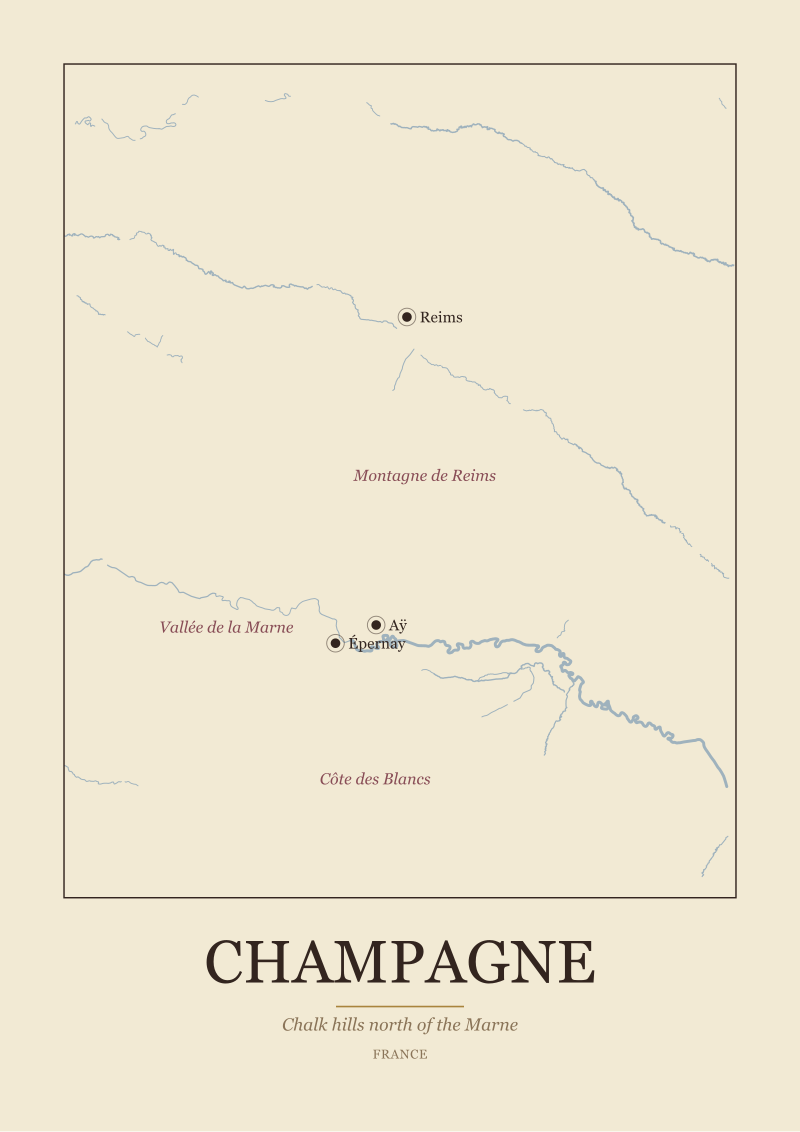 Champagne
The print from this article · from €29.95
View the print →
Champagne
The print from this article · from €29.95
View the print →
Scenario 3: The Mapmaker Drawing Alentejo's Subzones
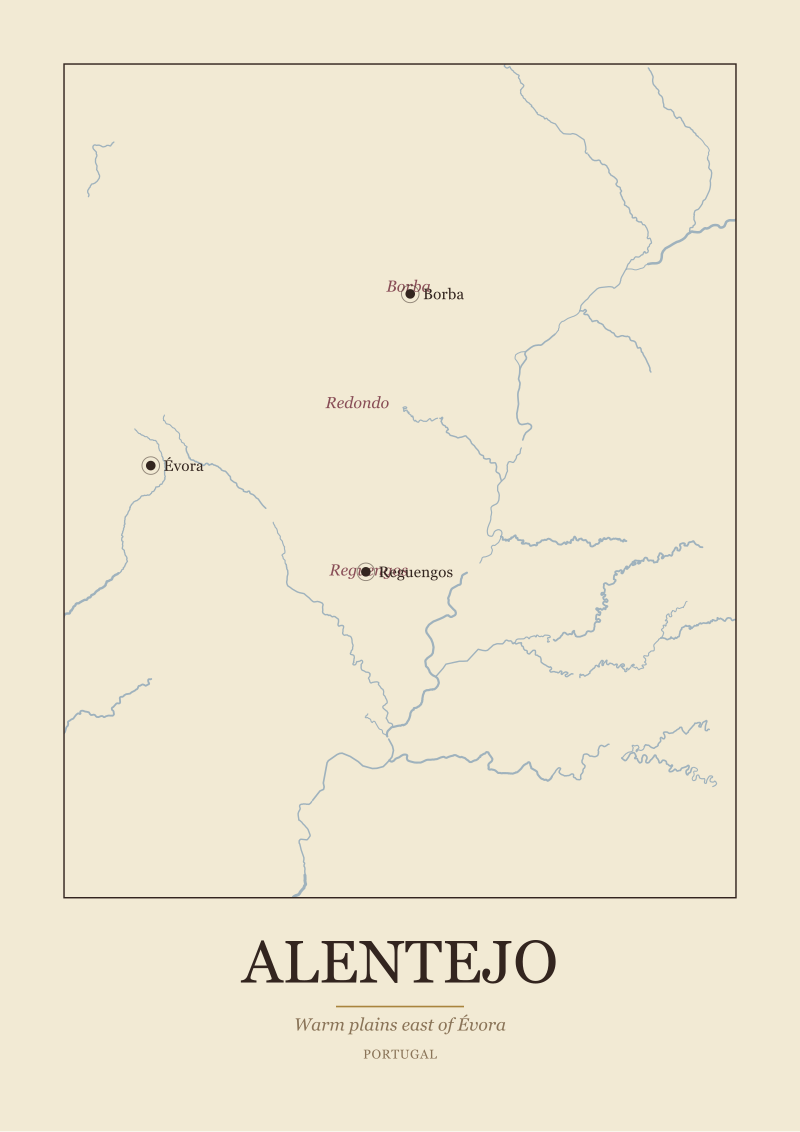
The third scenario is our own. Let us say a mapmaker at this studio is asked to draw Alentejo — a region a traveller and a collector might not consider a candidate for "smallest famous" at all. Alentejo, on the country map of Portugal, is enormous: a warm plain rolling east of Évora toward the Guadiana and the Spanish border, anchored by Évora, Reguengos, and Borba. The subzones — Borba, Redondo, Reguengos — are each larger, in surface area, than several of Burgundy's communal appellations combined. By the "smallest famous" logic of guidebook geography, Alentejo does not belong in this article.
Except that the mapmaker's job forces the question into a different shape. When we draw Alentejo, we do not draw one border and stop. We draw the outer edge — the great regional envelope — and then we draw the subzones inside it, because the subzones are what growers, exporters and drinkers actually name when they name the wine. Borba is not a village-sized appellation the way Aÿ is. It is a district, with its own subregional identity, its own marble-country geography around the town, its own claim on the drinker's attention. The mapmaker learns something the traveller and the collector see only partially: every famous European wine region is a subdivision decision, and the subdivision is where the fame lives.
This is why the size question is editorial rather than metric. A region's outer border is drawn by legislation. Its inner borders — the ones that make Pauillac different from Margaux, Chablis different from the Côte de Beaune, Borba different from Redondo — are drawn by consensus among growers about which piece of geography deserves its own name. Small famous regions, in the way the phrase is usually meant, are the *inner* borders. Champagne is famous as a whole because its inner borders are unusually tight and its outer border encloses a single geological feature: the chalk. Bordeaux is famous as a whole because its inner borders map exactly onto the interplay of two rivers and the gravels and clays they left behind. Burgundy is famous as a whole because its inner borders read a single slope wall by wall. Alentejo has inner borders too, and drawing them is the mapmaker's actual work — the moment when a plain becomes three regions and each of them starts to feel small.
What All Three Share
Three different readers, three different scales, one shared structural fact: in European wine, small famous is a statement about specificity, not surface area. The traveller experiences it as compactness — a region you can cross in a day. The collector experiences it as resolution — a lattice of named parcels a market has decided to price separately. The mapmaker experiences it as subdivision — the inner borders where a wider region breaks into pieces small enough to have distinct geographic identities. In all three cases, "small" is the presence of a border, not the absence of hectares.
The geography enforces this. Champagne's chalk is a single stratum; where the chalk ends, the appellation ends, and the region reads small because the geology reads small. Burgundy's Côte d'Or is one escarpment; where the slope faces flatten, the appellation ends. Bordeaux sits between two rivers, and the Médoc, Saint-Émilion, Graves, and Sauternes are readings of what the water left where. Alentejo's subzones are readings of the plain — where the marble surfaces, where the soils change, where the towns of Borba, Redondo and Reguengos have historically anchored the trade. Every famous small region in Europe is a legible geographic feature that a legislator eventually agreed to draw a line around. The famousness is downstream of the geography, and the smallness is downstream of the geography being specific.
The corollary is that a "smallest famous wine regions" list is really a list of the tightest geographic specificities Europe has bothered to name. That list looks different depending on who is reading it and what scale they are reading at — and any honest answer to the query has to make that visible.
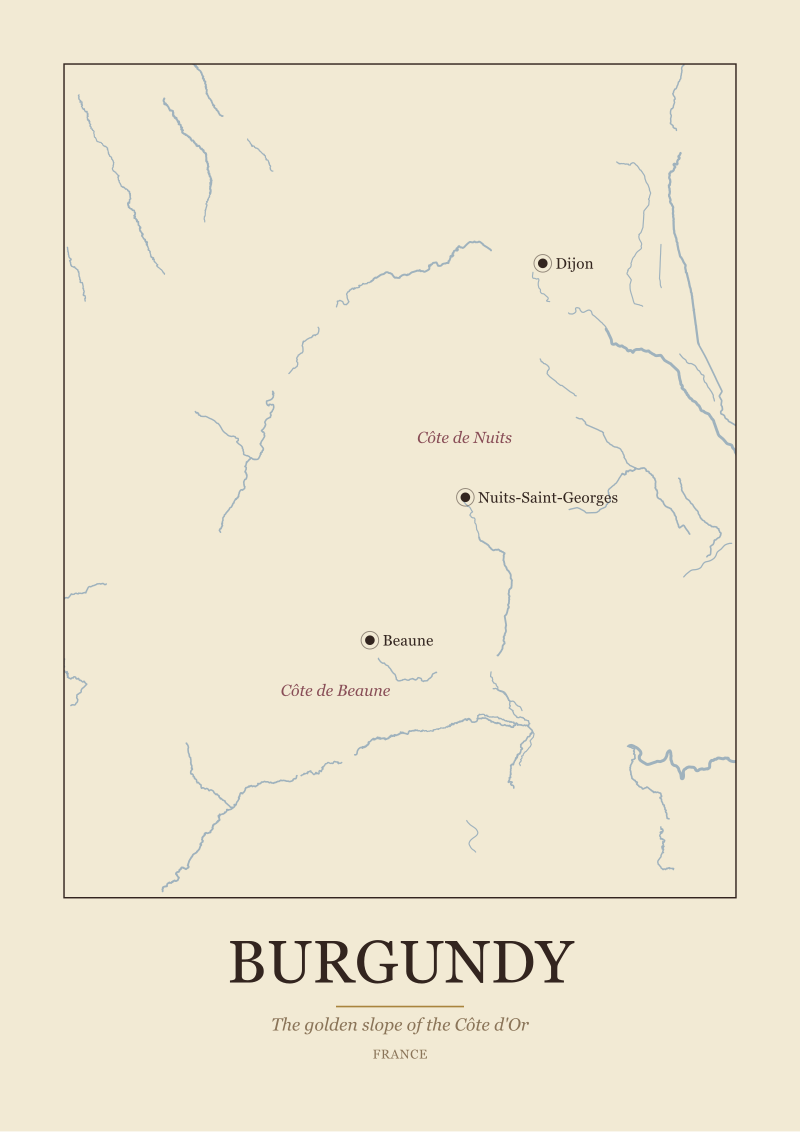 Burgundy
The print from this article · from €29.95
View the print →
Burgundy
The print from this article · from €29.95
View the print →
Which Scenario Is You
If you came to this question planning a trip, you are the traveller: what you want to know is which small famous region you can meaningfully see in the days you have. Champagne and the Côte d'Or are both good answers to that, for different reasons — Champagne for a single self-contained triangle around a river, Burgundy for a walk down a slope through named villages. If you came planning to specialise a cellar, you are the collector: the small famous region you actually collect is a level or two below the one you started reading about, and the geography of that level is what your money is really tracking. If you came trying to understand *why* certain regions are called small and famous when the numbers do not obviously agree, you are approaching the question the way we do — as a mapmaker, watching where the inner borders fall. All three readings are correct. None of them survives on its own.
FAQ
What actually counts as one of Europe's smallest famous wine regions?
It depends on which layer of the map you mean. If "region" means the outer legal envelope, Champagne — anchored on Reims, Épernay and Aÿ, defined by chalk hills north of the Marne — is among the tightest famous examples. If "region" means the inner appellation people actually buy from, the list is longer and smaller: a Burgundy village on the Côte d'Or, a Bordeaux commune like Pauillac, or a single subzone of Champagne like the Côte des Blancs.
Is Burgundy smaller than Champagne?
Geographically, the Côte d'Or — the famous slope running from Dijon through Beaune to Nuits-Saint-Georges — is a thinner object than the Champagne triangle around the Marne, but Burgundy as a wider viticultural area extends well beyond it. Champagne reads as one compact region because its outer border encloses a single chalk landscape. Burgundy reads as small only when you restrict yourself to the Côte d'Or itself and ignore the outlying zones.
Why are Bordeaux's subregions treated as separate small regions?
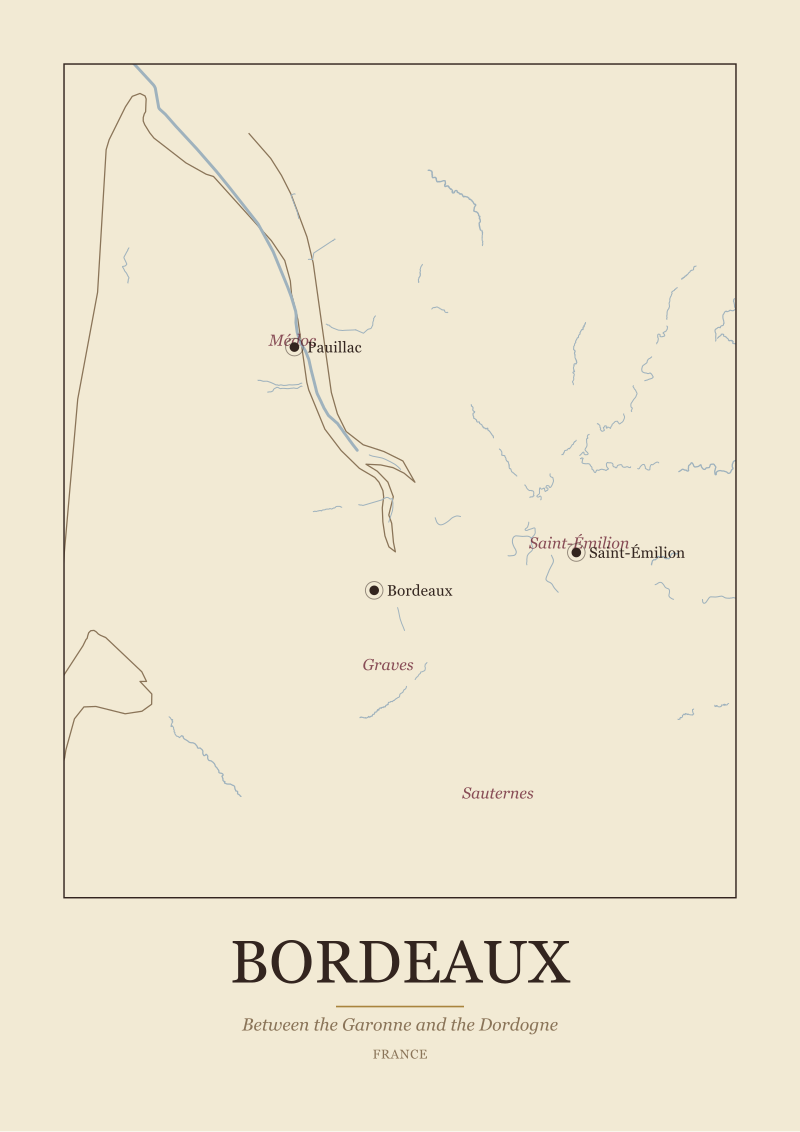
Because they sit on distinct geographies. Bordeaux is defined by the space between the Garonne and the Dordogne, and the famous subzones — Médoc, Saint-Émilion, Graves, Sauternes — each read a different piece of what those rivers left behind: gravel banks, clay-limestone plateau, sandy pine country, humid low ground good for noble rot. Each has its own anchor town and its own agreed border, so the trade treats them as independent regions rather than as one Bordeaux monolith.
Is Alentejo a small wine region?
Not by surface area. Alentejo covers the warm plains east of Évora, drained by the Guadiana, and its subzones — Borba, Redondo, Reguengos — are each substantial in their own right. It qualifies for the "smallest famous" conversation only at the subzone layer, where districts like Borba behave as legible small famous regions in their own right. The wider Alentejo envelope is one of Europe's larger named wine regions, not one of its smallest.
What is the "Côte d'Or" and why do so many small famous names sit on it?
The Côte d'Or is the escarpment running south from Dijon through Beaune and Nuits-Saint-Georges — one east-facing slope, split into the Côte de Nuits in the north and the Côte de Beaune in the south. Because the slope's orientation, soils and elevation change from village to village, growers have historically named vineyards at a very fine scale. That is why a small strip of hillside produces dozens of small famous appellations rather than one large one.
Why do the borders of European wine regions matter so much?
Because the border encodes a geographic claim. Champagne's edge is where the chalk ends. Burgundy's Côte d'Or ends where the slope flattens into the Saône plain. Bordeaux's subregions end where the river-deposited soils change. Alentejo's subzones end where the character of the plain changes from one district to the next. The border is the shorthand for a real geographic transition; when the border moves, growers argue, because the ground under the vine is genuinely different on either side of the line.
If I only have time to visit one small famous region, which is easiest to grasp on the map?
Champagne, in our view, is the most legible on a first visit. Its outer border is compact, its three named subzones — Montagne de Reims, Vallée de la Marne, Côte des Blancs — arrange themselves around Reims and Épernay in a way you can hold in your head, and the anchor towns are close enough together that a short drive shows you the whole geography. Burgundy's Côte d'Or is arguably smaller, but its finer subdivision rewards a slower, more collector-minded visit.
Where do you draw the line between a "small famous region" and just a famous vineyard?
At the point where the trade treats the name as a place rather than as a producer. Aÿ is a village and a Champagne cru — a place. A single named climat inside a Burgundy village is also a place. A specific estate on the Médoc is not a region, however famous, because its border is a property line rather than a geographic one. The regions we count are the ones whose borders read something on the ground: a river, a slope, a soil, a chalk edge. That is where our maps stop, and where we think the honest answer to this question stops as well.
New regions and 10% off your first print.
One email now with your code. No noise after.