Bordeaux is not one region. It is two regions divided by rivers, and a third region caught between them, and everyone who tries to explain "left bank versus right bank" without pointing at a map ends up describing wine flavours that the geography made inevitable. The Garonne comes up from the south. The Dordogne comes down from the east. They meet north of the city of Bordeaux to form the Gironde estuary, which then runs on to the Atlantic. The land west of that spine — Garonne then Gironde — is the Left Bank. The land east of the Dordogne is the Right Bank. Between the two rivers sits the Entre-Deux-Mers, which is a third answer to a two-part question.
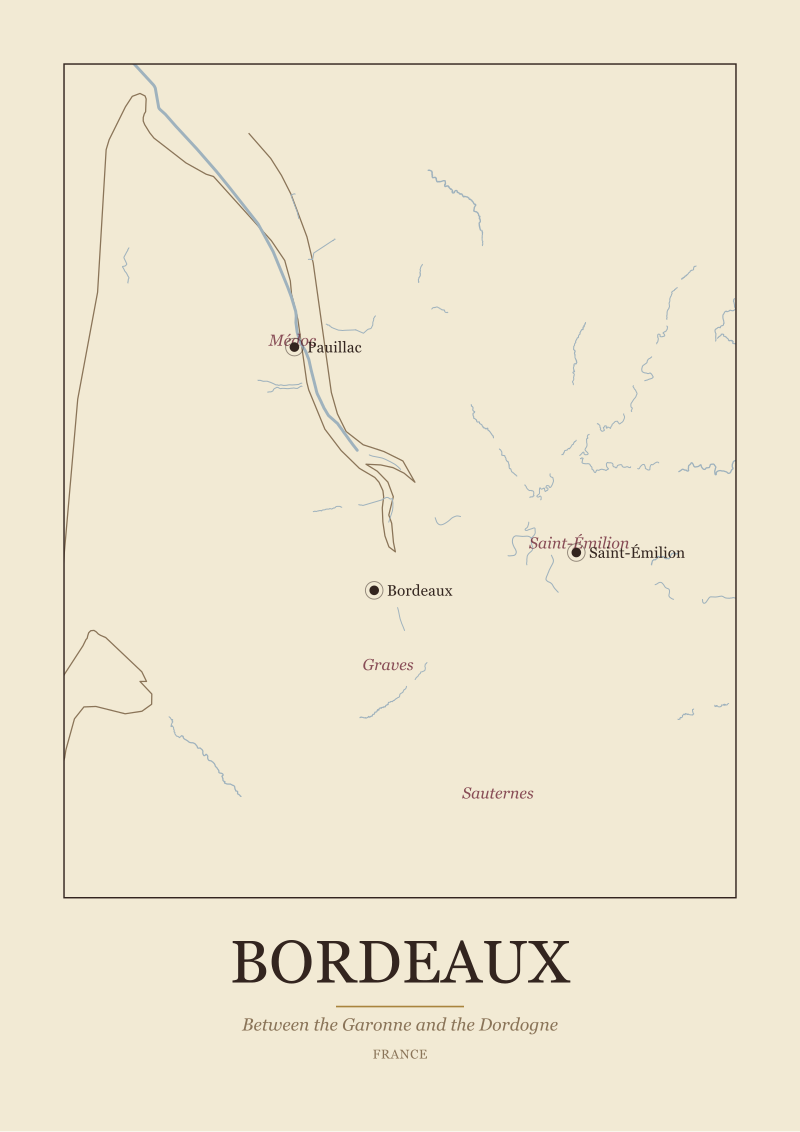
The problem with "left bank versus right bank differences explained" is that the honest answer depends on why you are asking. A person who has just tasted a Pauillac next to a Saint-Émilion is asking about soil. A person driving north from the city for a weekend is asking about roads and towns. A person staring at the back of a bottle is asking about a classification system that is really two classification systems. We are going to walk through three of these readers — three hypothetical composites, not people we interviewed — and let the geography do the explaining in each case. The maps we draw at our studio are built from Natural Earth's public-domain river and coastline data, and every scenario below can be traced on one.
Scenario 1: The Taster Who Just Noticed the Difference
Imagine a reader who has, in the same week, opened one bottle from the Médoc and one from Saint-Émilion. They did not plan the comparison. The Médoc bottle came from a friend; the Saint-Émilion was already in the rack. Both were red. Both said "Bordeaux" on the label. And yet, side by side, they behaved like wines from different countries. Our reader wants to know why, and they want an answer that is not "well, it's terroir" — a word that in most articles does the job of a shrug.
Terroir here is geography you can point to. The Médoc is a narrow strip of land running north from the city of Bordeaux along the western shore of the Gironde estuary. Its subsoil is one of the most specific things in European wine: gravel deposits left behind by the Garonne over millennia, piled into low mounds the locals call *croupes*. Gravel drains fast and holds heat. A vine planted on a Médoc *croupe* sits above the water table and roots deep into stone. The dominant grape planted here is Cabernet Sauvignon, a late-ripening variety that needs warmth, drainage, and a long season. Gravel gives it all three. Pauillac, one of the Médoc's anchor communes and the middle pin on the Left Bank strip, is essentially a study in that arrangement.
Cross the estuary and the Dordogne and you land in a completely different soil story. Saint-Émilion sits on a limestone plateau with clay on top. Clay is cold, holds water, and drains slowly — the opposite of gravel. The dominant grape here is Merlot, an earlier-ripening variety that thrives in cooler, damper soil where Cabernet Sauvignon would sulk. This is not a marketing choice; it is what the region's geology allows. Merlot on clay ripens reliably; Cabernet Sauvignon on clay struggles. Producers plant what works.
So the reader tasting the two bottles is tasting, at bottom, gravel against clay. Late-ripening Cabernet Sauvignon on stone that drains and warms, versus earlier-ripening Merlot on soil that stays cool and holds moisture. Everything downstream — the density of the wine, the way the tannins arrive, the acidity — flows from that difference. We are not a tasting-notes desk, so we will not tell you which one you should prefer. We will say that if you draw the estuary on a napkin and put a west-bank pin at Pauillac and an east-bank pin at Saint-Émilion, you have already explained more than most articles will.
Scenario 2: The Weekend Driver Landing at Bordeaux
Let us say a second reader is landing at Bordeaux-Mérignac airport on a Friday evening with a rental car and forty-eight hours. They want to see wine country. They are not visiting cellars. They want the land itself — the vineyards, the river, the towns. They have read "left bank vs right bank" articles and they cannot tell whether the two banks are close enough to visit both, or whether one is enough for a weekend.
The geography answers this cleanly if you look at it as a driver rather than as a wine student. The city of Bordeaux sits at a natural hinge: the Garonne runs through the city, then joins the Dordogne a short drive north to form the estuary. If our driver heads north-west from the city along the D2, they are on the Left Bank, driving straight up the Médoc: through Margaux, then Saint-Julien, then Pauillac, then Saint-Estèphe. This is flat country. The vineyards sit low. The estuary is on your right as you drive north; the pine forests of the Landes are on your left. The road is called the Route des Châteaux for a reason: the drive is essentially a linear reading of the Médoc's communes, in order.
If instead our driver heads east from Bordeaux, they cross the Garonne first, then the Dordogne, and after a short run they arrive in Libourne, the market town of the Right Bank. Ten more minutes and they are in Saint-Émilion, which is not flat: it is a walled hill town on a limestone escarpment above the plateau. The vineyards here are visibly different — smaller parcels, closer to the buildings, on land that rolls rather than lies flat. Pomerol is a short drive north of Libourne on the same right bank. This is a much more compact zone than the Médoc. A driver can see a lot of Saint-Émilion and Pomerol in a single day.
So the practical answer to "can I do both banks" is: yes, but understand that the Left Bank rewards a linear drive and the Right Bank rewards a walking day in one town. They are not two versions of the same experience. They are two different geographies with two different rhythms, and the fastest bridge between them runs through the city of Bordeaux itself.
 Bordeaux
The print from this article · from €29.95
View the print →
Bordeaux
The print from this article · from €29.95
View the print →
Scenario 3: The Reader Confused by the Classifications
Picture a third reader who has been trying to make sense of the fact that Bordeaux is famous for its 1855 Classification, and yet a bottle of Saint-Émilion Grand Cru Classé does not appear to sit inside that classification. They have tried to read about it and been told, correctly but unhelpfully, that Left Bank and Right Bank have their own systems. What they want is a geographic explanation for why this is the case.
The 1855 Classification was drawn up for the Paris Universal Exposition and covered the red wines of one specific stretch of land: the Médoc, plus a single château in Graves. It was a ranking of properties by then-current merchant prices. Every one of the classified reds sits on the Left Bank of the Gironde. The system was frozen almost entirely at its 1855 shape. From the reader's point of view, the 1855 list is a Left Bank list. If you draw it on a map, it is one long thin ribbon running north along the estuary, with the Sauternes properties added inland on the Garonne as the sweet-wine annex.
The Right Bank was not part of any of this. Saint-Émilion built its own separate classification a century later, in the 1950s, and — critically — it is periodically revised rather than frozen. Pomerol, which sits right next to Saint-Émilion, never adopted a classification at all. So a reader trying to compare a "Left Bank First Growth" with a "Right Bank Premier Grand Cru Classé" is comparing two hierarchies built on different sides of the river at different times for different reasons. The geography did not force this; the market did. But the geography is why it stayed this way: the two banks developed as separate commercial regions, with separate merchants, separate export routes down separate rivers, and separate reputations to defend.
The clean way to hold this in your head is to picture the estuary as a border. Left of the border, 1855. Right of the border, Saint-Émilion's own system, plus Pomerol which sits apart. Sauternes, inland on the Garonne, is on the same bank as the Médoc and was folded into 1855 alongside the Médoc reds. Every part of the answer is a map answer.
What All Three Share
The three scenarios above are asking different questions, but the answer in each case runs through the same three geographic facts. Bordeaux is a river system: Garonne from the south, Dordogne from the east, Gironde from their junction to the Atlantic. Bordeaux is a soil split: gravel on the Left Bank, clay-over-limestone on much of the Right Bank, with sand and other variations between them. And Bordeaux is a commercial history built on top of that geography: two banks with two grape traditions and two classification systems, because the rivers made them two markets.
Once these three facts are in place, most of the vocabulary that circulates around Bordeaux stops being intimidating. Cabernet-dominant on the Left Bank and Merlot-dominant on the Right Bank is not a stylistic choice; it is what the soil supports. The 1855 list running only on the Left Bank is not a snub of Saint-Émilion; it is a merchant list drawn in one place. The Entre-Deux-Mers name — "between two seas," meaning between two tidal rivers — is not a poetic flourish; it is a literal description of the strip of land between the Garonne and the Dordogne.
Everything else written about Bordeaux — the vintage debates, the arguments about ratings, the vocabulary of blends — sits on top of these three facts. If a wine article about Bordeaux does not make clear which bank it is describing and why, it is skipping the part that would have made it useful.
Which Scenario Is You
If you opened this article after tasting a wine and wanting an explanation, you are Scenario One, and the answer is soil: gravel that drains and warms on the Left Bank, clay that holds water and stays cool on much of the Right Bank, with the grape variety planted to match. If you opened it because you are about to be in the region, you are Scenario Two, and the answer is orientation: the Left Bank is a long peninsular drive from the city up the estuary, the Right Bank is a compact set of communes east of the Dordogne with Libourne as the hub. If you opened it because you were trying to make sense of a classification chart or a wine list, you are Scenario Three, and the answer is history: two banks, two systems, two market traditions, one estuary between them.
Bordeaux is not a mystery region. It is a river region, and every honest article about it should feel like a map with words on it. That, in the end, is what we do at our see the Bordeaux print: draw the rivers, the estuary, and the communes as they actually sit, so the words in articles like this one have a place to land.
FAQ
What is the actual physical border between Bordeaux's Left Bank and Right Bank?
The border is a continuous water system, not a single river. Going upstream from the Atlantic, it is the Gironde estuary as far south as the confluence, then it splits: the Garonne runs south through the city of Bordeaux and beyond, while the Dordogne runs east. The Left Bank is the land west of the Garonne and the Gironde. The Right Bank is the land east of the Dordogne. Everything between the Garonne and the Dordogne is Entre-Deux-Mers, which is a category of its own.
Why is Cabernet Sauvignon the Left Bank grape and Merlot the Right Bank grape?
The soils make the choice, not tradition. The Left Bank's Médoc is built on deep gravel mounds that drain quickly and hold heat — ideal for Cabernet Sauvignon, which ripens late and needs warmth and drainage. Much of the Right Bank sits on clay over limestone, which stays cool and holds moisture — conditions where Merlot ripens reliably and Cabernet Sauvignon would struggle. The two grape distributions are essentially a soil map with vines on it.
Where does Sauternes fit — is it Left Bank or Right Bank?
Sauternes sits inland on the Left Bank, upstream on the Garonne south of the city of Bordeaux. Geographically it shares the Left Bank with the Médoc, though it is a separate zone with its own microclimate driven by the confluence of the Ciron and the Garonne, which produces the autumn mists that shape its sweet wines. Because it is on the Left Bank, its top properties were included in the 1855 Classification as its sweet-wine annex.
Is Pomerol on the Right Bank, and why is it never mentioned in classifications?
Pomerol is on the Right Bank, immediately north of Libourne and adjacent to Saint-Émilion. It has never adopted an official classification of any kind. There is no historical ranking of Pomerol properties in the sense there is for the Médoc or Saint-Émilion. The region's reputation was built without one, which is a rare arrangement in French wine geography and part of why Pomerol is treated as its own case even in Right Bank discussions.
What is Entre-Deux-Mers and why is it counted as neither bank?
Entre-Deux-Mers is the land between the Garonne and the Dordogne — the name means "between two seas," referring to the two tidal rivers rather than to the Atlantic. It is neither Left Bank nor Right Bank because both terms refer to positions relative to a single river, and Entre-Deux-Mers is defined by sitting between two of them. It has its own appellation and a different character again, dominated in modern production by dry white wine.
Can I visit both banks in a weekend, or should I pick one?
Both are possible in a weekend because the two banks are separated only by the city of Bordeaux and the two rivers. The Left Bank rewards a linear drive north from the city up the Médoc peninsula along the estuary. The Right Bank rewards a shorter trip east to Libourne, Saint-Émilion, and Pomerol, which sit close together and are walkable in parts. Doing both means roughly one day per bank; doing one means going deeper into that bank's rhythm.
Why does the 1855 Classification only cover the Left Bank?
The 1855 Classification was drawn up by Bordeaux wine merchants for the Paris Universal Exposition and reflected the market prices of the top red properties they traded — which were almost entirely on the Left Bank, in the Médoc, plus one Graves château. Saint-Émilion's wines were sold through a separate merchant network based in Libourne on the Right Bank and were not part of the 1855 exercise. The system was frozen shortly after, so Right Bank properties never entered it.
New regions and 10% off your first print.
One email now with your code. No noise after.