You do not need to be a viticulturist to read a headline about French vineyards and fire. You do need a short glossary. The question — are vineyards burning in France — moves through four regions on our desk's map: Bordeaux on the Garonne, Burgundy along the Saône, Champagne above the Marne, and, by extension, every slope that touches a Mediterranean pine. Before anyone writes a sentence about smoke, these ten terms decide what the fire is actually touching, and what it is not.
Vineyard
A vineyard, read strictly, is a parcel of planted vines on a defined piece of ground. It is not the forest at its edge, not the pine stand on the hill above it, not the dry scrub between two parcels. When wire-service photographs show flames behind rows of trellised vines in southern France, the headline writer often collapses that distinction, and the collapse matters. Vines themselves — green, pruned, trained on wire — are among the worst fuels in a Mediterranean landscape. They burn poorly, slowly, and incompletely. What burns well is everything a vineyard tends to sit beside: pine, cypress, dry grass, abandoned terraces. So when the question is asked in the plural — vineyards burning in France — the honest first move is to ask which polygon the flames actually crossed. In Bordeaux, in Burgundy, in Champagne, the answer is almost always a forest edge, not the vineyard interior.
Appellation
An appellation is a legal border drawn around a geography. Bordeaux is not a town's worth of vines but a delimited zone across the Gironde departement; Burgundy's Côte d'Or is a ribbon of named communes along the eastern flank of a limestone escarpment; Champagne's border runs through chalk subsoils north of the Marne. The border is a courthouse line laid on top of a map our desk draws from rivers and ridges. When a fire enters an appellation, the appellation itself does not burn — a juridical boundary cannot combust — but the question of whether this year's wine from inside that polygon will carry the appellation name becomes immediate. In France, a vintage made from grapes exposed to significant smoke, or diluted by replanting from unauthorised sources, can be downgraded out of the appellation entirely. That is why the border is more than ink: it is the first thing a fire threatens.
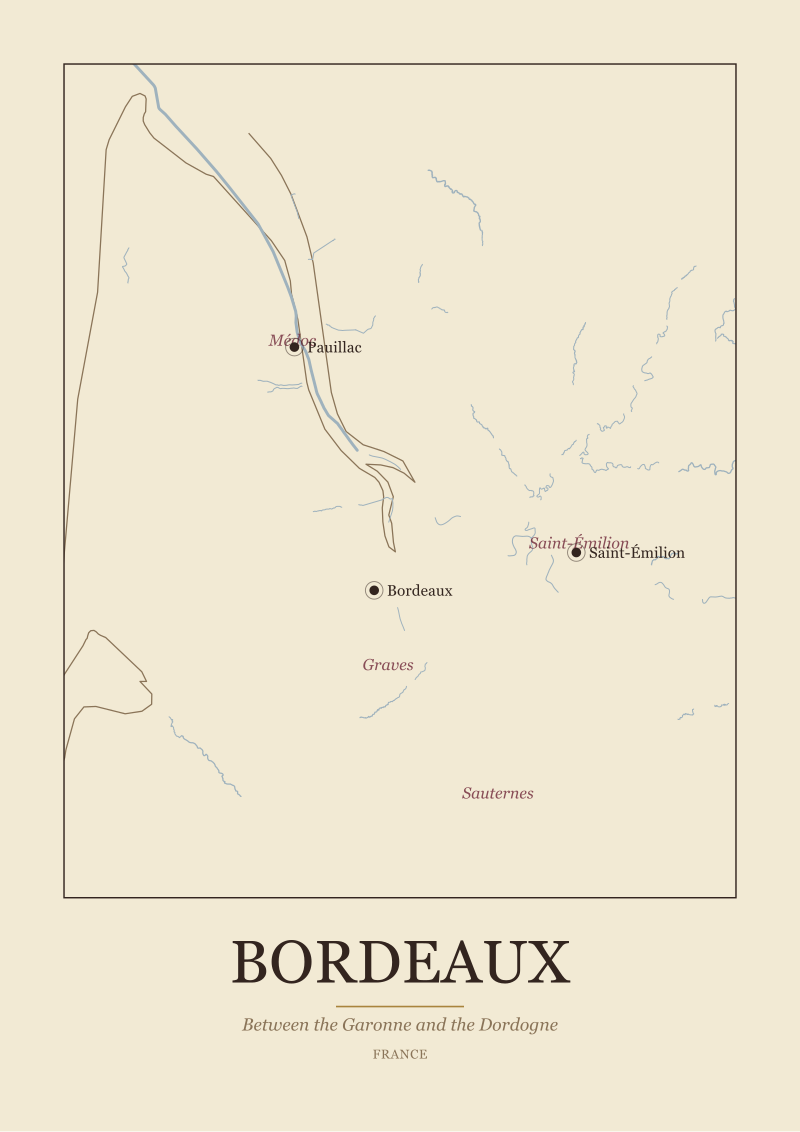 Bordeaux
The print from this article · from €29.95
View the print →
Terroir
Terroir, our desk's working definition: the sum of things you can point to on a map and the slower things you can only measure in the ground. Slope, aspect, altitude, bedrock, soil depth, drainage, mean temperature, prevailing wind, distance from the nearest river. In Bordeaux it is the Garonne's gravel beds; in Burgundy the limestone benches of the Côte de Nuits and Côte de Beaune; in Champagne the chalk under Reims and Épernay. Fire changes none of these overnight. What fire changes is the vegetation layer sitting on top of the terroir and, in extreme cases, the humic soil in the top centimetres of forest edge. The bedrock below Pauillac does not catch. The chalk under the Côte des Blancs does not catch. Terroir, in the geographic sense, outlives the fire season every time. That is why the panic about "losing terroir" to a wildfire is almost always a category error.
Slope Aspect
Aspect is the direction a slope faces. In Burgundy, the great wall of the Côte d'Or faces broadly east — morning sun, cool evenings, a long slow ripening window — which is why Dijon, Beaune, and Nuits-Saint-Georges sit where they do. South and south-west aspects are warmer and drier; north aspects stay cold. For fire behaviour, aspect is as decisive as any human choice. South-facing slopes in Mediterranean France dry out earlier in the season, hold less moisture in grass and shrubs, and carry fire uphill faster. The eastward aspect of Burgundy's premier slopes is one of several geographic reasons the Côte d'Or is not, historically, a wildfire landscape in the way the garrigue country further south is. Reading a fire map alongside an aspect map is one of the fastest ways to understand why some French wine regions appear in fire news almost every summer and others almost never.
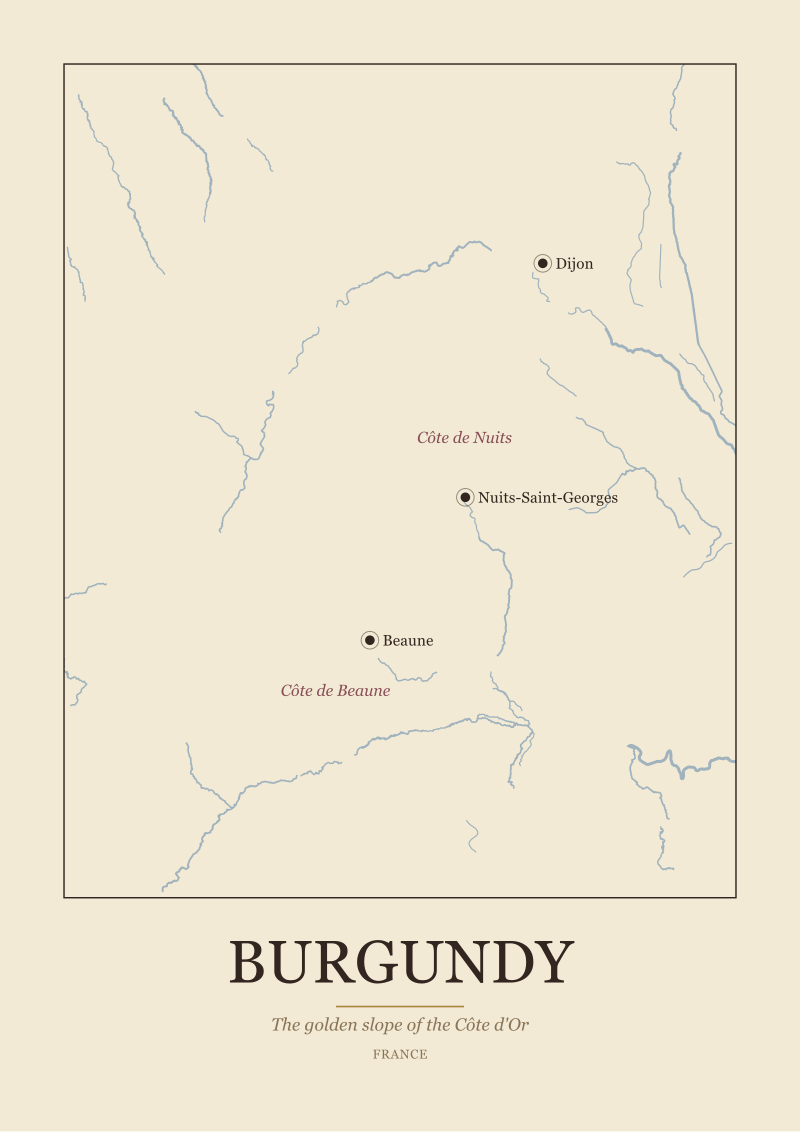 Burgundy
The print from this article · from €29.95
View the print →
River Corridor
A river corridor is a wine region's most reliable natural firebreak. The Garonne cutting through Bordeaux, the Saône running beside Burgundy, the Marne threading through Champagne — each is a wet seam in a dry country. Rivers slow fire by three mechanisms at once: the water itself, the elevated humidity of the valley floor, and the agricultural land that tends to crowd a river's banks, which replaces continuous forest with discontinuous fields. The Médoc north of Bordeaux sits between the Gironde estuary and the Atlantic; a fire approaching from the great Landes pine forest to the west has to cross farmland, roads, and the estuary wind before it reaches a classified-growth parcel. This is one reason classed-growth Bordeaux appears in fire headlines mostly when the Landes burns next door — the river corridor is doing geographic work most readers never see.
Garrigue
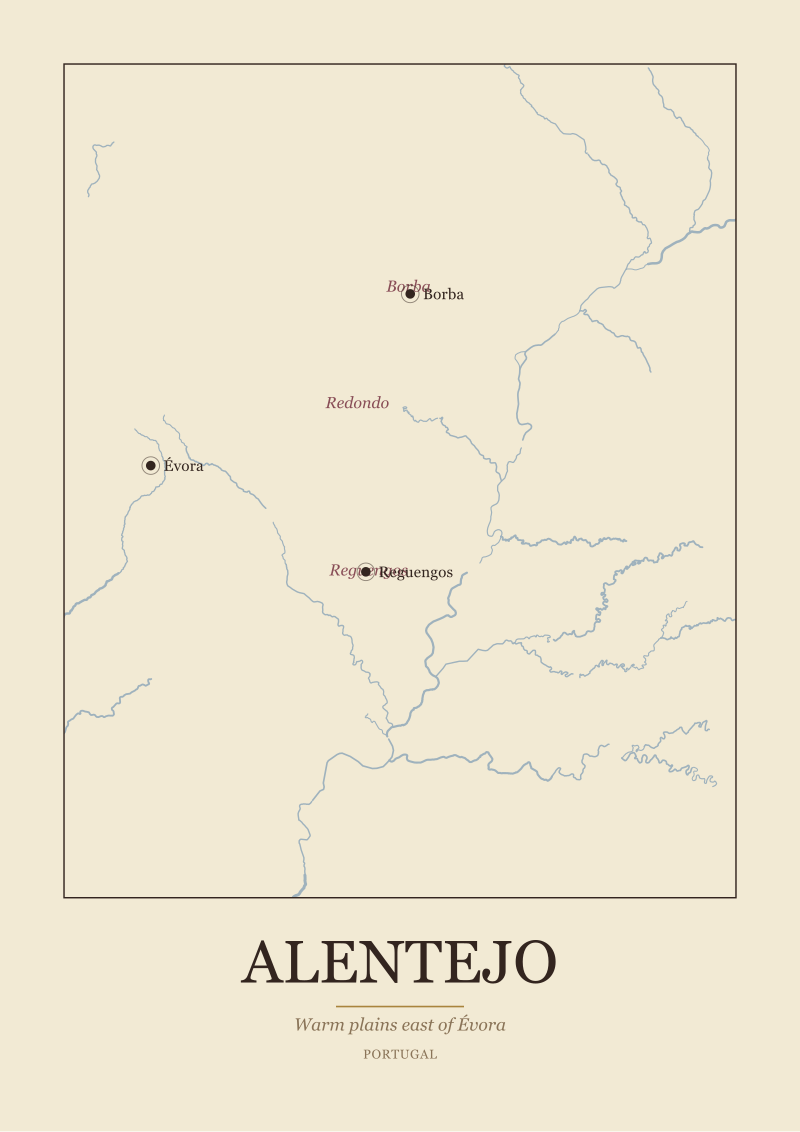
Garrigue is the low Mediterranean scrubland of thyme, rosemary, kermes oak, and dry grass that covers much of southern France outside the planted parcels. It is not a wine region, but it is the fuel bed that most French vineyard-fire stories are actually about. When flames arrive at a vineyard edge in Provence, the Languedoc, or the southern Rhône, they come across garrigue, not across the vines themselves. The garrigue is adapted to burn — many of its species regenerate from fire — but the vineyards embedded in it are not. Our four grounded regions, Bordeaux, Burgundy, Champagne, and (by extension of our Portuguese desk) Alentejo, do not sit in classic garrigue country. That geographic fact is why the four grand names of French wine are rarely the fire story, even when "vineyards in France are burning" is technically true somewhere further south.
Fire Break
A fire break is a strip of ground cleared or kept green to stop or slow a fire. In the Mediterranean south, formal fire breaks are bulldozed through forest; informal ones are provided, generously, by vineyards themselves. A dense planted vineyard, well irrigated or well tended, is a poor conductor of flame — the canopy is green, the inter-row is often ploughed, the trellis holds the fuel off the ground. Fire-fighting services in southern France have, for two decades, treated viticulture as part of the regional fire defence. This is why some French communes offer tax relief for maintaining vines on fire-prone slopes: a vineyard is cheaper than a bulldozed break and more productive than bare earth. The question "are vineyards burning in France" has an unintuitive counter-question beneath it: how much more of France would be burning if those vineyards were not there?
Vintage
A vintage is the wine of a single year, named for the harvest. In France, vintage is law — the year on the label must correspond to the fruit in the bottle. Fire enters a vintage in two ways: directly, when flame reaches planted ground, and indirectly, through smoke taint, when ambient smoke drifts across a ripening canopy and volatile compounds bind to the fruit. Direct loss is rare in the four grounded regions. Smoke taint is more generous with its geography — a fire several valleys away can mark a vintage without ever threatening the vines. A tainted Pauillac, a tainted Beaune, a tainted Épernay base wine: these would be the real vintage story of a serious French fire year, not photographs of flames beside trellises. The vintage carries the fire's memory even when the vineyard polygon never burned.
Phylloxera Memory
Phylloxera, the vine-root aphid that crossed from North America in the 1860s, destroyed most of France's vineyards within thirty years and reshaped the industry by force. Rootstocks changed. Grafting became universal. Ownership consolidated. Entire sub-regions never fully replanted. Phylloxera is not fire, but it is the memory French wine culture reaches for whenever a catastrophic shock is discussed. It is useful memory because it teaches a counter-intuitive lesson: the regions survived. The maps our desk draws today — Médoc, Côte de Nuits, Montagne de Reims — are post-phylloxera maps. The appellation boundaries themselves were in large part codified in the decades after that collapse. A region's response to large-scale damage is institutional before it is agricultural; the vines come back after the paperwork does. Any fire narrative that skips this precedent misreads how slowly, and how completely, French wine geography absorbs a shock.
Replant Right
A replant right, in French wine law, is the authorisation to replace a lost or grubbed-up vineyard with new vines, carrying the same appellation status, within a defined time window. It is the quiet legal instrument that decides what a region looks like after fire. Without a replant right, a parcel that burns reverts to generic agricultural land; with one, it goes back into Bordeaux, Burgundy, Champagne, or whichever appellation drew the border. In practice, these rights are tracked parcel by parcel, often by the growers' union of each appellation, and are among a vineyard's most valuable intangible assets. If you want to understand whether a fire has altered a French wine region permanently, the question is not how many hectares burned. The question is how many replant rights the appellation chooses to defend. Geography sets the stage; the replant right writes the next chapter.
FAQ
Are French vineyards actually on fire this year?
In most summers, the answer is: fires occur in southern France near planted vines — chiefly in Provence, the southern Rhône, and the Languedoc — but the four grand regions our desk tracks (Bordeaux, Burgundy, Champagne, and, by extension, Portugal's Alentejo) rarely see direct vineyard loss. Headlines that frame it as "French vineyards burning" collapse the distinction between a classified Bordeaux parcel and a garrigue-adjacent plot further south. Both are vines in France. Only one is usually threatened.
Can a vineyard itself actually burn?
Vines are poor fuel. A green, trained, well-pruned vineyard with a worked inter-row carries flame badly and often acts as a passive firebreak. What burns in "vineyard fire" footage is almost always the forest, scrub, or dry grass at the parcel edge, with vines losing leaves and shoots to radiant heat rather than full combustion. Trellis posts and irrigation infrastructure are more vulnerable than the vines themselves.
Does smoke taint damage wine without the vineyard burning?
Yes. Smoke taint is the main indirect fire risk to French wine. Volatile phenols released by burning vegetation can bind to grape skins during ripening, surviving fermentation and emerging as medicinal, ashy, or burnt-rubber notes in the finished wine. A fire several valleys away, under the wrong wind, can mark a vintage without a single vine losing a leaf. For Bordeaux, Burgundy, and Champagne, smoke taint from distant fires is a more realistic concern than direct burn.
Which French wine region is most exposed to wildfire?
Geographically, the Mediterranean fringe: Provence, the southern Rhône, the Languedoc, and parts of Corsica. These regions sit inside garrigue country, with south-facing aspects, low summer rainfall, pine, and oak forest at the parcel edge. Our four grounded regions sit elsewhere: Bordeaux between a river estuary and Atlantic weather, Burgundy on a limestone escarpment facing east, Champagne on chalk hills north of the Marne. Different climates, different fire exposures, same country.
Does a wildfire change a vineyard's terroir?
Not in the geographic sense our desk uses. Bedrock, slope, aspect, river proximity, and the deeper soil horizons are not altered by a surface fire. What a fire can change is the top few centimetres of humic soil at a forest edge, the shade canopy of adjacent woods, and the microclimate of a specific parcel for a season or two. The appellation map survives. The vintage memory does not.
What happens legally if a vineyard burns inside an appellation?
Each appellation handles loss parcel by parcel. The grower typically retains a replant right — the authorisation to put the parcel back under vine with full appellation status, inside a defined time window. Without that right, the parcel can slip to generic farmland. This is why the question "how much of Bordeaux burned" is less consequential than "how many Bordeaux replant rights were preserved" — the appellation defends itself through paperwork as much as through geography.
Is this fire season worse than historical precedent?
The honest answer our desk gives is a cautious one: dry summers and dry forests near planted land are the long-run pattern in southern France, and single-year comparisons rarely survive scrutiny. The useful historical anchor is not last year's fire count but phylloxera — a nineteenth-century catastrophe the regions absorbed through institutional change, not through heroic replanting alone. French wine geography has a long memory for shock.
Should I worry about my wine from a specific French region this year?
If the wine is from Bordeaux, Burgundy, or Champagne, direct fire loss is almost never the right thing to track; smoke taint from distant fires is the realistic variable, and it is detectable in the finished wine. If the wine is from a Mediterranean appellation, the question is more live. In both cases, the useful signal is not newspaper headlines about flames but the appellation body's own vintage report, which will state, in plain language, what the year actually did to the fruit.
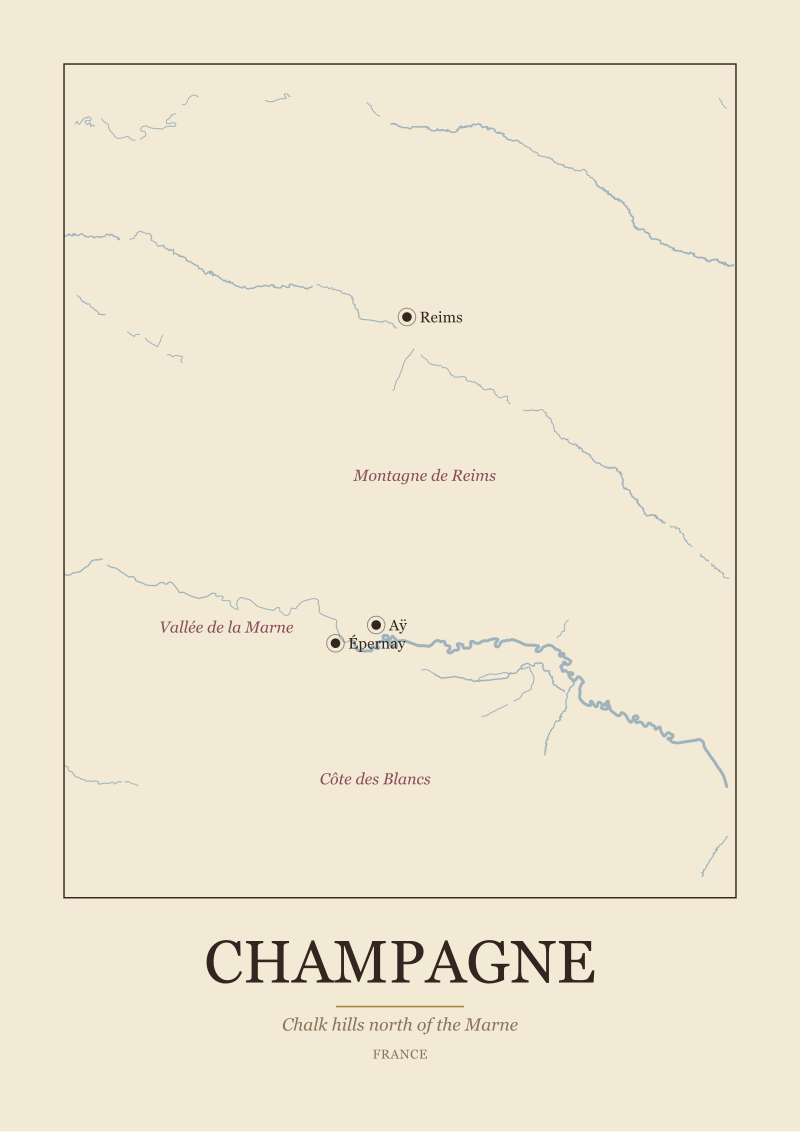
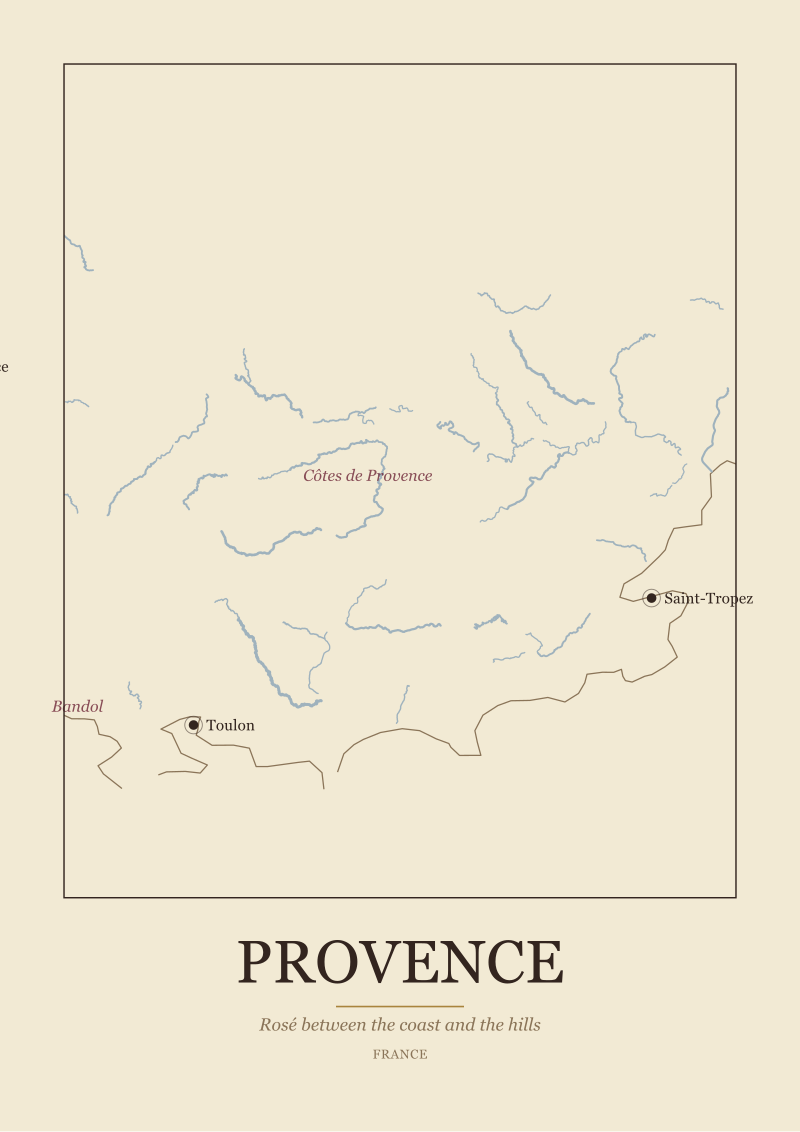
New regions and 10% off your first print.
One email now with your code. No noise after.