Most articles about wine appellations treat them as a naming system: a hierarchy of badges from generic to grand, ordered like tiers on a subscription plan. That is not what an appellation is. An appellation is a border drawn on the actual ground. Somebody walked the ridges, argued about parcels, and put a line where the land changed. Understanding the wine means understanding the line, not the badge. You do not need to be a sommelier to read one. You need nine terms, in the order they matter.
Appellation
An appellation is a legally protected place-name for wine. Nothing more, nothing less.
The confusion is that the phrase gets used as if it were a quality tier — as if "having an appellation" were the point. It isn't. What matters is that a specific piece of land, with a specific outline on a map, has been assigned a name that no wine made outside that outline may legally use. The name protects the geography, not the reputation attached to it.
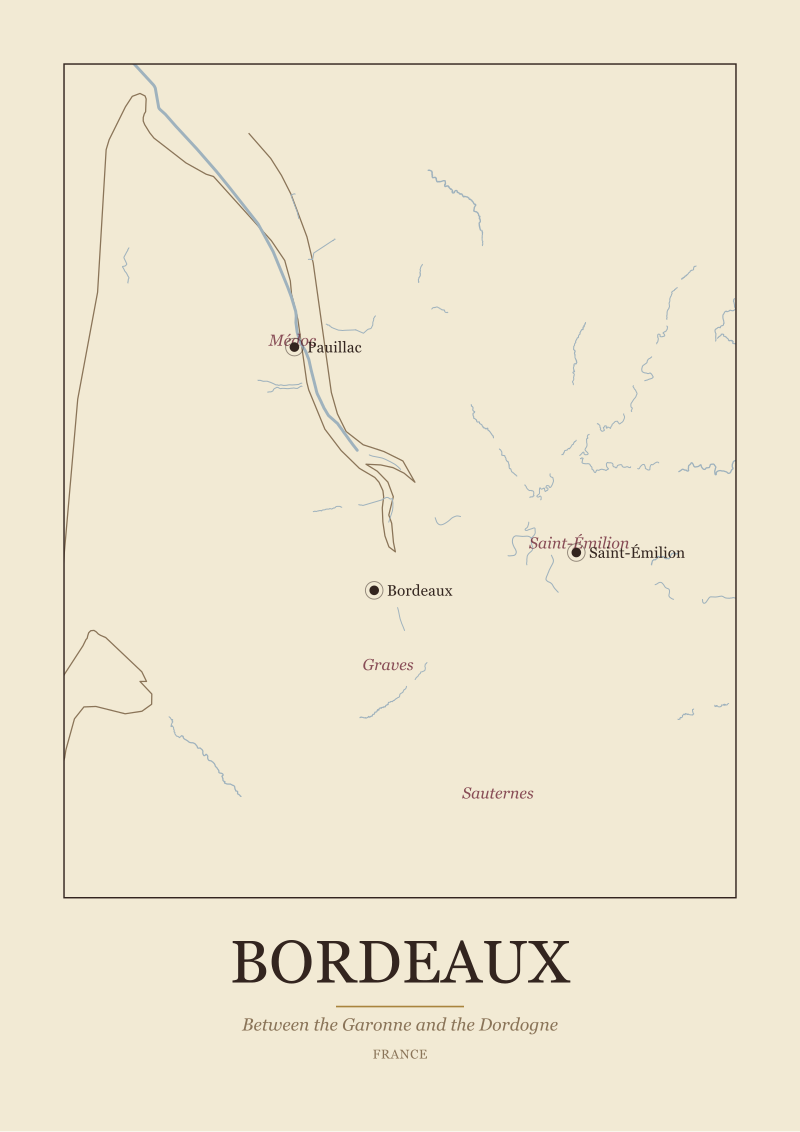
Bordeaux is an appellation covering vineyards around the city of Bordeaux, between the Garonne and the Dordogne. Sub-zones inside it — Médoc, Saint-Émilion, Graves, Sauternes — are also appellations, each with narrower outlines. A wine made in Provence, however excellent, cannot be sold as Bordeaux. Not because it is worse. Because it comes from somewhere else.
Delimitation
Delimitation is the historical act of drawing the border on the ground.
The word does most of the work of demystifying appellations. There was a moment — usually a commission of geographers, agronomists and ampelographers, sometimes bitterly argued — when a group of people walked the country and decided which slopes counted and which did not. They drew a line. That line is what the appellation is.
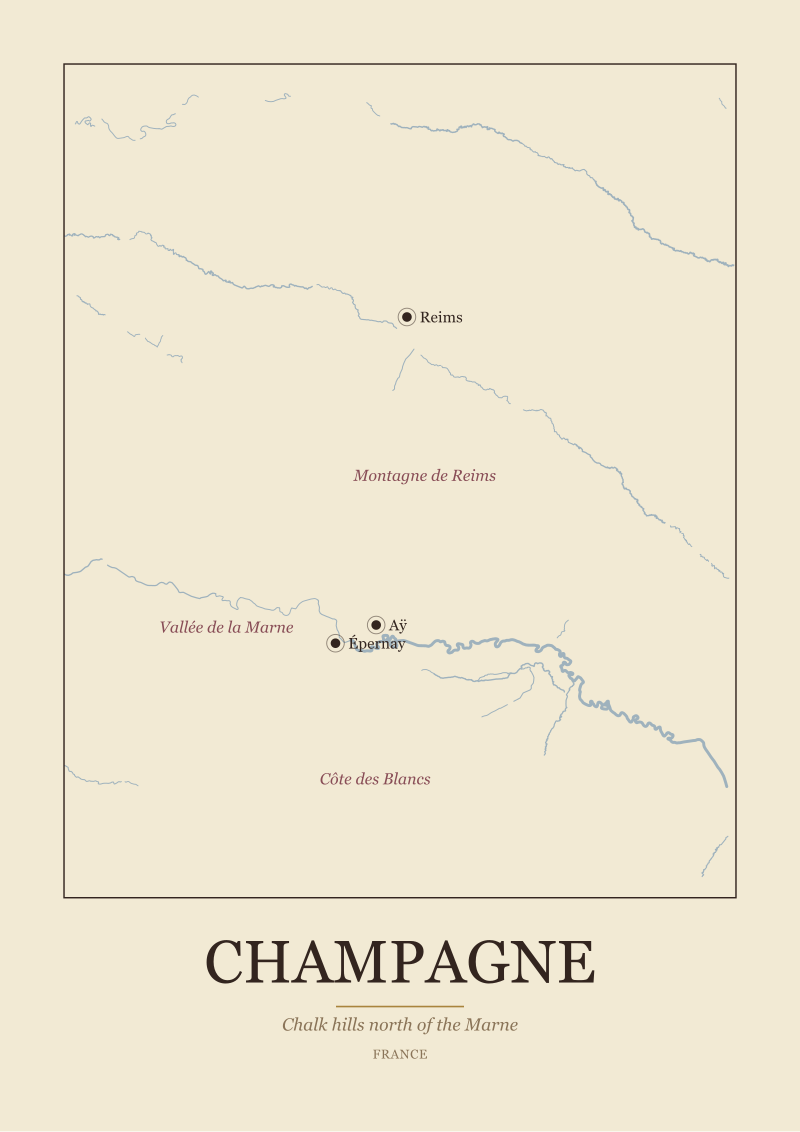
Champagne, for example, is delimited as the chalk hills north of the Marne, anchored on Reims, Épernay and Aÿ. Vineyards on the wrong side of that historic line grow the same grapes in similar soil and produce sparkling wine that cannot be called Champagne. When we draw these regions for the studio's shop, we start from the delimitation records — the border first, the label second. The line came before the fame.
 Bordeaux
The print from this article · from €29.95
View the print →
Bordeaux
The print from this article · from €29.95
View the print →
Terroir
Terroir is the geographic reasoning behind the line. It is not mysticism.
Terroir gets accused of being spiritual language, and honestly it deserves some of the accusation. But strip the incense off and the word is doing something concrete: it names the combination of soil, slope, aspect, altitude, river proximity and mesoclimate that made the delimiters put the border where they did. When a delimitation commission argues, it argues about terroir.
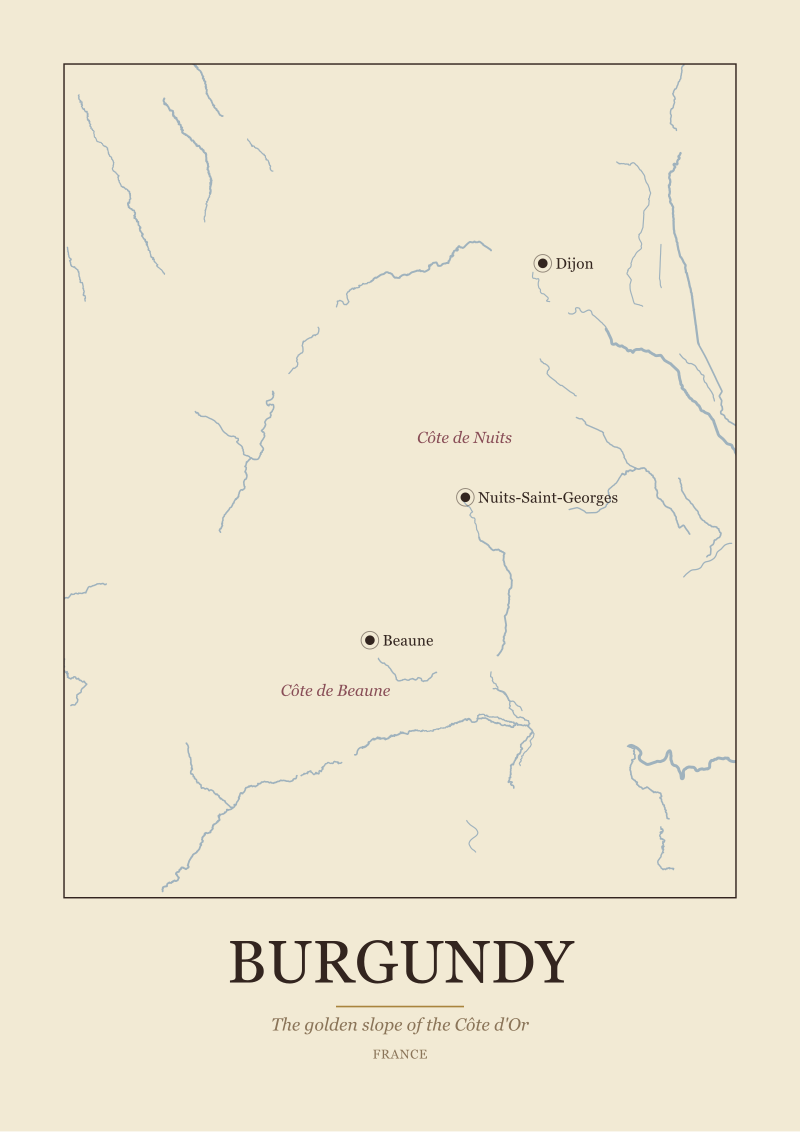
Burgundy's Côte d'Or is the clearest lesson. The appellation traces a slope — the golden slope — running from Dijon down through Beaune and Nuits-Saint-Georges. It faces east-southeast and drains toward the Saône. Above the slope, the woods start. Below, the plain gets flat and cold. The border of the appellation is essentially the border of the slope. The word terroir just names what that slope is doing.
Cadastre
The cadastre is the parcel-by-parcel land registry that the border actually runs through.
Appellation borders do not wander vaguely across the countryside. They cut through the cadastre — the official record of every plot of land, by number, in a national registry. Whether a specific row of vines is inside or outside the appellation is a matter of the cadastral parcel it sits on. Two rows of vines two metres apart can belong to different appellations because they belong to different parcels.
This is why the maps look strange. Bordeaux's Pauillac, a small strip on the Médoc peninsula, is delimited plot by plot. A vine on one side of a farm track may qualify; a vine on the other side may not. The line is not a metaphor. It is a set of parcel numbers in a Ministry of Agriculture file, updated by decree, checkable by anyone who asks.
 Champagne
The print from this article · from €29.95
View the print →
Champagne
The print from this article · from €29.95
View the print →
AOC, DOC, DO
AOC, DOC and DO are three national systems doing the same job in different languages.
France uses AOC — Appellation d'Origine Contrôlée. Italy uses DOC, with DOCG for a stricter tier. Spain uses DO, with DOCa for its stricter tier. Portugal uses DOC. The acronyms are administrative wallpaper; the substance is identical. Each system encodes a delimited geographic border, a set of production rules, and an inspection body that enforces them.
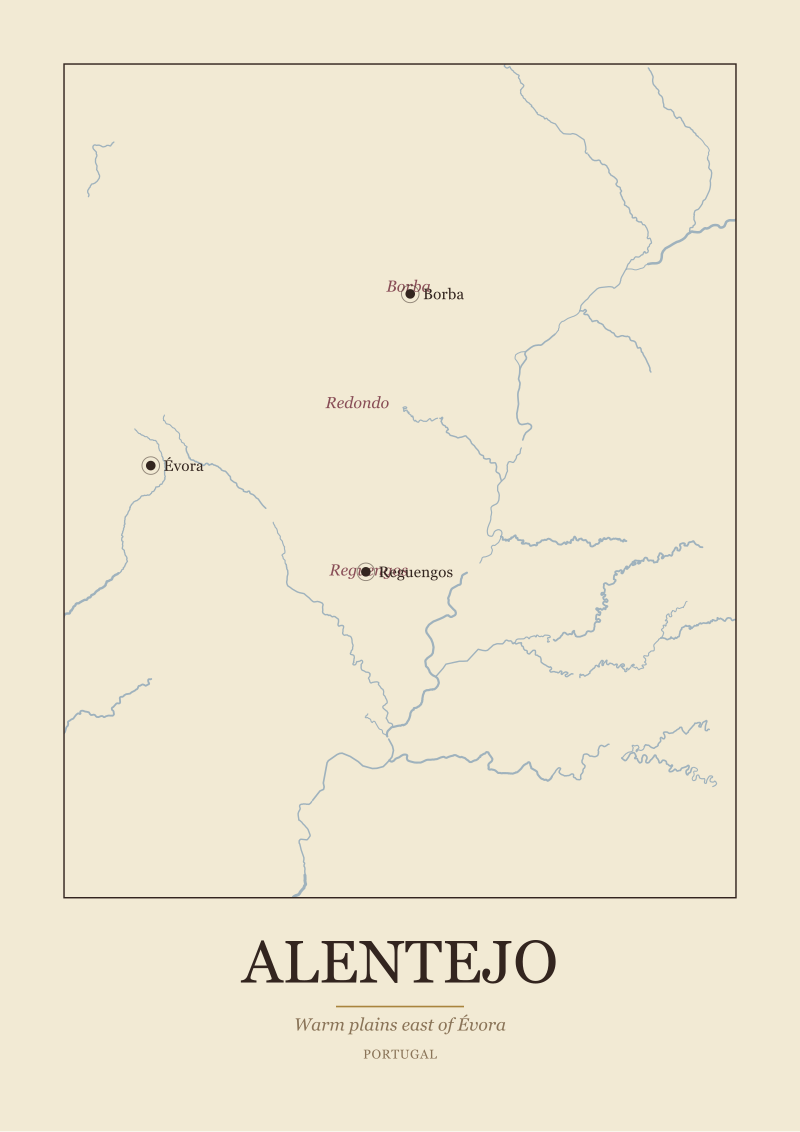
Alentejo, east of Évora in southern Portugal, is a DOC. The Guadiana river runs through the warm plains. The DOC delimits sub-zones — Borba, Redondo, Reguengos — and specifies for each one which grape varieties are permitted, what the maximum yield per hectare is, and what production methods a wine must follow to carry the appellation name. Different acronym, same anatomy: line on the ground, rules on the parcel.
PDO and PGI
PDO and PGI are the European umbrella terms that group every national wine appellation under two labels.
Since 2009, the EU has classified all wine geographic indications as either PDO (Protected Designation of Origin) or PGI (Protected Geographical Indication). PDO is the stricter tier: place-defined, tightly controlled, most of the famous appellations. PGI is the looser regional tier. Every French AOC, every Italian DOC, every Spanish DO, every Portuguese DOC is a PDO at the European level.
On a bottle of Bordeaux, "AOC" is the French vocabulary; "PDO" is the same object translated into Brussels vocabulary. It matters because it means the border is protected across the entire single market — a producer in Slovenia cannot label a red as Bordeaux any more than a producer in Provence can. The line is European law, not just French domestic decree.
Sub-appellation
A sub-appellation is a stricter border drawn inside a bigger one.
Appellations nest. Inside a large regional appellation, delimiters have often drawn tighter borders around smaller, more geographically specific parcels — usually the ones judged historically to produce more distinctive wine. The nested border is itself a full appellation, with its own rules that are typically tighter than the parent's.
Burgundy is the reference. The regional appellation is Bourgogne. Inside it lies the Côte de Nuits and the Côte de Beaune. Inside the Côte de Nuits lies the village appellation of Nuits-Saint-Georges. Inside Nuits-Saint-Georges lie individual named vineyard climats. Bordeaux does the same thing: Bordeaux the region contains the Médoc, and the Médoc contains Pauillac. Each nested line is a stricter delimitation of a smaller piece of ground, argued over separately, drawn separately.
Cépage Rules
Cépage rules are the grape-variety list tied to each appellation.
An appellation border isn't only about where; it's also about what. Each appellation specifies which grape varieties are legal for wines carrying its name. Plant a variety that isn't on the list — even inside the border, on a perfect slope — and the wine can still be made, but it cannot use the appellation. It has to be sold as a lower-tier regional wine or a simple varietal.
Champagne's principal permitted grapes are, historically and legally, Chardonnay, Pinot Noir and Pinot Meunier. Plant Merlot on the Côte des Blancs and it will grow; the resulting sparkling wine simply cannot be called Champagne. Alentejo's DOC does the same thing with a longer list of Portuguese varieties. The list is part of the border — a border made of soil and grape catalogue at once.
Yield Cap
The yield cap is the production ceiling tied to the border.
Every appellation caps how much wine may be produced per hectare and still qualify for the name. The number is set in the appellation decree and audited at harvest. Above the cap, the excess must be either declassified — sold as lower-tier wine without the appellation — or in some cases the whole harvest loses the right to the name. The rule exists because the delimiters believed that a slope worked too hard produces thinner wine, and they wrote that belief into law.
Burgundy's village and Grand Cru appellations sit under some of the strictest yield caps in France, considerably tighter than the regional Bourgogne appellation above them. That, too, is what the nested border is doing: it is encoding place, permitted grape, and how hard the land is allowed to be worked, all at once. The line on the map is the shortest way to say all three.
FAQ
Are appellation borders the same everywhere in Europe?
No. Every country runs its own national system — AOC in France, DOC/DOCG in Italy, DO/DOCa in Spain, DOC in Portugal — with its own delimitation history and enforcement body. What is uniform is the European umbrella: since 2009, all of them sit under PDO or PGI. The vocabulary changes; the underlying object — a geographic border with production rules — is the same.
Does an appellation guarantee that a wine is good?
No, and this is where the badge reading of the word fails hardest. An appellation guarantees origin: the wine came from inside a specific delimited area, was made under specific rules, and passed inspection. Quality inside the border still ranges enormously. A poorly farmed parcel in a great appellation can produce a duller wine than a well-farmed parcel just outside it. The border protects the place, not every bottle.
Can appellation borders be changed?
Yes. Delimitations are legal acts and can be amended by decree. Champagne's border was significantly redrawn in the early twentieth century after violent protest. Bordeaux sub-appellations have been adjusted. Changes are slow, contested and usually driven by decades of political and technical argument — but the borders are living administrative objects, not fixed inheritances.
Why do appellation borders look so odd on a map?
Because they follow soil, slope and cadastre, not administrative geography. A border that traces the top of a limestone ridge or the edge of a gravel bank will zigzag in ways a political border never would. When a border seems to jump around, it is usually tracing an underlying geological feature — the line looks strange because the geography is.
What is the difference between an appellation and a brand?
An appellation is a delimited piece of land with legal rules attached. A brand is a name a producer chooses for a specific wine they make. Many bottles carry both: the appellation names where the wine is from, the brand names who made it. The appellation cannot be owned by a single producer. The brand cannot be worn by wines from elsewhere.
Can two countries share an appellation?
No. Each appellation is a national legal act with a specific national geographic outline. There are cross-border regions where wine culture is continuous — the Rhine, for instance — but each side of the border has its own separate appellation system. What crosses the border is European recognition: a PDO in one country is recognised by every other EU member state.
Is terroir a legal term or a poetic one?
Both, and refusing to notice one of the two roles is how the word gets misread. In the everyday conversation about wine, terroir is used lyrically, sometimes indulgently. In appellation law, it names the specific combination of geographic factors the delimiters used to argue for the border. Legal texts around AOCs and DOCs use the word in an unromantic, technical sense. The poetry came later.
If a vineyard sits just outside the border, is its wine automatically worse?
Not necessarily. The line reflects a historical judgment, not a physical fault line under the vines. A vineyard just outside a famous appellation can produce wine indistinguishable from one just inside — the geography is often continuous. What it cannot do is use the appellation name. The wine may be equal in glass, but it will be labelled and sold under a broader regional name, at a different price and with a different story attached.
New regions and 10% off your first print.
One email now with your code. No noise after.